The Reliable Economy: A Vision for Socially Beneficial AI, Economics and Governance | Edward Jung
Title history
- The Reliable Economy: A Vision for Socially Beneficial AI, Economics and Governance | Edward Jung — observed on 20261105-1151 UTC (YouTube)
Keywords
Summary
171 words
Critical Evaluation
Value of the Information & Strength of the Argument
The talk offers substantial value by reframing AI’s societal impact around incentive structures, a perspective often overlooked in technical discussions. The argument is built historically, linking dopamine responses, economic evolution, and modern attention economies to explain systemic misalignment. The proposal for a financial instrument to reward reliable outcomes is innovative, though outlined at a high level. The argument is cohesive and persuasively delivered, but relies heavily on conceptual analogies and personal observations rather than empirical evidence. The speaker’s credibility and concrete examples from his work with CERN and distributed networks strengthen the argument, but the lack of detailed implementations or metrics limits its immediate applicability.
Scientific Rigor, Source Quality, Title Accuracy
The talk does not cite specific academic papers or external sources; it draws on the speaker’s extensive professional experience and a few historical references. The single link in the description points to the symposium page, which provides context but no supporting data. The lack of verifiable citations reduces the scientific rigor. The title is well-aligned with the content, accurately reflecting the core thesis on a reliable economy driven by AI and governance. No comments are provided for analysis, so no public trends can be assessed.
205 words
Title / Content Match
The title accurately captures the essence of the talk, which proposes a new economic framework integrating AI, incentives, and governance for social benefit.
Quality & Reliability
7/10
The speaker is a highly experienced technologist and inventor with a credible background, but the talk is largely conceptual and relies on anecdotal evidence and broad historical claims rather than detailed data or citations.
Key Moments
Markers derived by PSI from the transcript: the creator did not define chapters.
- Introduction of the speaker and the theme of AI and societal incentives.
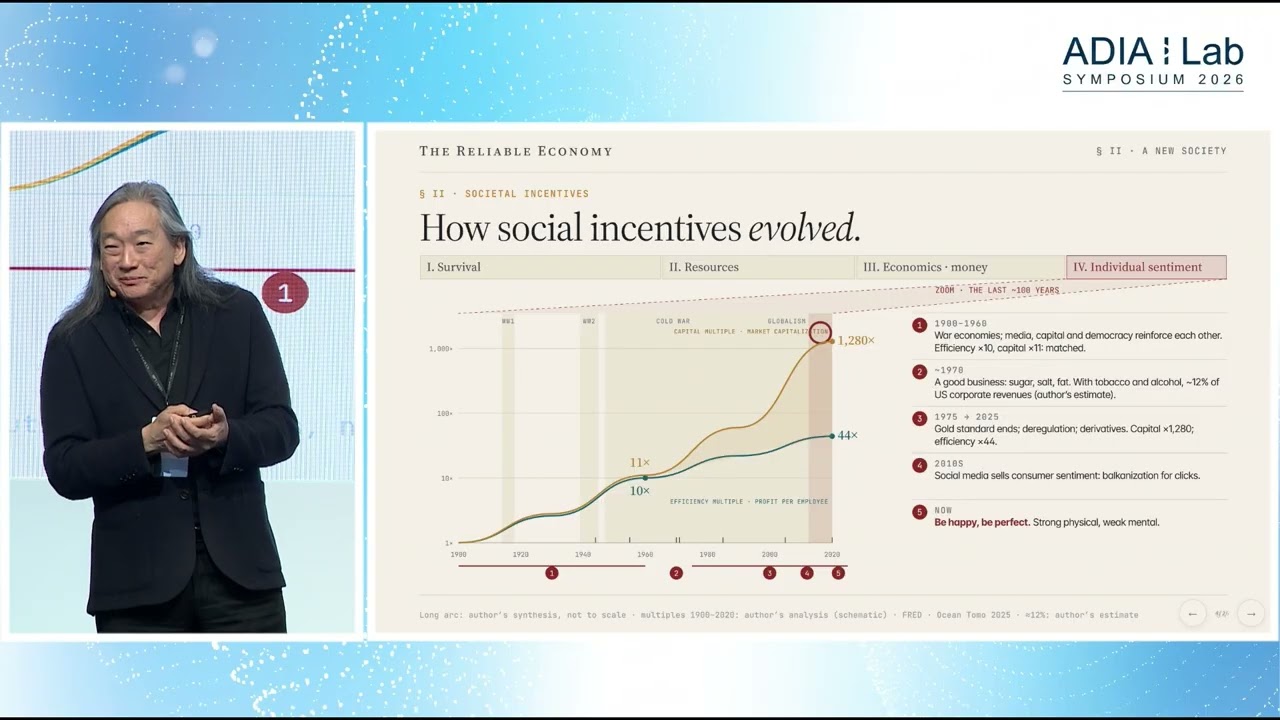
- Discussion of the evolution of social incentives from survival to dopamine-driven consumption.
- On the gap between claims and outcomes, and the rise of the narrative economy.
- Proposal for a financial instrument to create a reliable economy based on real assets.
- Emphasis on resilience, trusted relationships, and adaptability as key values, plus examples from CERN and global innovation networks.
Cited Sources
- ADIA Lab Symposium 2026 — Official event page where the talk was presented as part of the symposium.
Contribution & Novelties
The talk introduces a novel framework for aligning AI development with social well-being by focusing on incentive design and a ‘reliable economy’. It creatively combines neuroscience, economics, and AI governance to propose a financial instrument aimed at rewarding outcomes over claims. The perspective is original, especially in advocating for real assets and trusted relationships as counterweights to the intangible, narrative-driven economy.
Pour aller plus loin :
- Incentive — Provides a foundational overview of how incentives shape behavior in economics and society.
- AI governance — Note: This URL is not certain; I’ll use a more reliable one: [AI governance] (https://en.wikipedia.org/wiki/Regulation_of_artificial_intelligence ) — Discusses regulatory frameworks for AI, relevant to the talk’s governance proposals.
- Real assets — Explains the concept of real assets and their role in the economy, directly related to the talk’s emphasis on real-value backing.
- Dopamine and attention economy — Explores the relationship between dopamine-triggering content and economic incentives in the digital age.
154 words
Radar Profile
The scores indicate a talk that is rich in qualitative information and reliable in its overall message, but relatively low on technical depth and with moderate information quantity. This profile suits a visionary, interdisciplinary expert opinion rather than a data-dense technical presentation.