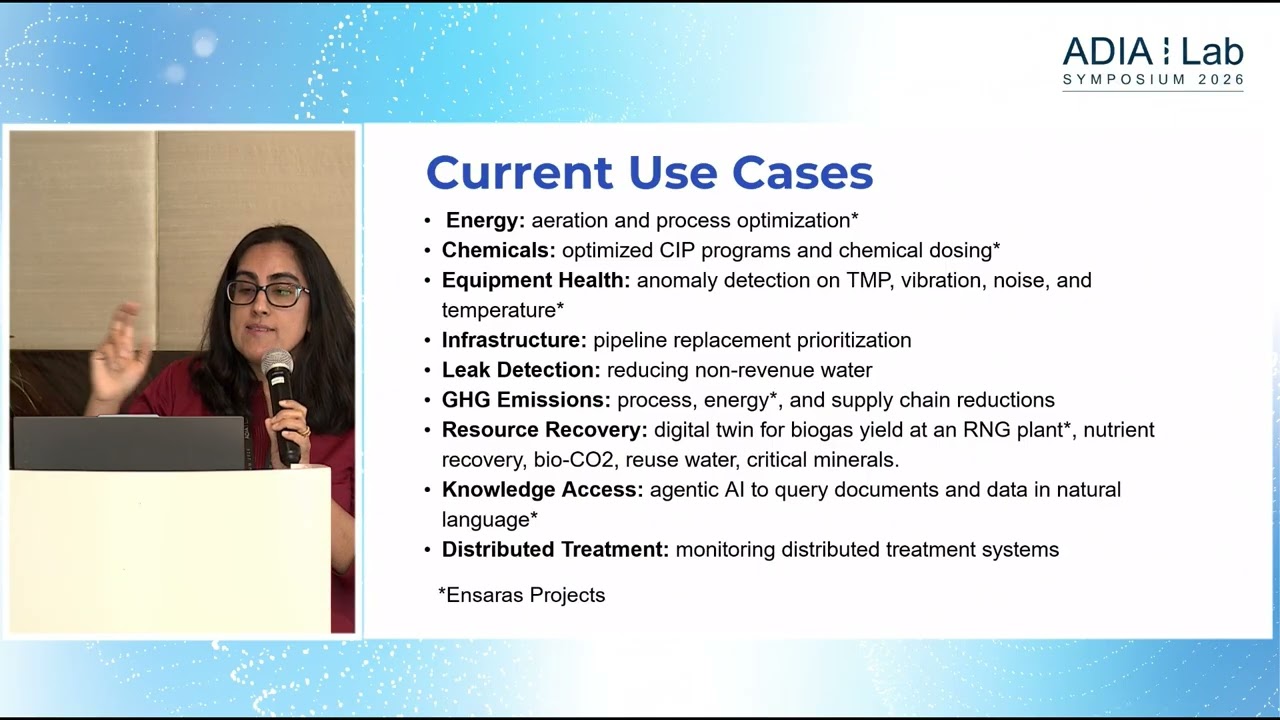
Beyond the Model: Scaling Applied AI for Water and Resource Recovery | Nina Kshetry | ADIA Lab 2026
Title history
- Beyond the Model: Scaling Applied AI for Water and Resource Recovery | Nina Kshetry | ADIA Lab 2026 — observed on 20261105-1151 UTC (YouTube)
Keywords
Summary
211 words
Critical Evaluation
Value of the Information & Strength of the Argument
The talk provides valuable insights from real-world deployments, offering concrete examples of successful AI implementations in water treatment. The argumentation is compelling, built on a clear narrative that moves from generic challenges to specific solutions, using case studies to illustrate key points. The speaker’s emphasis on data quality, contextualization, and safety mechanisms (like the one-class classifier) is well-argued and practically grounded. However, the presentation would benefit from more quantitative evidence, such as specific performance metrics or comparative baseline data, to strengthen its persuasive power.
Scientific Rigor, Source Quality, Title Accuracy
The scientific rigor is moderate; while the speaker references reputable sources like the World Resources Institute and UN Sustainable Development Goals, she does not cite specific peer-reviewed studies or provide external validation for her claims. The title accurately reflects the content, and the structure of the talk is coherent, but the lack of formal citations reduces its academic robustness. The talk is more of an experience-based expert report than a systematic review or original study.
174 words
Title / Content Match
The title accurately reflects the content, emphasizing the transition from building models to scaling applied AI in water infrastructure, with a focus on implementation challenges.
Quality & Reliability
7/10
Though based on extensive practical experience, the talk lacks explicit citations to peer-reviewed research or independent validation. The speaker's credibility is strong, but the evidence is anecdotal, limiting the reliability score.
Key Moments
Markers derived by PSI from the transcript: the creator did not define chapters.
- Introduction and overview of wastewater treatment industry scale in the US and globally.
- Discussion of water stress and key drivers for AI adoption in water facilities.
- Explanation of data sources in water facilities: smart meters, sensors, digital twins, and operator logs.
- Current state of digitization and AI adoption; most facilities still at dashboard and BI level.
- Case study in Oman: digitizing data via mobile web forms without SCADA, enabling benchmarking and KPI tracking.
- Case study in Chicago: predicting odor events with machine learning to guide mitigation.
- Case study for US Army: classifying wastewater safe to reuse using one-class classifier and safety bias.
- Real-time implementation in Pune, India: MBR health monitoring, anomaly detection, and 30% energy reduction.
- Renewable natural gas project with digital twin for process optimization and expansion planning.
- Conclusion: importance of data ontology, user trust, and AI for operator training.
Cited Sources
- ADIA Lab Symposium 2026 — Official symposium page providing context for the event and speaker.
- World Resources Institute - Water Stress Map — Mentioned as the source for water stress data used to illustrate global water scarcity.
- UN Sustainable Development Goals — Referenced in relation to sanitation and water access goals affecting infrastructure needs.
Concurring Sources
- World Resources Institute — Corroborates the global water stress context presented in the talk.
- UN Sustainable Development Goals — Supports the framing of water infrastructure challenges in alignment with global development targets.
Contribution & Novelties
The talk contributes practical knowledge on scaling AI in water infrastructure, emphasizing that successful deployment depends more on data infrastructure, user trust, and safety than on model sophistication. It offers specific examples of handling data scarcity, such as digitizing manual logs via mobile forms, and demonstrates the value of hybrid models combining AI with physics-based rules. The safety mechanism of a one-class classifier to prevent unsafe predictions is a distinctive contribution, relevant beyond water to critical infrastructure. The talk also highlights the role of AI in bridging the operator expertise gap.
Pour aller plus loin :
- Digital twin — Relevant to the digital twin applications in water and resource recovery described in the talk.
- One-class classification — Directly linked to the safety switch mechanism used in the US Army project.
- Smart water — Pertains to the digitization trends and AI integration discussed for water management.
145 words
Radar Profile
The radar profile shows strong scores in information quantity and quality, reflecting the talk's practical case studies and clear structure. The technical level is moderate, appropriate for a general conference audience. Reliability is slightly lower due to the lack of formal citations, making the overall profile balanced but indicating potential for more rigorous evidence.