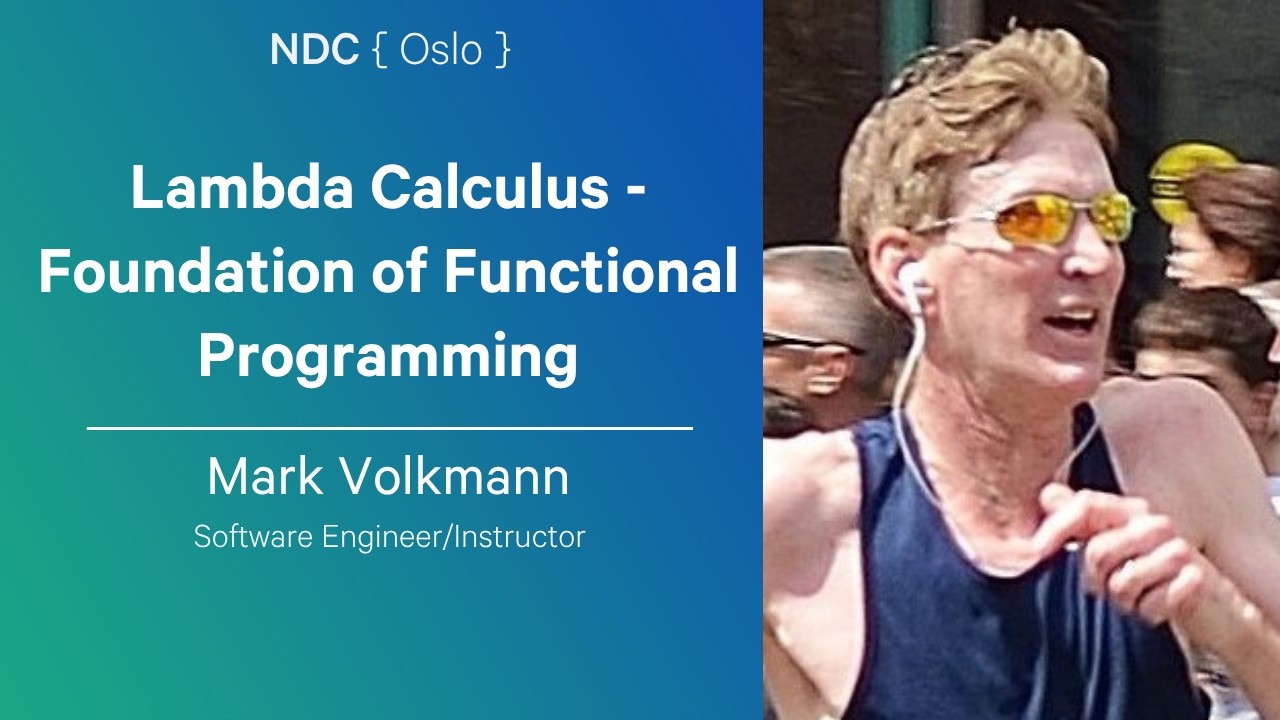
Lambda Calculus - Foundation of Functional Programming - Mark Volkmann - NDC Oslo 2026
Title history
- Lambda Calculus - Foundation of Functional Programming - Mark Volkmann - NDC Oslo 2026 — observed on 20261025-1532 UTC (YouTube)
Keywords
Summary
215 words
Critical Evaluation
Value of the Information & Strength of the Argument
VALUE: The talk offers a clear and practical introduction to a fundamental topic that many programmers encounter only as a vague concept. By providing JavaScript equivalents for each lambda calculus expression, Volkmann bridges the gap between abstract theory and concrete coding, making the material accessible and actionable. The progression from booleans to numbers and arithmetic demonstrates how complex operations can emerge from simple function applications, which is intellectually valuable and helps deepen understanding of functional programming paradigms.
ARGUMENTATION: The reasoning is solid and logically sequenced. Each step builds on the previous one, and the speaker anticipates potential confusion by explicitly explaining why certain function choices are made (e.g., representing true as the first-argument selector). The worked examples for beta reduction and for the predecessor algorithm illustrate the correctness of the definitions. The argumentation is convincing because it not only states the rules but also shows how they are applied in concrete computations.
Scientific Rigor, Source Quality, Title Accuracy
RIGUEUR: The scientific rigor is high. The content is based on well-established concepts in lambda calculus, and the speaker accurately names historical figures (Alonzo Church, Stephen Kleene) and relates the topic to Peano numbers. The formal rules (alpha, beta, delta, eta) are correctly explained, and the JavaScript implementations are faithful to the lambda calculus semantics. No references are cited within the talk itself, but the field is classical and the explanations are consistent with standard literature.
SOURCES: The only external sources are the conference website links in the description (ndcconferences.com, ndcoslo.com), which are not content-specific. The talk does not provide a bibliography, but the audience is expected to know that this topic is widely documented. The absence of explicit citations does not undermine the correctness, given the canonical nature of the material.
TITRE: The title is accurate and descriptive. It clearly states the subject (lambda calculus) and its relevance to functional programming, along with the speaker and event. It sets proper expectations for the content.
332 words
Title / Content Match
The title precisely matches the content: it is entirely about lambda calculus and how it underpins functional programming concepts.
Quality & Reliability
8/10
The talk is presented by an experienced software engineer and covers established theoretical concepts accurately. The explanations are clear and logically structured, though no external citations are given directly.
Key Moments
Markers derived by PSI from the transcript: the creator did not define chapters.
- Introduction and personal anecdote about the band Conradson
- Definition of lambda calculus and its core principles (pure functions, anonymous functions, etc.)
- Historical context: Alonzo Church, Stephen Kleene, and relation to Turing
- JavaScript syntax for functions and currying, preparing for lambda calculus implementation
- Formal evaluation rules: alpha conversion, beta reduction, delta rules, eta conversion
- Implementing booleans (true/false) as functions and logical operations NOT, AND, OR
- Church numerals: representing numbers as functions that apply a function n times
- Successor function and addition using iterated successors
- Predecessor function and Kleene's pair-based solution
Cited Sources
- NDC Conferences — Conference organizer website providing information about NDC events.
- NDC Oslo — Specific conference page for NDC Oslo where this talk was recorded.
Concurring Sources
- Lambda calculus - Wikipedia — Standard reference confirming the definitions and rules described in the talk.
- Church encoding - Wikipedia — Explains the representation of numbers and booleans as functions, consistent with the talk.
External References
Contribution & Novelties
The talk does not present new research but provides a didactic explanation of lambda calculus with immediate JavaScript examples. Its contribution lies in making an abstract theory accessible to practitioners, effectively bridging high-level concepts and code. The clear step-by-step demonstrations and the use of modern JavaScript syntax help demystify a topic often considered too theoretical. The talk also highlights the historical significance and the elegant simplicity of a system built solely on functions.
Pour aller plus loin :
- Lambda calculus - Wikipedia — Comprehensive reference covering syntax, reduction rules, and applications.
- Church encoding (Church numerals) - Wikipedia — Details on representing numbers and booleans in lambda calculus.
- Combinatory logic - Wikipedia — Related foundational system, relevant for understanding function composition and combinators.
122 words
Radar Profile
The radar profile shows high scores across all dimensions, with particularly strong marks for quantity of information and technical depth. The talk packs a lot of ground into 47 minutes, offering a deep dive into fundamental concepts. The reliability is slightly lower but still solid, reflecting the absence of explicit citations, though the content is standard and well-established.