L18 Grover's Algorithm II
Keywords
Summary
195 words
Critical Evaluation
Value of the Information & Strength of the Argument
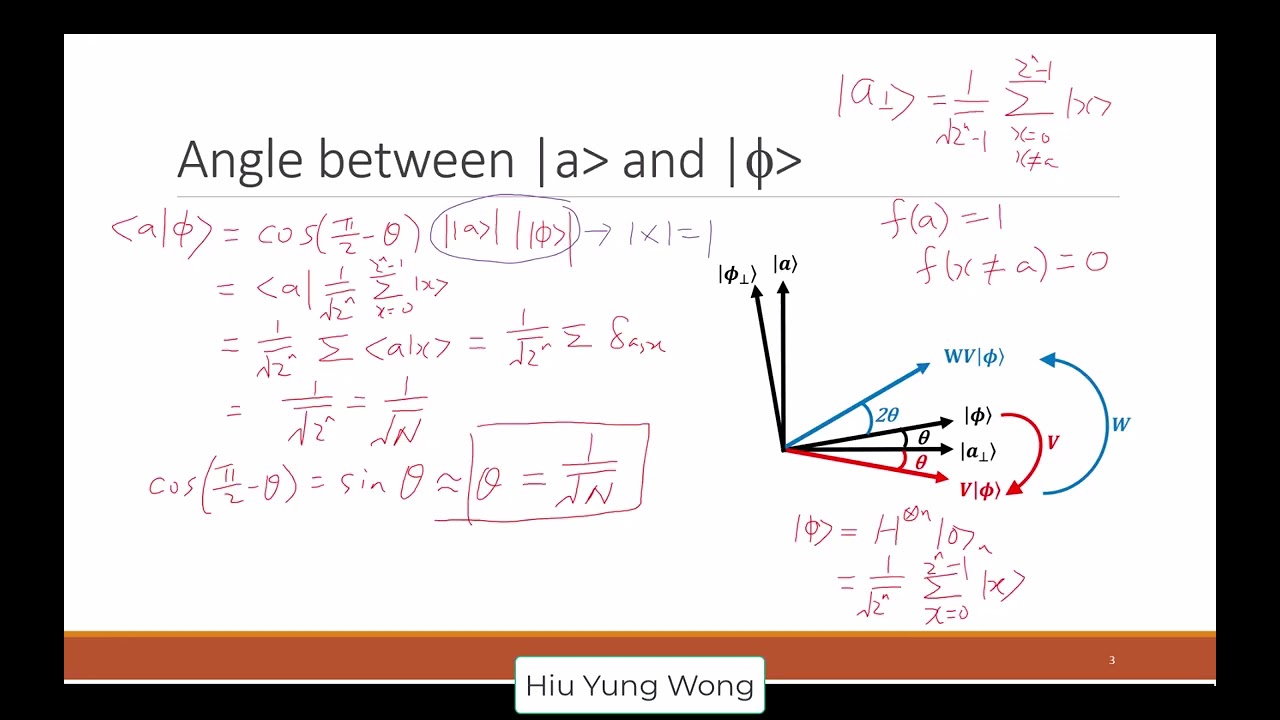
The video provides deep insight into the geometric interpretation of Grover’s algorithm, showing how the oracle and diffusion operator jointly rotate the state vector to amplify the target amplitude. The argumentation is logical and step-by-step, with the instructor responding to student questions to clarify potential misunderstandings. The value lies in making the algorithm’s quadratic speedup intuitive through the derivation of the rotation angle and the counting of iterations. The connection to realistic constraints like gate time and decoherence adds practical context.
Scientific Rigor, Source Quality, Title Accuracy
The presentation is mathematically rigorous, building on quantum mechanics principles and linear algebra. However, no external sources are cited beyond the course playlist link; the content relies on established textbook knowledge. The title is accurate, as it directly reflects the lecture’s focus on the second part of Grover’s algorithm. The lack of citations does not diminish the correctness of the mathematical content, but limits independent verification of the specific formulations used.
167 words
Title / Content Match
The title accurately reflects the content: it is the 18th lecture in a series, focusing on Grover's algorithm (part II).
Quality & Reliability
8/10
The video provides a clear, mathematically rigorous exposition of Grover's algorithm, building on prior lectures. The instructor derives key relationships (e.g., inner product, rotation angles) from first principles and ties them to computational complexity. The material is accurate and well-structured, though it lacks external source citations and is based entirely on the instructor's presentation.
Key Moments
Markers derived by PSI from the transcript: the creator did not define chapters.
- Introduction and recap of the search problem and basis encoding
- Derivation of the inner product between |ψ⟩ and |a⟩, showing it equals 1/√N
- Geometric meaning of the oracle V as reflection about |a⊥⟩
- Geometric meaning of the diffusion operator W as reflection about |ψ⟩
- Derivation of the number of iterations π/4√N needed to rotate |ψ⟩ to |a⟩
- Discussion of practical implementation: circuit diagram, gate times, and error correction considerations
Cited Sources
- Quantum Computing, TCAD, Semicond (Lecture Playlist) — Source of the entire lecture series, from which this video is part 18.
Concurring Sources
- Quantum Computing, TCAD, Semicond (Lecture Playlist) — The lecture series provides a structured progression, and this video builds on the earlier content from previous lectures.
Contribution & Novelties
The lecture offers a pedagogical insight into Grover’s algorithm by emphasizing the geometric interpretation and deriving the number of iterations in a very intuitive way. It also bridges the mathematical abstraction to practical hardware considerations (gate time, decoherence, error correction), which is often omitted in typical tutorials.
Pour aller plus loin :
- Grover’s algorithm - Wikipedia — A comprehensive overview of the algorithm, its history, and applications.
- Quantum oracle - Wikipedia — Explanation of the oracle concept used in quantum algorithms.
- Amplitude amplification - Wikipedia — The general framework that Grover’s algorithm is a special case of.
97 words
Radar Profile
The radar profile shows high scores in technical level and quantity of information, with moderate scores in quality and reliability due to lack of external references. The emphasis is on depth of explanation rather than breadth of cited sources, typical for a lecture format.