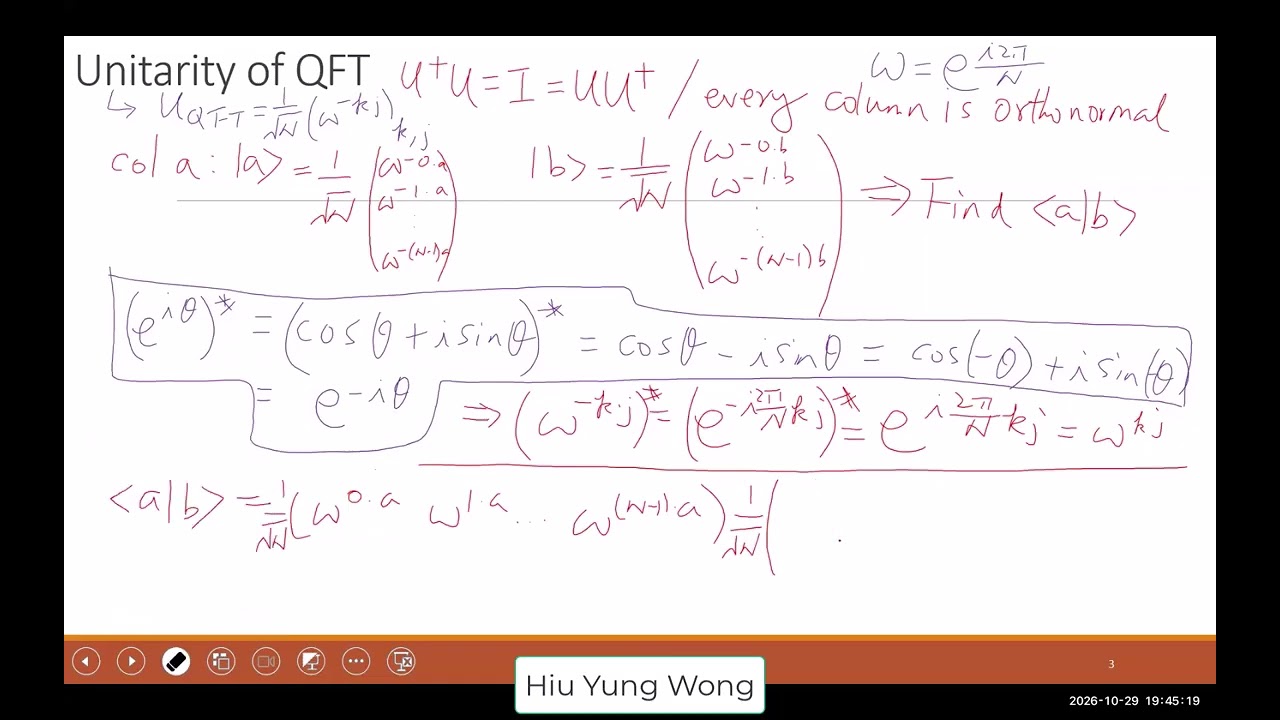
L20 Quantum Fourier Transform II
Title history
- L20 Quantum Fourier Transform II — observed on 20261030-0852 UTC (YouTube)
Keywords
Summary
180 words
Critical Evaluation
Value of the Information & Strength of the Argument
The value of the information lies in its thorough, step-by-step derivation of the QFT’s mathematical properties and its translation into quantum circuits. The argumentation is rigorous: the proof of unitarity is built on the orthonormality of roots of unity, and the inverse QFT is correctly derived from the adjoint. The use of explicit examples for one- and two-qubit cases solidifies the concepts. However, the lecture does not discuss alternative derivations or cite external literature, which slightly limits its broader scientific context.
Scientific Rigor, Source Quality, Title Accuracy
The scientific rigor is high: mathematical proofs are presented with precision, and the reasoning is logically consistent. The quality of sources is limited because no external references are given; the only link is to the course playlist. The title accuracy is strong, as the video fully addresses the quantum Fourier transform topics it promises. There are no user comments provided, so public reception trends cannot be assessed.
163 words
Title / Content Match
The title accurately reflects the content: a continuation of the quantum Fourier transform lecture, focusing on unitarity, inverse transform, and circuit construction.
Quality & Reliability
7/10
Rigorous mathematical derivations are presented clearly, but no external references or citations are provided beyond the course playlist. The reasoning is sound and follows established quantum computing principles.
Key Moments
Markers derived by PSI from the transcript: the creator did not define chapters.
- Recap of unitarity definition and goal to prove QFT matrix is unitary.
- Proof that columns of QFT matrix are orthonormal using roots of unity properties.
- Derivation of inverse QFT as the adjoint of QFT, noting sign difference.
- Example of 1-qubit QFT reduces to Hadamard gate.
- Constructing 2-qubit QFT matrix using ω powers and multiplication by ω^(-1).
- Explanation of multi-qubit swap gates and their decomposition into two-qubit swaps.
- Circuit implementation of 2-qubit QFT: Hadamard, phase shift, and swap gates.
Cited Sources
- Quantum Computing Course Playlist — The complete lecture series from which this video is taken.
Contribution & Novelties
The video provides a clear, pedagogical derivation of the QFT matrix’s unitarity and inverse, with detailed examples that are often omitted in standard texts. Its contribution lies in making the mathematical structure accessible through step-by-step proofs and circuit construction, including the subtlety of sign conventions between different textbooks. This is particularly useful for students new to quantum algorithms.
Pour aller plus loin:
- Quantum Fourier transform — Directly related to the topic; foundational concept in quantum algorithms.
- Phase shift gate — Essential gate used in the QFT circuit.
- Hadamard gate — Core component of QFT circuits.
- Swap gate — Discussed extensively for reordering qubits in QFT.
- Root of unity — Mathematical basis for ω and orthogonality proofs.
116 words
Radar Profile
The radar profile shows very high technical level (9) and strong information quality (8), indicating deep mathematical exposure. Quantity is also high (8), while overall reliability is slightly lower (7), reflecting the absence of external citations.