FMSZ 2026 Annual CongressPresentation by Dr Musana
Title history
- FMSZ 2026 Annual CongressPresentation by Dr Musana — observed on 20261026-0836 UTC (YouTube)
Keywords
Summary
216 words
Critical Evaluation
Value of the Information & Strength of the Argument
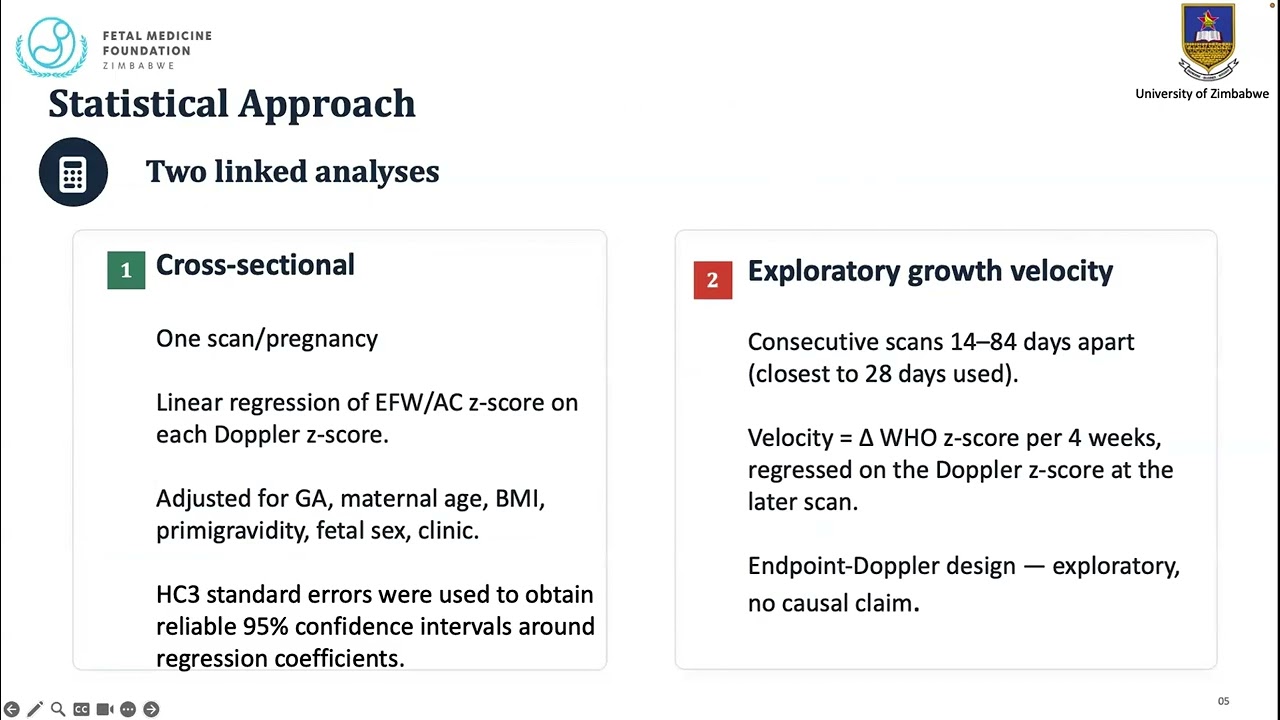
The study provides valuable population-specific data from Zimbabwe, confirming known physiological relationships between placental Doppler indices and fetal size. The argumentation follows the logical chain of placental insufficiency: increased vascular resistance leads to reduced perfusion and growth restriction. The cross-sectional analysis is robust, with a large sample and rigorous statistical adjustments, producing narrow confidence intervals and consistent results across EFW and AC. The longitudinal exploratory analysis is appropriately cautious, highlighting the lack of statistical significance due to small sample size. The presenter clearly distinguishes between association and causation, explicitly stating that no directional conclusion can be drawn from a cross-sectional snapshot. The value is enhanced by the deliberate retention of high-risk conditions to preserve clinical spectrum. However, the absence of pregnancy outcomes weakens the clinical applicability, as the study cannot link Doppler indices to adverse outcomes.
Scientific Rigor, Source Quality, Title Accuracy
The scientific rigor is moderate. The methodology is clearly described, including standardized z-score calculations and use of HC3 standard errors for robust confidence intervals. The study relies on internal data from the fetal medicine unit, and no external references or sources are cited in the presentation itself. The title of the video is generic and does not convey the specific research topic, but the description clarifies it. The study design is retrospective, which introduces potential selection bias and unmeasured confounding. The lack of outcome data and the underpowered longitudinal arm are acknowledged limitations. The quality of sources is acceptable for a conference presentation, but the lack of external validation and absence of a published preprint or peer-reviewed reference limit the verifiability. The title-content adequacy is correct but brief; the actual study title is more informative.
286 words
Title / Content Match
The video title is generic and does not mention the specific study, but it accurately identifies the presentation. The description provides the full study title.
Quality & Reliability
7/10
Large retrospective cohort (4,578 pregnancies) with standardized measurements and robust statistical adjustments. However, the longitudinal arm is underpowered and no outcome data were collected, limiting causal inference.
Key Moments
Markers derived by PSI from the transcript: the creator did not define chapters.
- Introduction and background on placental dysfunction and fetal growth restriction.
- Objectives: examine associations between fetal size (EFW, AC) and Doppler indices.
- Methods: cohort selection and eligibility criteria (4,984 scans screened, 4,578 cross-sectional, 257 longitudinal).
- Cross-sectional results: higher UA and uterine artery PI associated with smaller EFW; higher CPR with larger EFW; all statistically significant.
- Longitudinal exploratory results: only UA PI significantly associated with slower growth; other associations not significant.
- Interpretation, limitations, and conclusion: supports standardized Doppler recording but no new clinical thresholds without prospective validation.
Cited Sources
- Hadlock formula for estimated fetal weight — Used to calculate estimated fetal weight z-scores.
- Fetal Medicine Unit (FMU) data — Reference for Doppler indices medians per gestational age.
- Standard references on placental insufficiency pathway — Background for the expected relationship between Doppler indices and fetal growth.
Contribution & Novelties
This study provides large-scale, population-specific data from Zimbabwe confirming the well-established associations between fetoplacental Doppler indices and fetal size. Its novelty lies in demonstrating graded associations across the entire Doppler distribution, not just pathological extremes, and in exploring interval growth velocity in a sub-cohort. The findings reinforce the need for standardized Doppler recording but emphasize that prospective outcome-linked validation is required before clinical use.
Pour aller plus loin :
- Fetal growth restriction — Directly related to the study’s core concept of restricted growth due to placental insufficiency.
- Doppler ultrasonography — Provides background on the technique used to measure the vascular indices discussed.
- Placental insufficiency — Explains the pathophysiological mechanism linking Doppler changes to fetal growth restriction.
116 words
Radar Profile
The radar profile shows balanced scores with slightly lower values for quantity and reliability compared to quality and technical level. This reflects a well-executed but limited study with good statistical rigor yet missing outcome data and external validation.