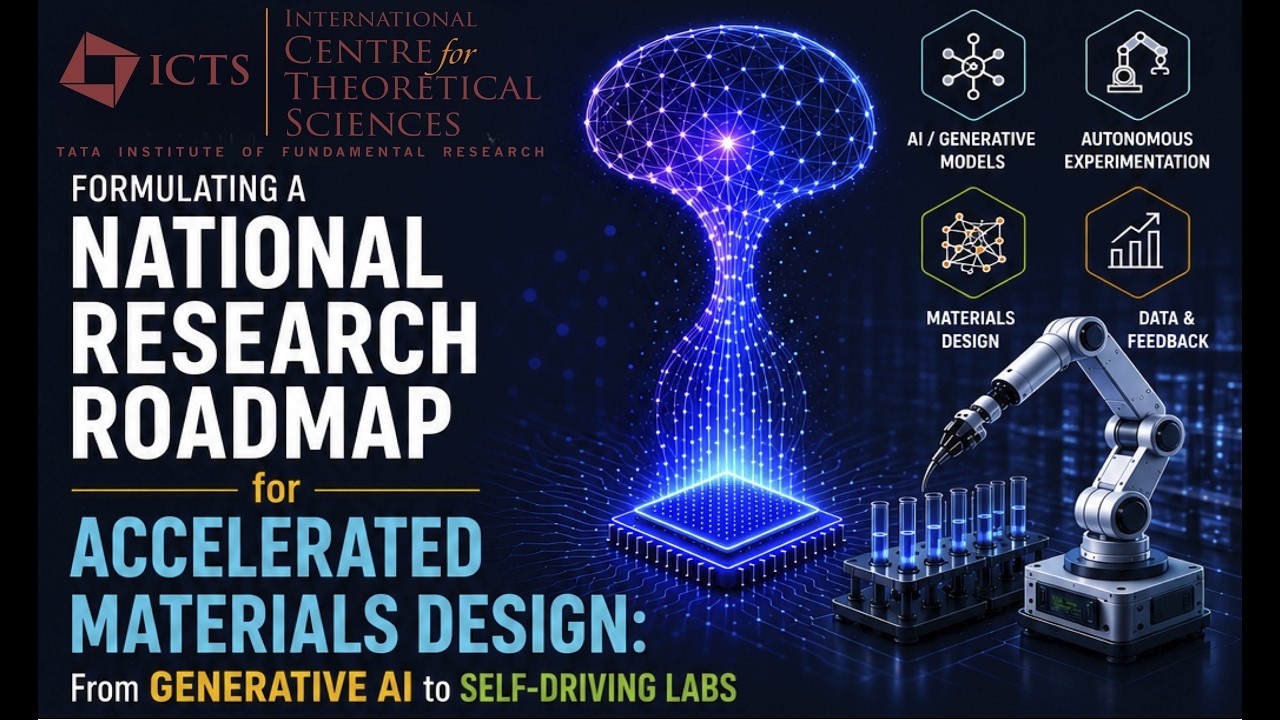
National Priorities 2 by Hemant Agnihotri; KNS Pavan Kumar
Title history
- National Priorities 2 by Hemant Agnihotri; KNS Pavan Kumar — observed on 20261030-1129 UTC (YouTube)
Keywords
Summary
179 words
Critical Evaluation
Value of the Information & Strength of the Argument
The value of this presentation lies in its insider perspective on national research priorities and funding mechanisms. The authors provide concrete information on funding schemes, eligibility criteria, and budgetary thresholds, which is valuable for researchers seeking grants. The argumentation is generally clear and structured: the first speaker systematically walks through BRNS’s organization, committee structure, and material needs, while the second speaker justifies the development of the AMDAD tool by citing challenges in data access and the lack of ML expertise. However, the presentation lacks critical analysis of the effectiveness of these initiatives, and the second speaker’s narrative is somewhat anecdotal, focusing on personal experiences rather than systematic evidence. The claims about the tool’s capabilities are detailed but not empirically validated with performance metrics or case study results beyond anecdotal examples. Overall, the argumentation is persuasive for stakeholders but does not provide rigorous scientific depth.
Scientific Rigor, Source Quality, Title Accuracy
The scientific rigor is moderate. The speakers rely on their institutional authority and personal experience rather than citing specific studies or publications. The only external source mentioned is the BRNS website and the ICTS program link, which are legitimate but not used for in-depth referencing. The title ‘National Priorities 2’ is somewhat generic but accurately reflects the discussion of national research priorities. The content aligns with the meeting’s objective of formulating a roadmap, but the lack of detailed data, controls, or comparisons weakens the scientific robustness. No external sources are cited beyond the program page, and the presentation does not engage with existing literature or best practices comprehensively. The presence of a slide describing thrust areas is useful, but the information is presented as given without critical evaluation.
287 words
Title / Content Match
The title accurately reflects the content: two speakers address national research priorities, funding mechanisms, and strategic material needs from their respective agency perspectives.
Quality & Reliability
7/10
Presentation by representatives of two Indian funding agencies (BRNS/DAE and DRDO), providing insider perspectives on material research priorities, funding schemes, and infrastructure. The content is authoritative from an institutional standpoint, but remains largely qualitative and promotional, without peer-reviewed data or detailed methodology.
Key Moments
Markers derived by PSI from the transcript: the creator did not define chapters.
- Introduction to BRNS, its history and role as India's first extramural funding agency.
- Overview of BRNS funding schemes: RRP, YRP, CRP, and Mega projects.
- DAE's mandated material research areas: nuclear fuels, cladding, structural materials, corrosion-resistant alloys.
- Gap areas and required infrastructure: hot cells, high-temperature testing, and computational-experimental coupling.
- Introduction to DRDO's Young Scientist Laboratory and its focus on smart materials.
- Development of AMDAD tool: data scraping, preprocessing, visualization, and ML model fitting for materials discovery.
- Challenges in data sharing and the need for a data ecosystem within DRDO.
- Features of AMDAD: ANN modeling, custom code integration, and optimization for active learning.
- Closing remarks and call for collaboration between academia and funding agencies.
Cited Sources
- ICTS Discussion Meeting: Formulating a National Research Roadmap for Accelerated Materials Design — Program link provided in the video description, serving as the official page for the discussion meeting.
Concurring Sources
- ICTS Discussion Meeting program page — This page lists the meeting's agenda, organizers, and scope, supporting the context of the talks.
Contribution & Novelties
The presentation provides unique insight into the funding priorities and internal challenges of two major Indian research agencies. It explicitly addresses the gap between computational design and experimental validation, and highlights the critical bottleneck of synthesis pathways. The second speaker’s proposal for a user-friendly ML tool (AMDAD) is a practical contribution to lowering the barrier for ML adoption in materials research, although no public release is mentioned.
Pour aller plus loin :
- Materials informatics — Integration of data-driven methods in materials science, relevant to the discussed data ecosystem.
- Self-driving laboratories — Automated labs that combine AI and robotics, central to the meeting theme.
- Machine learning in materials science — Overview of applications, including property prediction and design.
- Large language models for materials — Potential for information extraction and generation, as hinted in the discussion.
- High-entropy alloys — Mentioned as a thrust area; these alloys are of interest for extreme environments.
150 words
Radar Profile
The radar profile shows high scores in reliability and quantity of information, with moderate technical depth and quality. This suggests a presentation that is authoritative and informative but not highly technical or analytically rigorous, typical of a policy-oriented talk.