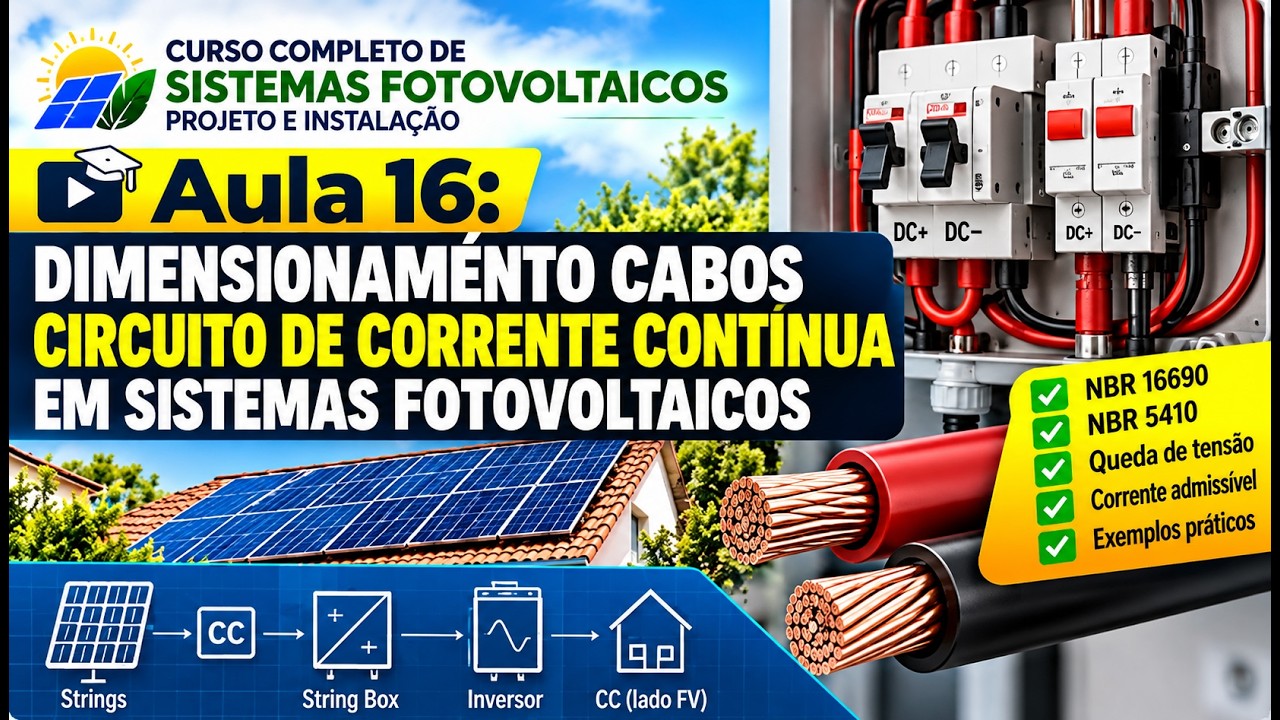
Aula 16: Dimensionamento cabos circuito de corrente contínua em sistemas fotovoltaicos
Class 16: Sizing cables for direct current circuit in photovoltaic systems
Title history
- Aula 16: Dimensionamento cabos circuito de corrente contínua em sistemas fotovoltaicos — observed on 20261026-1453 UTC (YouTube)
Keywords
Summary
176 words
Critical Evaluation
Value of the Information & Strength of the Argument
The value of the information lies in its direct applicability to real-world PV system design, especially within the Brazilian regulatory framework. The argumentation is solid and deductive, building from the normative tables to specific numerical examples. The instructor clearly justifies each step, such as why a cable must have an ampacity at least equal to the nominal current of the protection device, avoiding the practical mismatch between a 30A protection and a 20A cable. The use of spreadsheet tools for automation, along with manual validation, strengthens the credibility of the presented method.
Scientific Rigor, Source Quality, Title Accuracy
The scientific rigor is high, as the entire methodology is based on the explicit requirements of ABNT NBR 16690 and ABNT NBR 5410, with precise references to specific clauses (items 5.3.9, 5.3.10, 5.3.11). The instructor uses module datasheet values accurately and applies the normative formulas without omitting constraints. The title’s adequacy is excellent, fully encapsulating the subject matter. The description properly acknowledges the use of these standards and provides a direct link to the instructor’s full course, ensuring traceability of the educational material.
190 words
Title / Content Match
The title precisely matches the content, which focuses exclusively on the sizing of DC cables in photovoltaic systems.
Quality & Reliability
8/10
The video provides a rigorous, step-by-step tutorial grounded in the Brazilian standards ABNT NBR 16690 and ABNT NBR 5410. It relies on specific module datasheet values (Isc = 11.29 A) and consistently applies the normative requirements for overcurrent protection, resulting in highly accurate and verifiable guidance.
Key Moments
Markers derived by PSI from the transcript: the creator did not define chapters.
- Introduction to DC cable sizing in PV systems
- Interpretation of Table 5 of NBR 16690 for minimum current capacity
- Example 1: Sizing for a single string without protection (1.5 x Isc = 17A)
- Example 2: Two strings without protection (still 17A due to INP=0)
- Example 3: Three strings requiring overcurrent protection (18A fuse)
- Spreadsheet demonstration for automatic calculations
- Subarray sizing example: two subarrays without protection (84.67A)
- Subarray with three subarrays and array protection rules
Cited Sources
- ABNT NBR 16690 - Photovoltaic systems — Main standard referenced for dimensioning and protection requirements
- ABNT NBR 5410 - Low voltage installations — Referenced for electrical installation requirements
- Elétrica&Renováveis - Official course website — Linked in video description as the course platform
Concurring Sources
- ABNT NBR 16690 — The video's calculations align with the standard's Table 5 requirements
- Module datasheet for HiKu CS3W — Used to obtain Isc = 11.29 A for the examples
Contribution & Novelties
The video provides a detailed, step-by-step tutorial on sizing DC cables for photovoltaic systems, specifically according to Brazilian standards (NBR 16690 and NBR 5410). It clearly explains how to determine the minimum current carrying capacity based on whether the string, subarray, or array has overcurrent protection or not, backed by practical examples.
Pour aller plus loin :
- Photovoltaic system — General overview of PV system components and design.
- Solar inverter — Details on inverter types and DC input requirements.
- Electric current — Fundamental concepts of current flow and circuit analysis.
90 words
Radar Profile
The profile shows high scores in quantity and quality of information, indicating a dense and accurate technical presentation. The technical level is solid for professionals, while global reliability is high due to strict adherence to national standards.