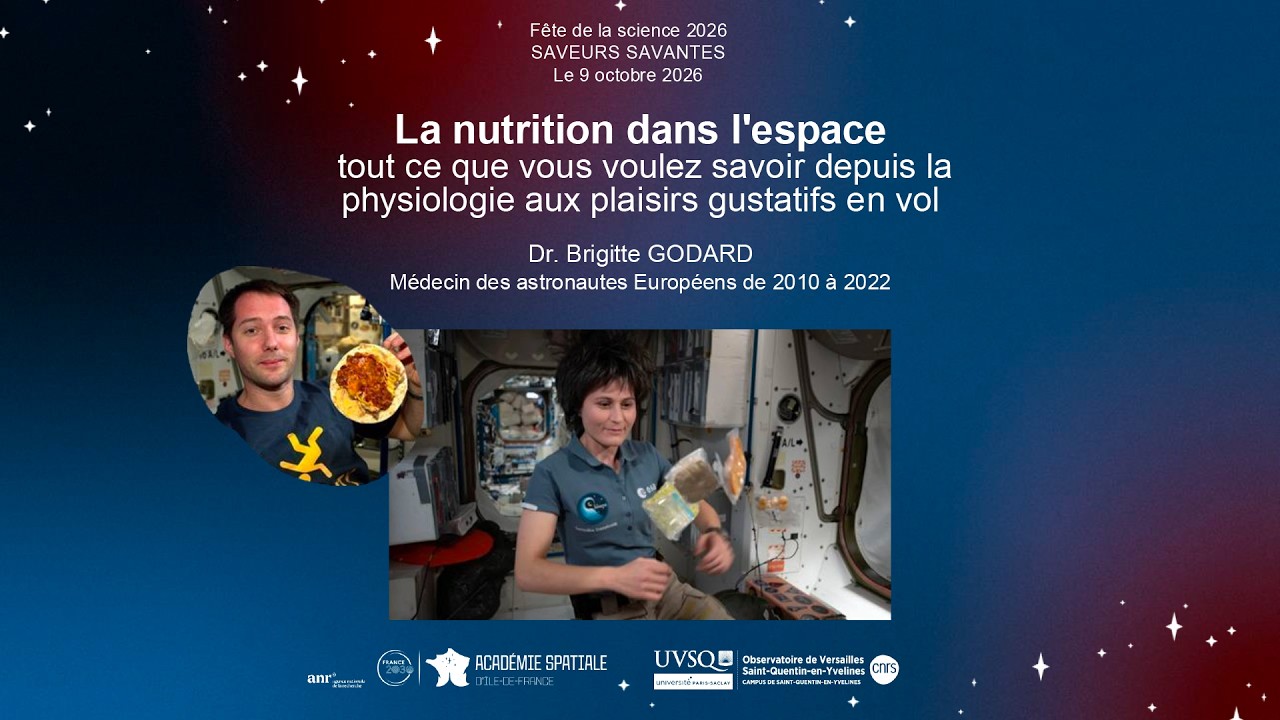
La nutrition dans l'espace avec le Dr Brigitte Godard - Fête de la Science 2026
Nutrition in space with Dr. Brigitte Godard - Science Festival 2026
Keywords
Summary
192 words
Critical Evaluation
Value of the Information & Strength of the Argument
The presentation offers valuable insights into the practical and physiological challenges of feeding astronauts, drawing on the speaker’s direct experience as a space physician. The argumentation is solid, supported by historical examples (Apollo, Skylab, ISS) and clear explanations of reasons for food development choices. The speaker logically addresses common misconceptions (e.g., calorie needs in zero gravity) and systematically answers the posed questions. The reasoning is coherent, with a balance of physiological, engineering, and psychological considerations.
Scientific Rigor, Source Quality, Title Accuracy
The content is rigorously sourced from official space agencies (NASA, ESA) and historical records, reflecting a well-established body of practice rather than speculative claims. The lack of explicit citations (no footnote or reference list) slightly reduces the academic rigor, but the information aligns with well-documented public knowledge. The title accurately matches the content, and the lecture maintains a high level of scientific credibility. No significant discrepancies between title and content were identified.
162 words
Title / Content Match
The title exactly reflects the content: a detailed lecture on space nutrition by Dr. Godard.
Quality & Reliability
9/10
Presentation by a medical doctor with direct experience in space medicine, based on historical records and current NASA/ESA practices. The content is authoritative and well-structured, but lacks formal citations and relies on retrospective summary.
Key Moments
Markers derived by PSI from the transcript: the creator did not define chapters.
- Introduction to the need for adequate nutrition in space, highlighting calorie requirements and the physical demands of extravehicular activities.
- Historical evolution of space food from early tube purees to the first rehydratable meals during Apollo missions.
- Development of Skylab menu variety, introduction of the communal table and liquid salt supplementation.
- Current ISS food system: over 200 products, packaging, and the role of cargo resupply missions.
- Physiological changes affecting taste and digestion in microgravity, and strategies to stimulate appetite.
- Future prospects: 3D food printing, in-space plant growth (VEGGIE), and implications for long-duration missions like Mars.
Cited Sources
- NASA — Mentioned as the agency managing space food programs and historical missions.
- European Space Agency (ESA) — Referred to as the coordinating body for European astronaut nutrition and cargo missions.
Contribution & Novelties
The lecture provides a comprehensive synthesis of space nutrition, bridging historical evolution, current practices, and future technologies. The original contribution lies in the presenter’s personal medical perspective, offering insights into the psychological and physiological aspects of eating in space that are often overlooked in technical summaries. The discussion of taste changes, digestive adaptations, and the role of social meals adds a human dimension rarely addressed in public communications.
Pour aller plus loin :
- Space food - Wikipedia — Overview of the history and categories of food used in spaceflight.
- Microgravity - Wikipedia — Effects of reduced gravity on the human body, including appetite and digestion.
- Veggie (ISS plant growth system) - Wikipedia — Details on the VEGGIE experiment for growing plants on the ISS, increasingly important for future missions.
129 words
Radar Profile
The radar profile shows very high scores in information quantity and global reliability, with slightly lower technical level due to accessible language. This indicates a content-rich, trustworthy presentation that remains approachable for a general audience.