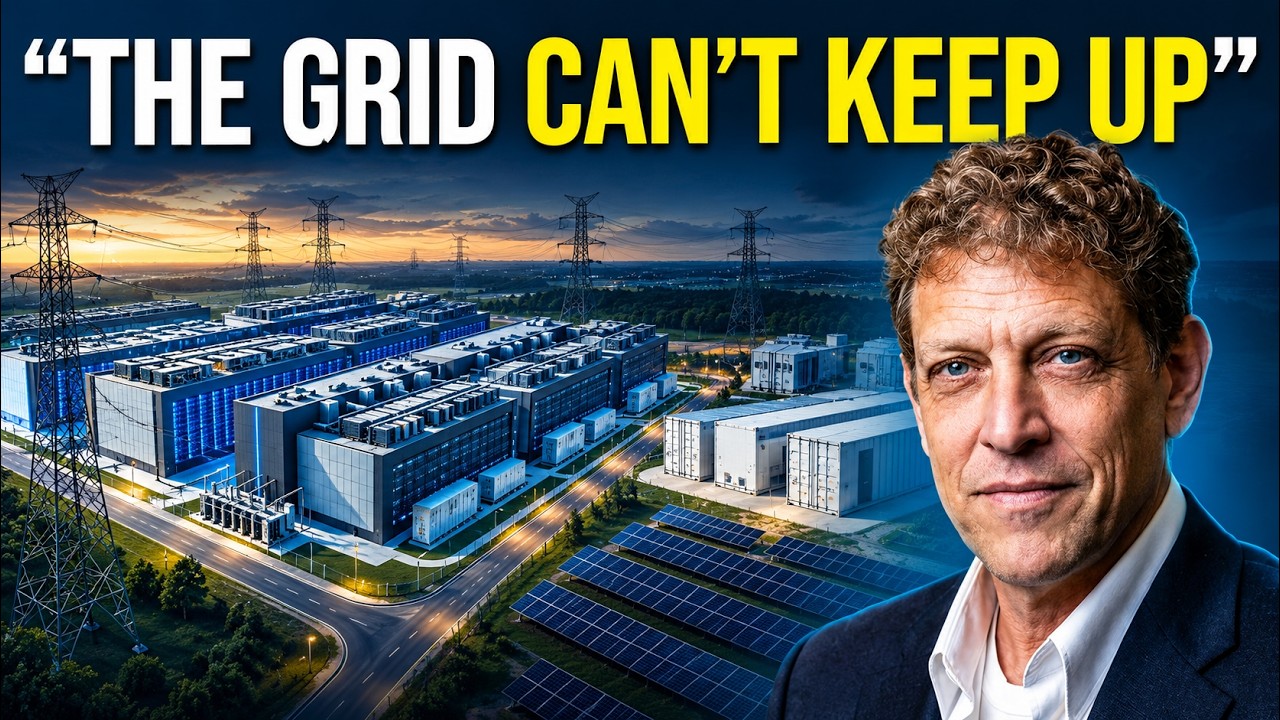
Can Microgrids Solve America’s AI Power Crisis? | Lester Crafton
Title history
- Can Microgrids Solve America’s AI Power Crisis? | Lester Crafton — observed on 20261030-1054 UTC (YouTube)
Keywords
Summary
171 words
Critical Evaluation
Value of the Information & Strength of the Argument
The value of this episode lies in the concrete example of the Isha microgrid project, which illustrates how a buffer battery can enable development despite grid constraints. Lester argues that microgrids can provide firm, dispatchable power to utilities while giving consumers resilience and control over their energy costs. The argumentation is largely qualitative and based on anecdotal evidence, but it is supported by real-world projects and specific figures (e.g., the $70 million grid upgrade avoided). However, some claims, such as the projection of 100 times more blackouts by 2030, are quoted without the original source details, which diminishes the rigor. The conversation remains conversational and exploratory, offering insights rather than systematic analysis.
Scientific Rigor, Source Quality, Title Accuracy
The episode relies primarily on the guest’s professional experience and a single case study. Specific numbers are given, but their sources are not always cited within the video; for example, the DOE blackout projection is mentioned but not referenced with a document name or date. The title is a provocative question that the content partially addresses, but the discussion is broader than just solving the AI power crisis, covering many aspects of microgrid implementation. The description includes a sponsor segment, but the absence of a dedicated reference list in the video means viewers cannot easily verify the claims. Overall, the rigor is moderate for an expert interview, but it lacks the transparency expected of a scientifically rigorous piece.
245 words
Title / Content Match
The title asks whether microgrids can solve the AI power crisis, and the video discusses microgrids as a potential solution while also highlighting challenges, so it is adequately aligned.
Quality & Reliability
6/10
The information is based on the guest's professional experience and a specific case study, but lacks peer-reviewed or independent verification. Some claims are forward-looking and speculative.
Key Moments
Markers derived by PSI from the transcript: the creator did not define chapters.
- Introduction of the episode and guest Lester Crafton.
- Discussion about Ovanova's start with a 'give first' marketing model.
- Ovanova's evolution into battery storage and microgrids.
- Introduction of the Isha Institute microgrid project and the buffer battery solution.
- Funding model for microgrids and comparison to grid upgrades.
- Discussion on earning revenue through demand response and the role of data centers.
- Cybersecurity and communications considerations for distributed energy resources.
- Concluding thoughts on scaling microgrids and the need for a grid of microgrids.
Cited Sources
- Ovanova official website — Company website of the guest's company, providing more information about their services.
- Lester Crafton on LinkedIn — Guest's professional profile.
- Clean Power Hour website — Official website of the show.
- Clean Power Hour on Spotify — Podcast streaming page.
- Clean Power Hour on Apple Podcasts — Podcast streaming page.
- BatteryMBA program — Referral link for a battery business course, mentioned by the host.
- Tim Montague's book 'Wired for Sun' — Book by the host on commercial solar.
- Clean Power Hour media kit — Sponsorship and partnership information.
- Clean Power Hour on LinkedIn — Show's LinkedIn page.
- Consultation scheduling (Calendly) — Link to book a free consultation with the host.
- Clean Power Hour merchandise — Merchandise store for the show.
External References
Contribution & Novelties
The episode provides a practical case study of how a microgrid can overcome grid capacity limitations, demonstrating a novel ‘buffer battery’ approach. It also discusses the economic viability of distributed energy resources by framing homeowners as potential power sellers. The discussion of cybersecurity for aggregated DERs is a valuable contribution, as this is often overlooked in popular discourse. The guest’s experience across multiple utilities and states offers a broad perspective on interconnection challenges.
Pour aller plus loin :
- Microgrid — Overview of microgrid technology and its benefits.
- Virtual power plant — Concept of aggregating DERs to provide grid services.
- Demand response — Mechanism for loads to adjust consumption in response to grid conditions.
- Vehicle-to-grid — Bi-directional EV charging as a grid resource.
122 words
Radar Profile
The radar profile would show high scores in information quantity and technical level, but lower in reliability due to the lack of verifiable sources. The 'applique' phylum emphasizes practical engineering over theoretical rigor.