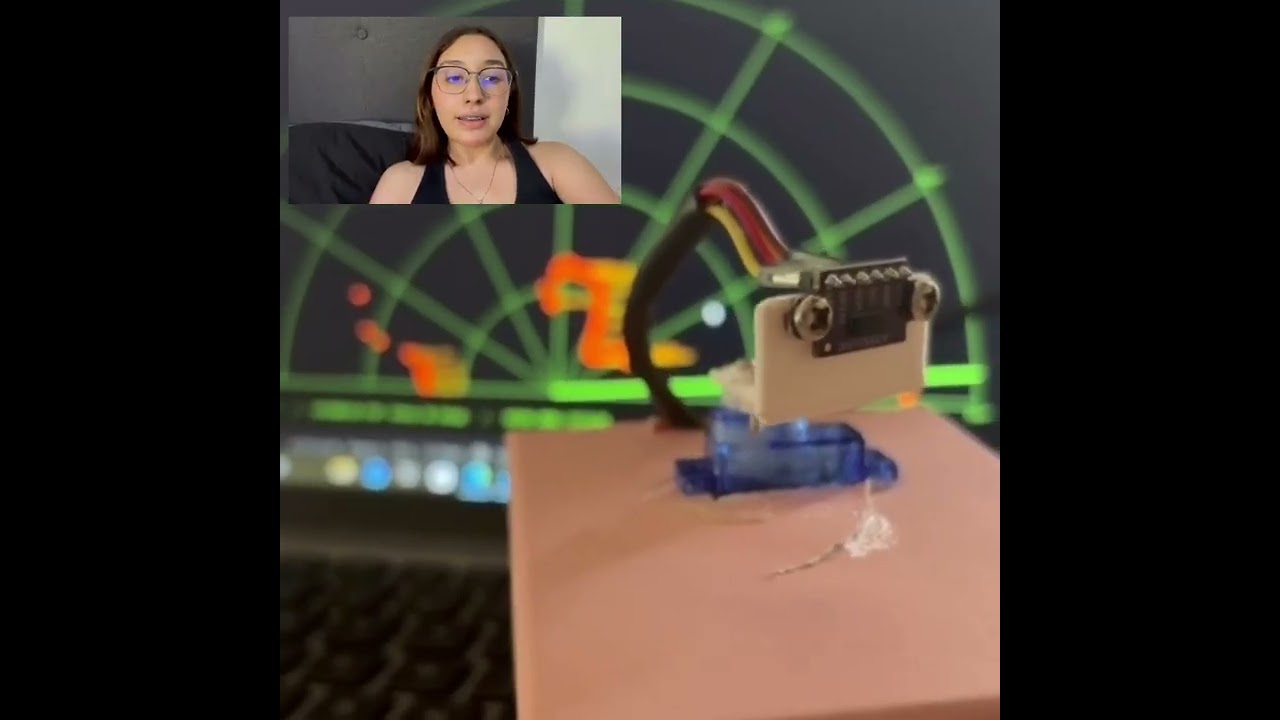
MEMS Y NEMS - ESTUDIANTES ISC UNISON
MEMS AND NEMS - ISC UNISON STUDENTS
Title history
- MEMS Y NEMS - ESTUDIANTES ISC UNISON — observed on 20261030-1054 UTC (YouTube)
Keywords
Summary
183 words
Critical Evaluation
Value of the Information & Strength of the Argument
The video provides a clear and structured explanation of the project’s implementation, from hardware connections to software algorithms. The argumentation is coherent, with each stage logically following the previous one: the why and how of choosing Python over Processing, the importance of the 80 ms delay for motor stability, and the mathematical conversions for plotting. The value lies in its educational demonstration of integrating MEMS sensors with microcontrollers and real-time graphics, making it useful for students. However, the presentation is descriptive rather than analytical; it lacks comparative performance data, error analysis, or validation against other techniques. Claims about speed and stability are not supported by benchmarks. The argumentation is solid for a student project but not rigorous enough for a scientific audience.
Scientific Rigor, Source Quality, Title Accuracy
The video does not cite any external scientific sources; it relies solely on the team’s own implementation and results. The description contains no links to papers or supplementary materials. The content is self-contained but unverified. The title includes ‘MEMS y NEMS’, but NEMS (nano-electromechanical systems) is never discussed, which is a slight mismatch. Overall, while the technical explanations are plausible, the lack of references and peer validation limits the scientific rigor. No comments are provided to indicate audience reception.
216 words
Title / Content Match
The title is somewhat vague and mentions both MEMS and NEMS, but the content focuses specifically on a MEMS time-of-flight radar project; the NEMS part is not addressed.
Quality & Reliability
4/10
The video is a student project presentation with detailed technical descriptions but lacks external references, peer review, or verification, reducing its overall reliability.
Key Moments
Markers derived by PSI from the transcript: the creator did not define chapters.
Contribution & Novelties
The project demonstrates a practical application of MEMS technology for environmental mapping, though it does not present groundbreaking innovation. The educational value is clear, showing integration of hardware and software.
Pour aller plus loin :
- MEMS — Background on micro-electromechanical systems.
- Time of flight — Principle behind the VL53L0X sensor.
- Lidar — Related technology for distance measurement.
- Arduino — Microcontroller platform used.
62 words
Radar Profile
The radar profile shows moderate scores in information quantity and technical level, but lower quality and reliability, indicating a lack of rigorous sources and verification.