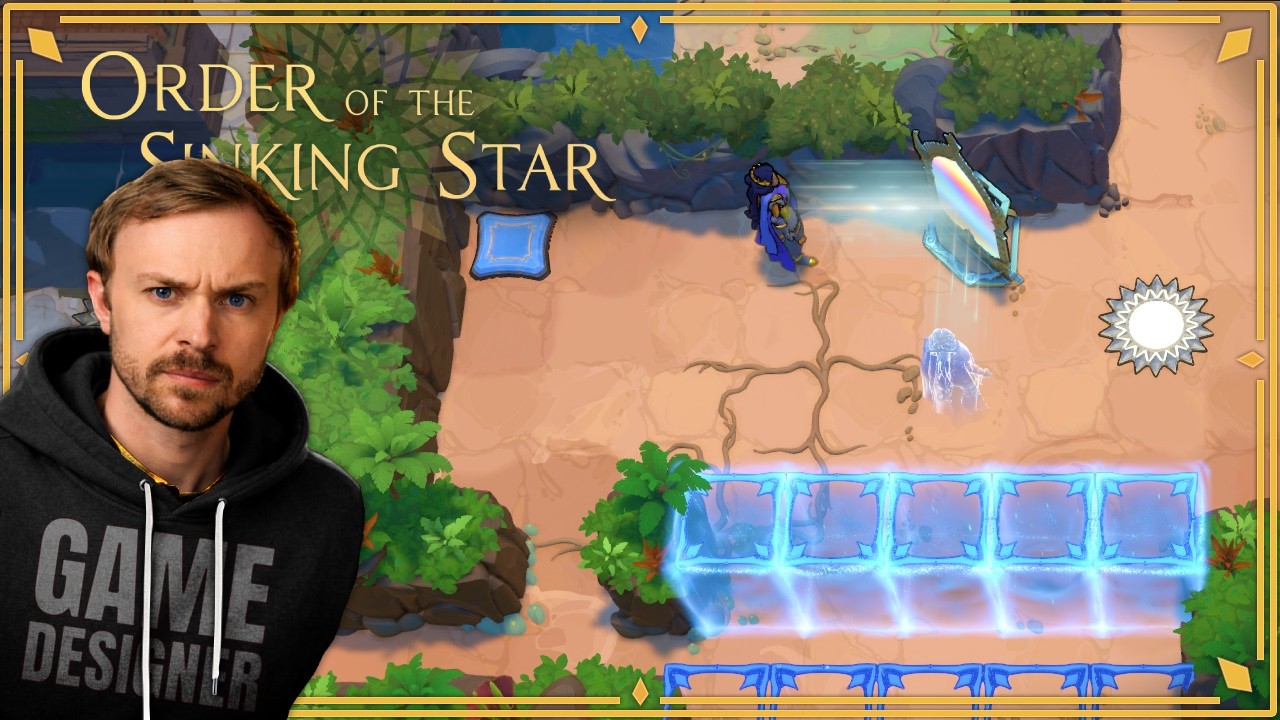
The Hero In the Mirror | Order of the Sinking Star Design Study
Title history
- The Hero In the Mirror | Order of the Sinking Star Design Study — observed on 20261101-0209 UTC (YouTube)
Keywords
Summary
154 words
Critical Evaluation
Value of the Information & Strength of the Argument
The value of the information lies in its honest, exploratory approach to understanding puzzle mechanics. Noël doesn’t just solve puzzles; he articulates his thought process, hypotheses, and mistakes, which offers a rich perspective on how players learn and how designers structure challenge. The argumentation is solid: he bases each observation on concrete examples from the game, and when he makes speculative claims, he clearly marks them as such. The video demonstrates a strong understanding of game feel and level design. He often derives general principles from specific interactions, such as the difference between origin and secondary mirrors, and the significance of range limits. His discussion of off-by-one errors is particularly insightful, linking programming concepts to puzzle logic. The live interaction with chat adds authenticity but also introduces digressions; however, his focus on design remains clear throughout.
Scientific Rigor, Source Quality, Title Accuracy
The video relies primarily on the game itself as a source, which is appropriate for this type of analysis. No external references are used, but that’s acceptable given the personal nature of the content. The title accurately reflects the episode’s focus on the mirror mechanics and the hero’s exploration. There is a clear alignment between the title and the content. The video’s rigor is evident in the methodical way he tests hypotheses and verifies solutions, although some observations are speculative and not backed by external citations. Given that this is a playthrough with commentary, the lack of external sources is not a major weakness, but it limits the verifiability of claims beyond the game’s own rules.
267 words
Title / Content Match
Title accurately reflects the content, focusing on the mirror-based puzzle design.
Quality & Reliability
7/10
The content is a subjective but well-informed analysis from a game designer and programmer. The observations are concrete and based on direct gameplay experience. No external sources are cited, but the analysis is grounded in the game's mechanics.
Chapters
Cited Sources
- Order of the Sinking Star Design Study (Playlist) — Link to the full playlist containing this episode.
- Live Playthrough Playlist — Link to the series live playlist.
- Order of the Sinking Star on Steam — Official Steam page for the game being played.
Contribution & Novelties
This video contributes an authentic, in-the-moment design analysis of a niche puzzle game, capturing how a designer approaches unfamiliar mechanics. It offers practical examples of how to articulate spatial reasoning and discrete math problems in puzzle design. The novelty is the combination of blind playthrough and professional commentary, providing a unique educational resource for game design students. The creator’s live problem-solving and explicit reasoning about mechanics like mirror range, crystal alignment, and off-by-one errors illustrate core game design principles in action.
Pour aller plus loin :
- Off-by-one error — Noël discusses this programming concept repeatedly; it’s fundamental to spatial logic and puzzle design.
- The Witness (2016 video game) — Noël cites it as a major influence on his design thinking.
- Jonathan Blow — The designer behind The Witness and Braid, central to the puzzle game genre.
136 words
Radar Profile
The profile shows a moderate-to-high score in information quantity and quality, with a technical level that is accessible but nuanced. The reliability score is consistent with the subjective yet expert nature of the analysis.