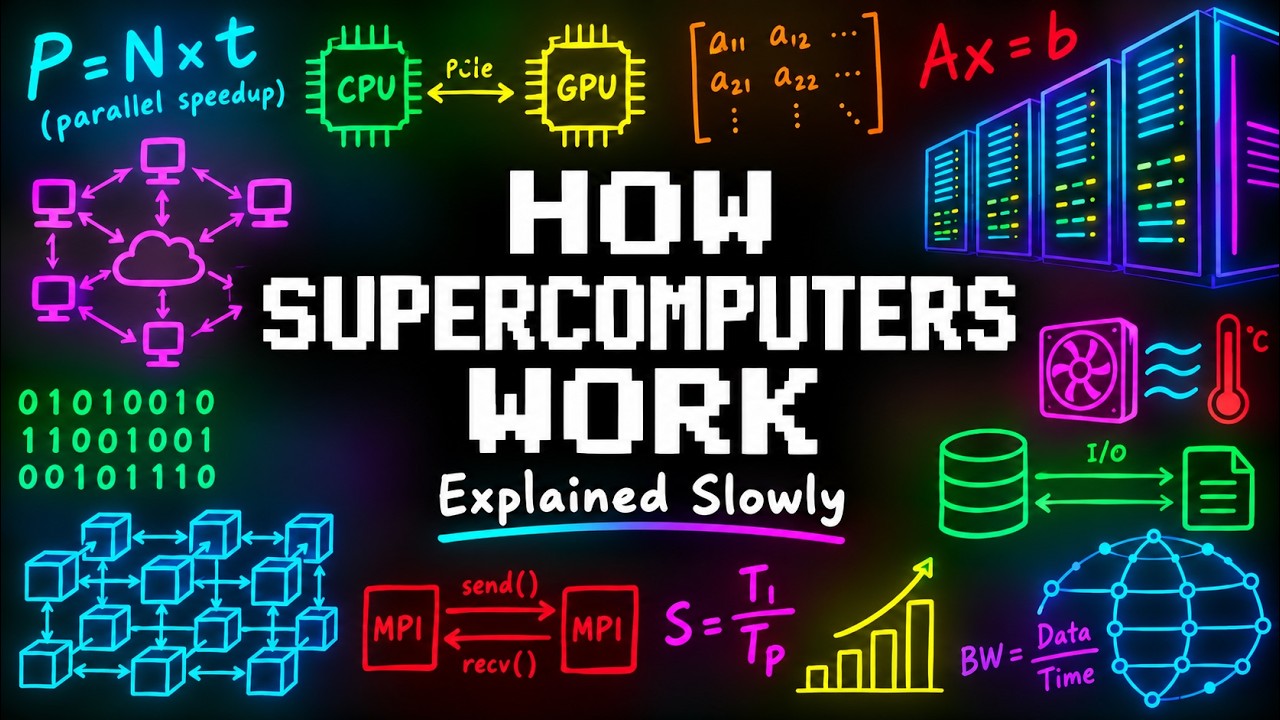
Literally Everything About How Supercomputers Work Explained Slowly
Title history
- Literally Everything About How Supercomputers Work Explained Slowly — observed on 20261102-0826 UTC (YouTube)
Keywords
Summary
156 words
Critical Evaluation
Value of the Information & Strength of the Argument
The video provides substantial informational value by tracing the development of supercomputers through a well-structured historical narrative. It effectively explains complex concepts like instruction-level parallelism and functional unit design in an accessible manner, making them understandable for a lay audience. The argumentation is solid, relying on documented facts and widely cited milestones. The reasoning flows logically, from the initial computational bottlenecks to the architectural innovations that addressed them, and finally to the current state of high-performance computing. The narrative style, while sometimes personal, does not compromise the factual content.
Scientific Rigor, Source Quality, Title Accuracy
The video demonstrates strong scientific rigor by referencing specific machines, dates, and individuals, and by grounding its explanations in established computer science history. The sources listed in the description—Britannica, TOP500, Oak Ridge National Laboratory, and IBM—are authoritative and directly relevant. The title accurately reflects the content, as the video indeed covers nearly all aspects of supercomputer operation and history. However, the lack of in-video citations or direct references to these sources limits the ability to verify specific claims immediately, though the overall narrative aligns with widely accepted knowledge.
192 words
Title / Content Match
The title accurately reflects the content: a comprehensive, slow-paced explanation of supercomputers, covering their history, architecture, and operation.
Quality & Reliability
8/10
The video provides a detailed and historically grounded explanation of supercomputers, referencing key figures and machines. The information is consistent with established knowledge in computer science and is supported by credible resources in the description. Minor simplifications are appropriate for a general audience.
Key Moments
Markers derived by PSI from the transcript: the creator did not define chapters.
- Introduction to the concept of supercomputers and their computational power
- Discussion of the Manhattan Project and the role of human computers
- John von Neumann and the stored-program architecture
- The ENIAC and its use for hydrogen bomb calculations
- Transition to transistors and early supercomputers
- Seymour Cray and the CDC 6600: instruction-level parallelism
- Cray's design philosophy and physical layout considerations
- The challenges of parallel computing and coordination overhead
- Modern exascale systems and applications like weather forecasting and AI
Cited Sources
- Encyclopaedia Britannica — Supercomputer — Reference for definition and history of supercomputers
- IBM — What Is Supercomputing? — Overview of supercomputing concepts and applications
- Oak Ridge National Laboratory — Frontier Supercomputer — Details about the Frontier exascale supercomputer
- TOP500 — Supercomputer Rankings — Ranking and performance data of the fastest supercomputers
- Cosmo Explains (Spotify) — Audio version of the content
Concurring Sources
- Top500.org — Supports the claim of Frontier as a leading exascale supercomputer.
Contribution & Novelties
The video’s original contribution lies in its comprehensive, narrative-driven synthesis of supercomputing history and technology, making it accessible to a broad audience without oversimplifying the core principles. It weaves together technological progress, key personalities, and the persistent drive for speed in a coherent and engaging manner.
Pour aller plus loin :
- Von Neumann architecture — Detailed explanation of the stored-program concept.
- Parallel computing — Overview of parallelism in computing, including challenges and types.
- Seymour Cray — Biography and contributions of the supercomputer pioneer.
- CDC 6600 — Specific details on the first true supercomputer.
93 words
Radar Profile
The radar profile shows high scores for quantity and quality of information, reflecting the extensive and reliable content. Technical level is moderately high, suitable for a general audience interested in detailed explanations. Fiabilite is strong due to authoritative sources and accurate historical references.