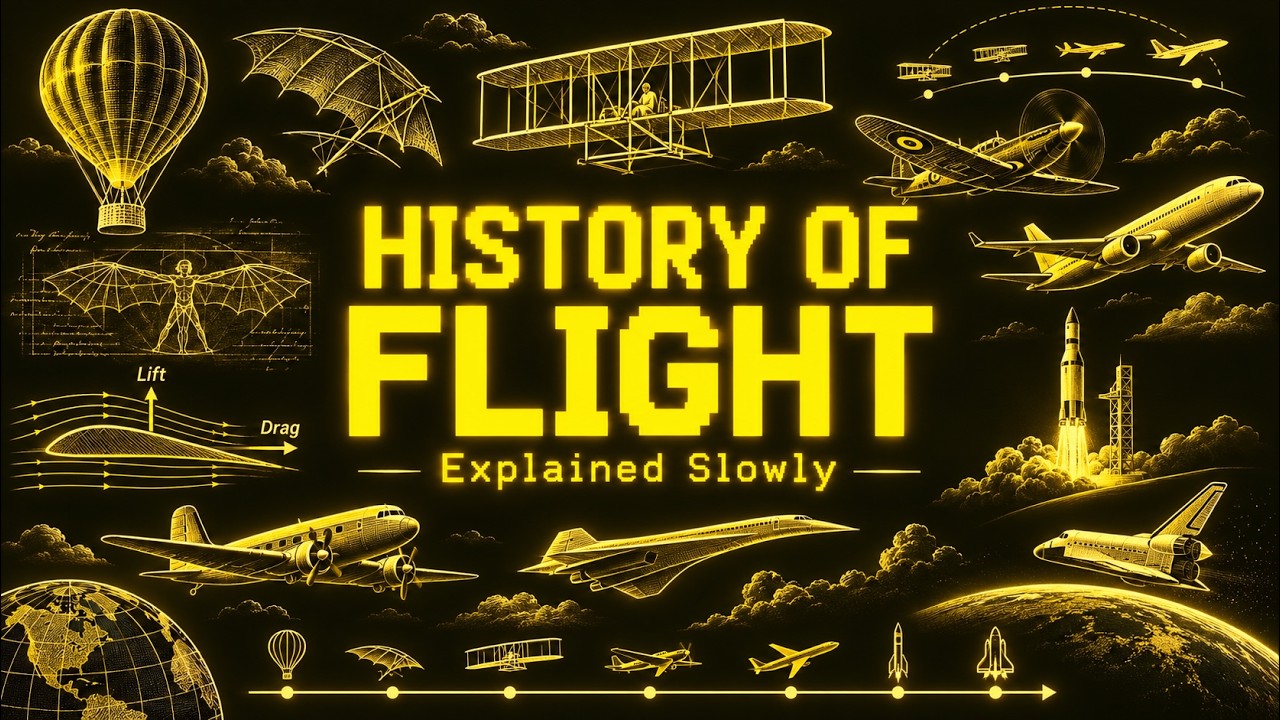
The Entire History Of Flight Explained Slowly
Title history
- The Entire History Of Flight Explained Slowly — observed on 20261104-0837 UTC (YouTube)
Keywords
Summary
179 words
Critical Evaluation
Value of the Information & Strength of the Argument
The value of the information lies in its ability to connect scientific principles with historical events, making complex aerodynamics concepts accessible through storytelling. The narrative is well-argued, developing logically from myth to empirical experimentation, and highlights the importance of methodical engineering in solving problems. The emphasis on the decomposition of flight into lift, thrust, and control is a strong explanatory framework that unifies different eras of progress. The argumentation is solid, though occasionally relies on anecdotal evidence, which tempers its rigor.
Scientific Rigor, Source Quality, Title Accuracy
The scientific rigor is moderate: the video correctly explains aerodynamic forces and principles without oversimplifying, but it does not cite specific primary sources or peer-reviewed references. The description links to reputable institutions (Smithsonian, NASA, Britannica, FAA), but these are not explicitly used to support claims in the transcript. This limits the ability to verify exact historical details. The title is partially adequate: the ’entire history’ promise is broader than the content provided in this excerpt, which focuses mainly on early pioneers. However, the ’explained slowly’ aspect is faithfully rendered in the deliberate, educational tone.
190 words
Title / Content Match
The title accurately reflects the slow, accessible explanatory style of the video. However, in the provided transcript, the narrative covers only up to the Wright brothers' early work, not the 'entire history' as promised, leaving the full scope implied by the title incomplete in this excerpt.
Quality & Reliability
7/10
The video provides a coherent and well-structured narrative of aviation history, correctly explaining key aerodynamic principles such as lift, thrust, and control. However, it relies on anecdotal evidence and lacks direct citations to primary sources within the transcript. Some historical details are presented with caveats (e.g., Abbas Ibn Firnas), indicating a degree of uncertainty. The provided external resources are general and not directly referenced, limiting the ability to verify specific claims.
Key Moments
Markers derived by PSI from the transcript: the creator did not define chapters.
- Introduction to the human longing for flight and the myth of Icarus, highlighting the engineering insight within the myth.
- Discussion of ornithopter designs and the physiological impossibility of human- powered flapping flight.
- Abbas Ibn Firnas's gliding attempt in 9th century Spain and the importance of fixed wings.
- Leonardo da Vinci's flying machine designs and his shift toward fixed-wing gliders, though his insights were not widely shared.
- George Cayley's decomposition of flight into lift, thrust, and control, and his experiments with model gliders and whirling arm tests.
- Otto Lilienthal's 2,000+ glider flights, his data collection, and his fatal crash in 1896.
- The Wright brothers' systematic approach, building a wind tunnel and focusing on control, as they prepare for powered flight.
Cited Sources
- Smithsonian National Air and Space Museum — Aviation — Background resource on the history of aviation, linked in the description.
- NASA — History of Flight — Resource on the history of flight, provided as a reference in the description.
- Encyclopaedia Britannica — History of Flight — General article on the history of flight, cited in the description.
- Federal Aviation Administration — History of Aviation — Resource on aviation history and regulation, provided as a reference.
- Cosmo Explains Podcast — Spotify — Alternative viewing/listening source for the video content, mentioned in the description.
Contribution & Novelties
This video adds value by presenting the history of flight through the lens of engineering problem-solving, making the technical concepts of lift, thrust, and control accessible to a general audience. It synthesizes well-known historical anecdotes into a coherent narrative. The novelty is not in uncovering new facts but in framing the evolution as a series of engineering breakthroughs. It also highlights underappreciated figures like George Cayley and Otto Lilienthal, correcting the common overemphasis on the Wright brothers.
Pour aller plus loin :
- George Cayley — Overview of his life and contributions to aeronautics.
- Otto Lilienthal — Details on his glider flights and crash.
- Wright brothers — Comprehensive article on their achievement of powered flight.
114 words
Radar Profile
The radar profile shows high scores in information quantity and technical level, consistent with a detailed educational narrative. Quality and reliability are moderate, reflecting the absence of explicit source citations and reliance on historical storytelling. The overall balance suggests a well-crafted but not rigorously referenced documentary.