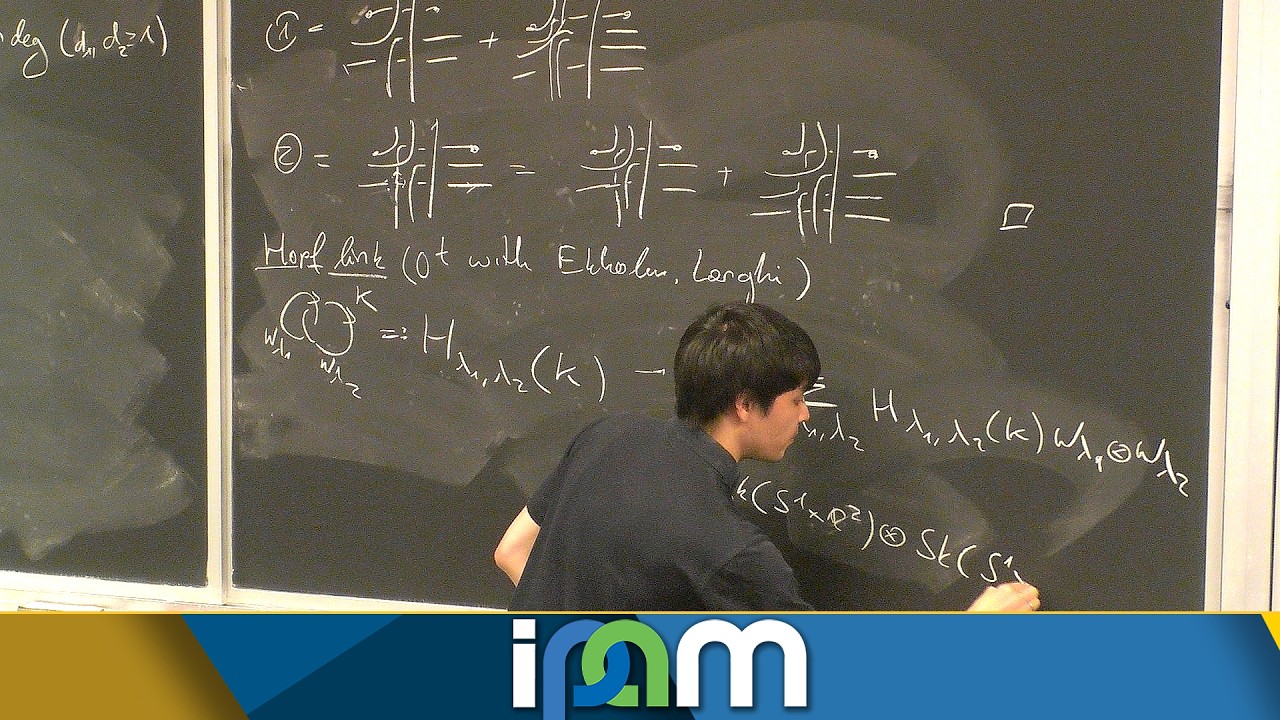
Lukas Nakamura - Recursion relations in the HOMFLYPT skein of the solid torus - IPAM at UCLA
Title history
- Lukas Nakamura - Recursion relations in the HOMFLYPT skein of the solid torus - IPAM at UCLA — observed on 20261030-1847 UTC (YouTube)
Keywords
Summary
165 words
Critical Evaluation
Value of the Information & Strength of the Argument
The value of the information is high, as it presents novel recursion relations that simplify proofs in skein theory and offer new computational tools. The argumentation is solid and mathematically rigorous: the speaker explicitly distinguishes theorems from observations, and the proofs given rely on injectivity and induction, with careful handling of sign and degree considerations. The pentagon identity proof is particularly elegant, reducing a complex identity to a short manipulation of the recursion relation. The link to Gromov-Witten theory provides broader context and demonstrates the conceptual depth of the results.
Scientific Rigor, Source Quality, Title Accuracy
The scientific rigor is strong: the talk is based on established work in skein theory (HOMFLYPT) and cites contemporary research by Ekholm, Shende, and Longhi. The speaker is careful to indicate when results are joint and to attribute prior contributions. The title accurately reflects the content, focusing on recursion relations in the HOMFLYPT skein of the solid torus. The description provides a link to the IPAM workshop page, which likely contains abstracts and further references, but no external sources were directly cited within the video itself.
191 words
Title / Content Match
The title accurately reflects the content: the talk focuses on recursion relations in the HOMFLYPT skein of the solid torus.
Quality & Reliability
8/10
Clear and rigorous presentation of new recursion relations within HOMFLYPT skein theory, backed by proofs and references to recent work; the technical level is high and the argumentation is sound.
Key Moments
Markers derived by PSI from the transcript: the creator did not define chapters.
- Introduction to skein relations and definition of the HOMFLYPT skein module.
- Presentation of the skein module of the solid torus with basis elements W_lambda and algebra structure generated by P_d.
- Introduction of the recursion operator and uniqueness of solutions; definition of the disk partition function.
- Statement and proof of the skein-valued pentagon identity using recursion relations.
- Applications to colored HOMFLYPT invariants of the Hopf link and relation to Gopakumar-Vafa factorization.
Cited Sources
- IPAM Workshop: Contact Geometry, Cluster Algebras and Skein Theory — Workshop page where the talk was recorded, containing abstract and related materials.
Contribution & Novelties
The talk introduces new recursion relations for partition functions in the HOMFLYPT skein of the solid torus, providing a unified method for proving identities and computing invariants. The proof of the pentagon relation via recursion is notably simpler than existing proofs. The connection to skein-valued Gromov-Witten invariants offers a geometric interpretation and suggests future generalizations to other Riemann surfaces.
Pour aller plus loin :
- HOMFLY polynomial — Relevant because the talk deals with HOMFLYPT invariants, the polynomial invariant generalizing Jones and Alexander polynomials.
- Skein module — The central object of study; the talk builds on skein theory and its algebraic structure.
- Gromov–Witten invariants — These count holomorphic curves and underpin the geometric motivation for the recursion relations.
- Quantum integer — The localization and quantum integers are key technical tools used in the work.
133 words
Radar Profile
The radar profile shows high scores across all dimensions, particularly in technical level and information quality, indicating a dense and rigorous mathematical talk. The slightly lower quantity score reflects the focused scope on a specific research topic rather than a broad overview.