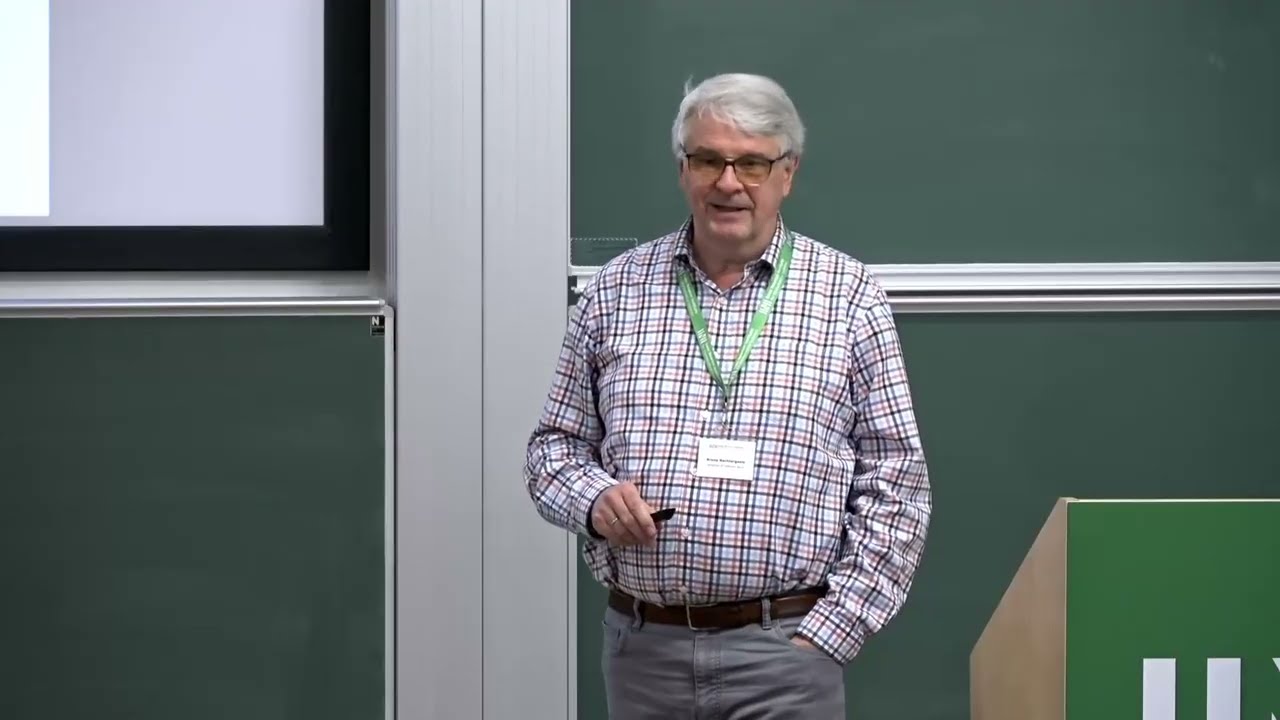
Prof. Bruno Nachtergaele | The theory of tensor networks Part I
Title history
- Prof. Bruno Nachtergaele | The theory of tensor networks Part I — observed on 20261030-1104 UTC (YouTube)
- Prof. Bruno Nachtergaele | The theory of tensor networks — observed on 20261028-1223 UTC (YouTube)
Keywords
Summary
235 words
Critical Evaluation
Value of the Information & Strength of the Argument
The value of the information lies in its authoritative synthesis of tensor network theory from one of its pioneers. Nachtergaele not only recaps established results but also provides a unified conceptual framework, linking finitely correlated states to modern MPS and explaining how injectivity determines the structure of ground states. The argumentation is rigorous yet accessible to a mathematically trained audience; he carefully defines each concept (e.g., states as functionals, injectivity length) and justifies claims with explicit calculations, such as the derivation of the reduced density matrix for finitely correlated states. The lecture builds logically from one-dimensional MPS to parent Hamiltonians and gap stability, with clear emphasis on why these results are important for quantum many-body physics. The inclusion of recent progress on two-dimensional AKLT models and the candid discussion of omitted topics demonstrate both depth and intellectual honesty.
Scientific Rigor, Source Quality, Title Accuracy
The rigor is exemplary. Nachtergaele cites the original 1992 paper on finitely correlated states (with Fannes and Werner) and refers to standard lecture notes (e.g., Bridgeman and Chubb) for further details. He is meticulous about conventions and notation, warning listeners that left/right orientations may vary across the literature. The sources used are appropriate for a research-level audience, though the talk does not provide explicit references for every claim, which is typical for a survey lecture. The title ‘The theory of tensor networks Part I’ is fully justified: the content is indeed a focused presentation of the theoretical foundations, not a hands-on tutorial. The binder between title and content is strong, and the lecture lives up to its promise by covering both classical results and modern developments.
279 words
Title / Content Match
The title accurately reflects the content: a lecture on the theory of tensor networks, covering their mathematical foundations, matrix product states, parent Hamiltonians, and symmetry-protected topological phases.
Quality & Reliability
9/10
Lecture by a leading expert in the field, based on established results, with rigorous mathematical derivations and a clear historical perspective. The content is accurate and well-structured, though it assumes prior familiarity with quantum many-body systems.
Key Moments
Markers derived by PSI from the transcript: the creator did not define chapters.
- Introduction of Bruno Nachtergaele and his 1992 paper; outline of the lecture.
- Setting up the mathematical framework: observables, states, and automorphisms.
- Definition of finitely correlated states and derivation of the MPS representation.
- Discussion of injectivity length, normality, and the AKLT model as an example.
- Introduction of parent Hamiltonians and proof that they are gapped; stability of gapped phases.
- Generalizations to symmetry-protected topological phases and two-dimensional AKLT models.
Cited Sources
- Isaac Newton Institute Website — General information about the institute and its programmes.
- Seminar page: European tensor networks school — Details of the lecture series and the specific seminar.
Contribution & Novelties
This lecture provides a unique bird’s-eye view of tensor network theory, bridging the foundational works of the 1990s with contemporary research directions. Nachtergaele’s emphasis on the relationship between finitely correlated states and modern MPS, including the role of injectivity and parent Hamiltonians, offers a coherent narrative that is rarely found in a single talk. He also highlights recent advances in two-dimensional systems, illustrating the ongoing relevance of the theory.
Pour aller plus loin :
- Matrix product state — A key concept central to the lecture; Wikipedia provides an accessible overview.
- Symmetry-protected topological order — A concept discussed in relation to SPT phases and classification.
- Tensor network — General framework for representing quantum states; background to the entire lecture.
118 words
Radar Profile
The radar profile is strongly weighted towards technical depth and reliability, with very high scores in all dimensions. This indicates that the video is a rich, expert-level resource, ideal for researchers already familiar with quantum many-body physics. Its communicative clarity is slightly lower relative to technical content, reflecting the advanced nature of the material.