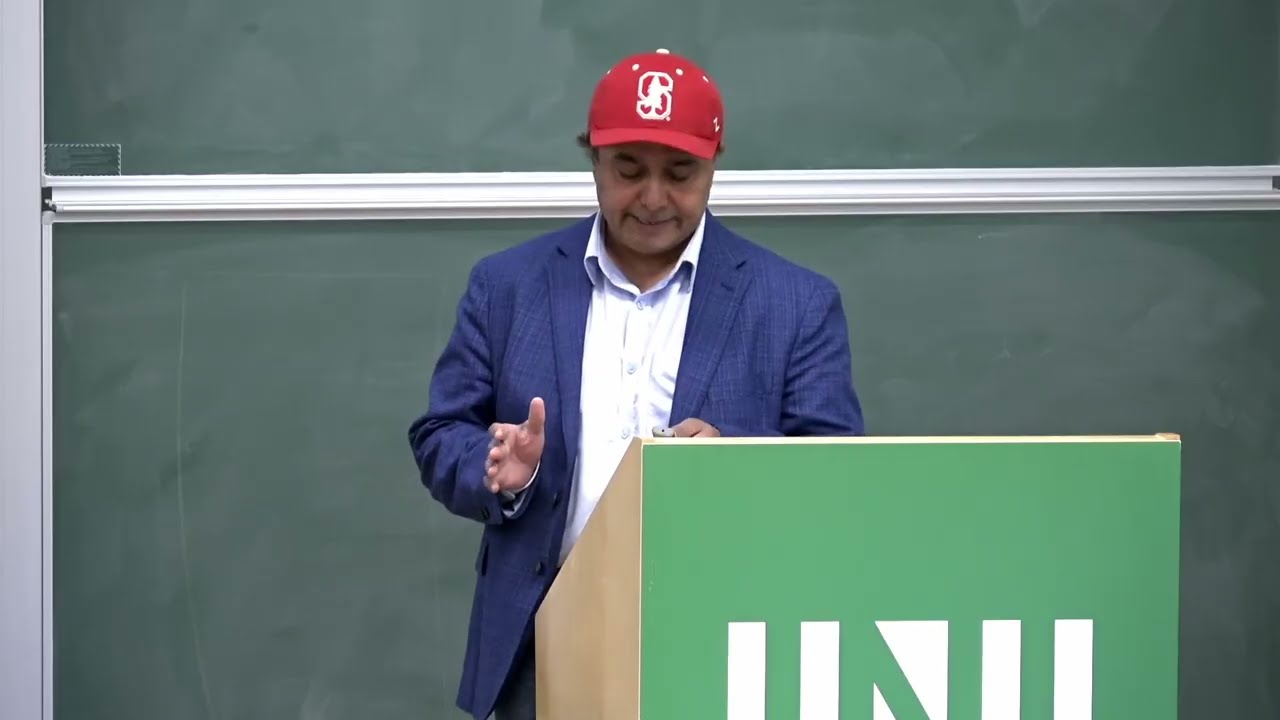
Prof. Vijay Ganesh | Autoformalization of research mathematics, from mizar to bounded arithmetic
Title history
- Prof. Vijay Ganesh | Autoformalization of research mathematics, from mizar to bounded arithmetic — observed on 20261025-1505 UTC (YouTube)
Keywords
Summary
197 words
Critical Evaluation
Value of the Information & Strength of the Argument
The talk provides valuable insights into the current state of AI-based formalization and proof synthesis. The speaker clearly articulates the technical problem, including its inherent limitations (e.g., semantic equivalence is undecidable), and argues for open-source tools as a viable alternative to closed systems. The argumentation is built on analogies to CDCL, which is a powerful explanatory framework, and is grounded in concrete experimental results from the AI Prover tool. However, the presentation is high-level and lacks deep technical detail, and some claims (e.g., the errors found in Lisa’s work) are only mentioned briefly without full context. The reasoning is solid and the overall message is persuasive, though it primarily reflects the author’s own perspective rather than a comprehensive survey.
Scientific Rigor, Source Quality, Title Accuracy
The talk is presented at the Isaac Newton Institute, a prestigious mathematical venue, and the speaker is a recognized expert in formal methods. The sources cited include the tool’s own benchmark (LocalBench) and the book on bounded arithmetic, but detailed references are not provided in the video. The title accurately matches the content: the talk indeed covers autoformalization from Mizar to bounded arithmetic, with emphasis on the AI Prover tool. No external sources are used beyond the speaker’s own work and the description links. The content is rigorous within the scope presented, but the lack of citations and detailed data limits full verification. The audience appears to be academic, and the Q&A suggests engaging discussion, but no statistical comments are available in the provided data.
259 words
Title / Content Match
The title accurately reflects the content: the speaker discusses autoformalization from Mizar to bounded arithmetic, detailing the AI Prover tool and its applications.
Quality & Reliability
8/10
The talk is given by a leading researcher in formal methods and SAT/SMT solvers, and presents original results from a specific tool (AI Prover) within an academic context (INI seminar). The claims are based on experiments described verbally, but detailed data and reproducibility are not provided in the video. Overall, the information is expert and reliable, though not fully verifiable from the video alone.
Key Moments
Markers derived by PSI from the transcript: the creator did not define chapters.
- Speaker introduces himself and his background in formal methods and SAT/SMT solvers.
- Discussion of the tension between formal methods and mathematics communities, proposing a middle path.
- Formal definition of the autoformalization problem and required properties of the output.
- Analogy to CDCL SAT solvers, explaining the student-teacher model and conflict-driven learning.
- Introduction of AI Prover architecture, including semantic alignment and certification-driven evolutionary search.
- Experimental results comparing AI Prover with 39 other tools, showing high accuracy and low cost.
Cited Sources
- Isaac Newton Institute - Seminar 51888 — Official seminar page with details of the talk and related program.
- Isaac Newton Institute for Mathematical Sciences — Main website of the hosting institution.
Contribution & Novelties
The talk contributes an open-source tool (AI Prover) for autoformalization, demonstrating that open-weight agents can achieve competitive performance on research-level mathematics. It also introduces a framework based on CDCL-style student-teacher loops that combines machine learning with symbolic verification, and highlights the importance of proof quality (e.g., faithfulness and abstract jumps). The presenter argues that open-source tools enable mathematicians to shape the proof search to their specific needs, which is not possible with closed-source systems.
Pour aller plus loin :
- CDCL (Conflict-Driven Clause Learning) — A foundational algorithm for SAT solving, directly inspiring the learning loop in AI Prover. No URL provided due to uncertainty.
- Lean theorem prover — The target formal language used in the tool. See https://lean-lang.org (official website).
- Mizar system — A historical formal mathematical language, used as a benchmark source. See https://mizar.uwb.edu.pl (official site).
- Bounded arithmetic — The subject of the benchmark book, related to theories of arithmetic in proof complexity. No URL provided.
- Flywheel project — The proposed AI-curated database for theoretical CS, analogous to Tao City. No URL provided as it is not publicly announced.
180 words
Radar Profile
The radar profile shows high technical level and good quality/quantity of information, but moderate reliability due to limited verifiable details. The tool score reflects the strong emphasis on technical expertise and the presentation of original results, while the reliability is slightly lower because the talk does not provide full references or reproducible data.