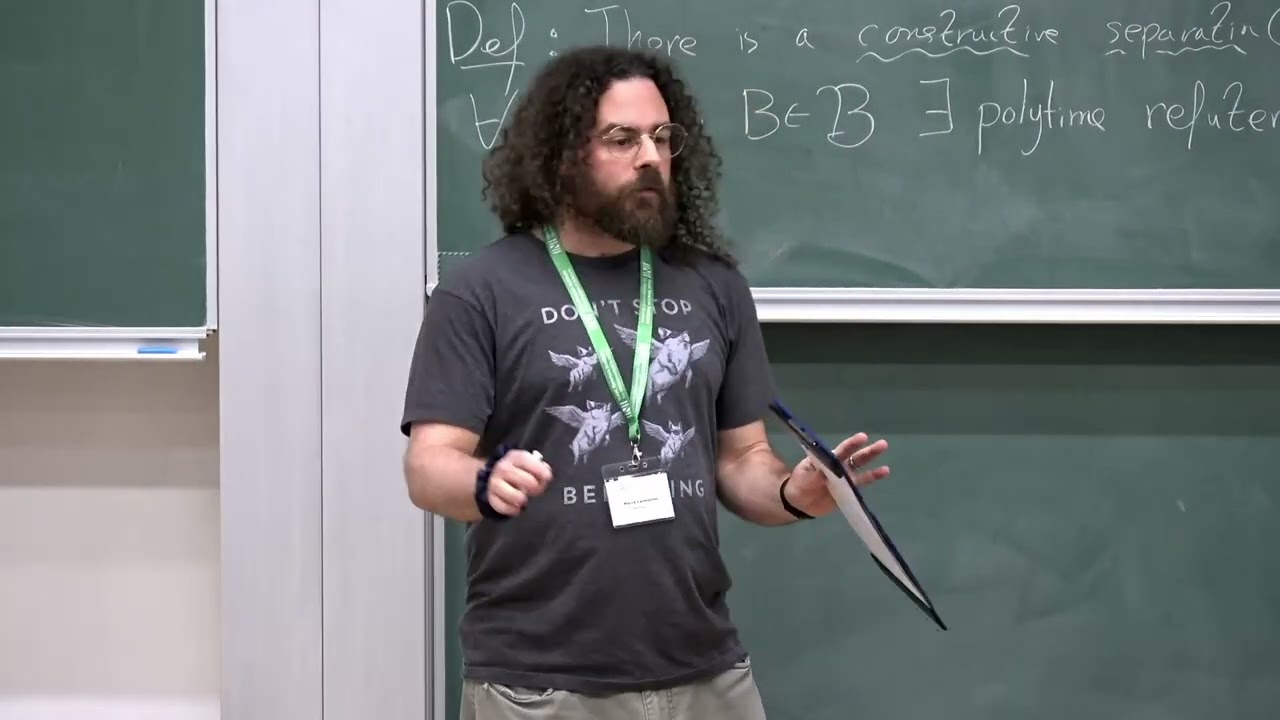
Dr. Marco Carmosino | Constructive separations from gate elimination
Keywords
Summary
170 words
Critical Evaluation
Value of the Information & Strength of the Argument
The talk provides valuable insights into constructive separations as a research direction, linking them to known results and open problems. The argumentation is solid: the speaker starts with motivations, defines concepts clearly, and presents results that support the feasibility of constructive separations. He also highlights surprising consequences, such as that constructivizing a simple lower bound for palindromes would imply breakthrough circuit lower bounds. This demonstrates the depth of the questions. The discussion of gate elimination and its constructivity is also well-founded, with references to recent work and open challenges. The speaker engages with audience questions, which adds to the clarity.
Scientific Rigor, Source Quality, Title Accuracy
The talk references several research papers (e.g., Gutfreund et al. 2005, Chen et al. 2024, etc.) and mentions specific results. However, no slides or explicit citations were visible, but the speaker mentions authors and years. The title accurately reflects the content. The talk is hosted by the Isaac Newton Institute, a reputable research institution, which adds credibility. The speaker’s affiliation with IBM Research also supports expertise. The description provides links to the seminar page and the institute, which can serve as sources for further verification.
200 words
Title / Content Match
The title matches the content: the talk discusses constructive separations and gate elimination as a method to obtain them.
Quality & Reliability
8/10
The talk presents rigorous concepts from complexity theory, referencing multiple research papers. The speaker is an expert (IBM Research) and the talk is part of an Isaac Newton Institute workshop. The arguments are logically structured, with definitions and motivations. However, the talk is a presentation of existing and ongoing work, not a peer-reviewed article, so full verification of claims is not possible.
Key Moments
Markers derived by PSI from the transcript: the creator did not define chapters.
Cited Sources
- Isaac Newton Institute — Institute website.
- Seminar page — Details of the presentation.
Contribution & Novelties
The talk offers an original perspective on constructive separations, but its main contribution is the claim that gate elimination proofs can be constructivized. It discusses recent results and open problems, highlighting the potential of unifying these two areas. The speaker proposes to formalize gate elimination in proof theory, which could lead to a better understanding of its limitations. The talk encourages further research at the intersection of complexity theory and proof theory. Pour aller plus loin :
- Circuit complexity — Overview of circuit lower bounds.
- P versus NP problem — Central open problem motivating constructive separations.
- Bounded arithmetic — Relevant to formalizing proofs.
- Gate elimination — Technique discussed in the talk (note: page may not exist, but concept known).
119 words
Radar Profile
The radar profile shows high scores in quality and technical level, with slightly lower but still strong scores in quantity and reliability. This indicates a dense, technical talk with solid content, suitable for specialists.