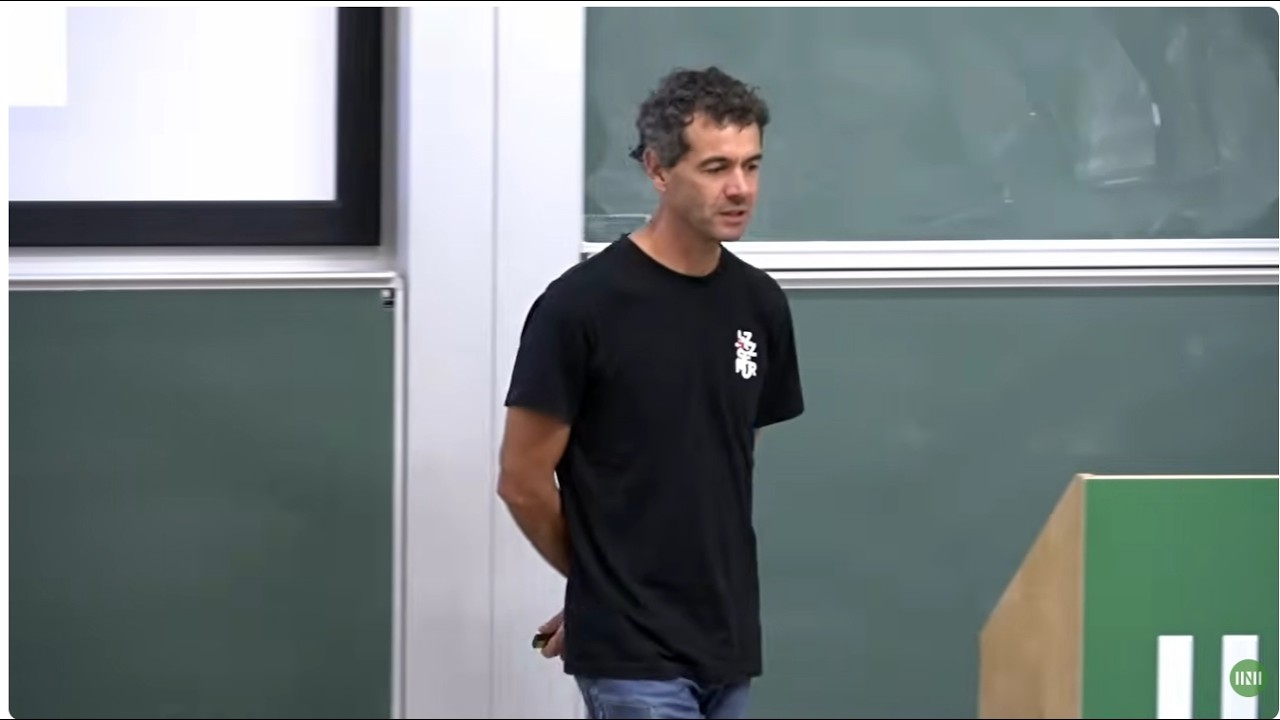
Prof. Julien Vidal | Mutual information in string-nets at finite temperature
Title history
- Prof. Julien Vidal | Mutual information in string-nets at finite temperature — observed on 20261106-1237 UTC (YouTube)
Keywords
Summary
237 words
Critical Evaluation
Value of the Information & Strength of the Argument
The talk presents original results obtained from a series of papers, providing exact formulas for string-net models at finite temperature. The argumentation is rigorous, built on established mathematical frameworks such as fusion categories, Drinfeld centers, and TQFT. The speaker carefully explains each step, from the construction of the Hilbert space to the final computation of the mutual information. He also addresses potential subtleties, such as the internal multiplicity of fluxons and the role of pure fluxons in thermodynamic limits. The results are coherent with known results like the absence of topological order at finite temperature, and provide deeper insights into the behavior of Wilson loops and entanglement measures.
Scientific Rigor, Source Quality, Title Accuracy
The talk is rigorous, with careful derivations and references to the literature. The sources cited are the speaker’s own papers and the workshop page. The title accurately reflects the content. No comments were provided to analyze public reception.
161 words
Title / Content Match
The title accurately reflects the content: a seminar on mutual information in string-net models at finite temperature.
Quality & Reliability
9/10
High scientific rigor, exact mathematical derivations, presented by an established researcher at a prestigious institute.
Key Moments
Markers derived by PSI from the transcript: the creator did not define chapters.
- Introduction and outline: collaboration, three papers, goal of the talk
- Definition of Levin-Wen model, fusion category input, Hamiltonian as commuting projectors
- Hilbert space dimension for Fibonacci category, only depends on number of vertices
- Ground state degeneracy formula in terms of Drinfeld center objects, example of Fibonacci and Ising
- Excitations: fluxons, internal multiplicity, degeneracy of excited states
- Exact partition function for arbitrary graph, topology, and fusion category; thermodynamic limit driven by pure fluxons
- Specific heat per plaquette, no finite-temperature phase transition
- Wilson loops: contractible loops show area law except for pure fluxons; Polyakov loops for non-contractible loops
- Topological mutual information: definition, conjecture by Niblisdier et al., application to Ising category
- Results for Ising category, recovery of zero-temperature entropy, and outlook
Cited Sources
- Isaac Newton Institute for Mathematical Sciences — Host institution and general information about the seminar series
- Seminar page for the talk — Specific event page with details on the workshop and schedule
Concurring Sources
- Levin-Wen model (original paper) — Seminal paper by Levin and Wen defining the string-net model.
- Topological entanglement entropy (Kitaev-Preskill) — Associated concept of topological entropy, related to the mutual information discussed.
Dissenting Sources
Contribution & Novelties
The talk presents novel exact results for string-net models at finite temperature, including an exact partition function valid for any fusion category and any closed orientable surface. It also provides a systematic computation of Wilson loops and topological mutual information, extending prior work that was largely at zero temperature. The approach leverages the construction of the Drinfeld center and the internal multiplicities of fluxons, offering a complete physical picture. This work fills a gap in the literature by providing rigorous finite-temperature analyses for these topologically ordered systems.
Pour aller plus loin :
- String-net condensation — Wikipedia article explaining the concept and its relevance to topological phases.
- Fusion category — Mathematical framework underlying the string-net models.
- Drinfeld center — Construction that yields the excitations of the Levin-Wen model.
127 words
Radar Profile
The radar profile shows a very high technical level (9) and high information quality (9) with slightly lower but still strong scores for quantity (8) and reliability (8), indicating a dense, rigorous, and trustworthy presentation.