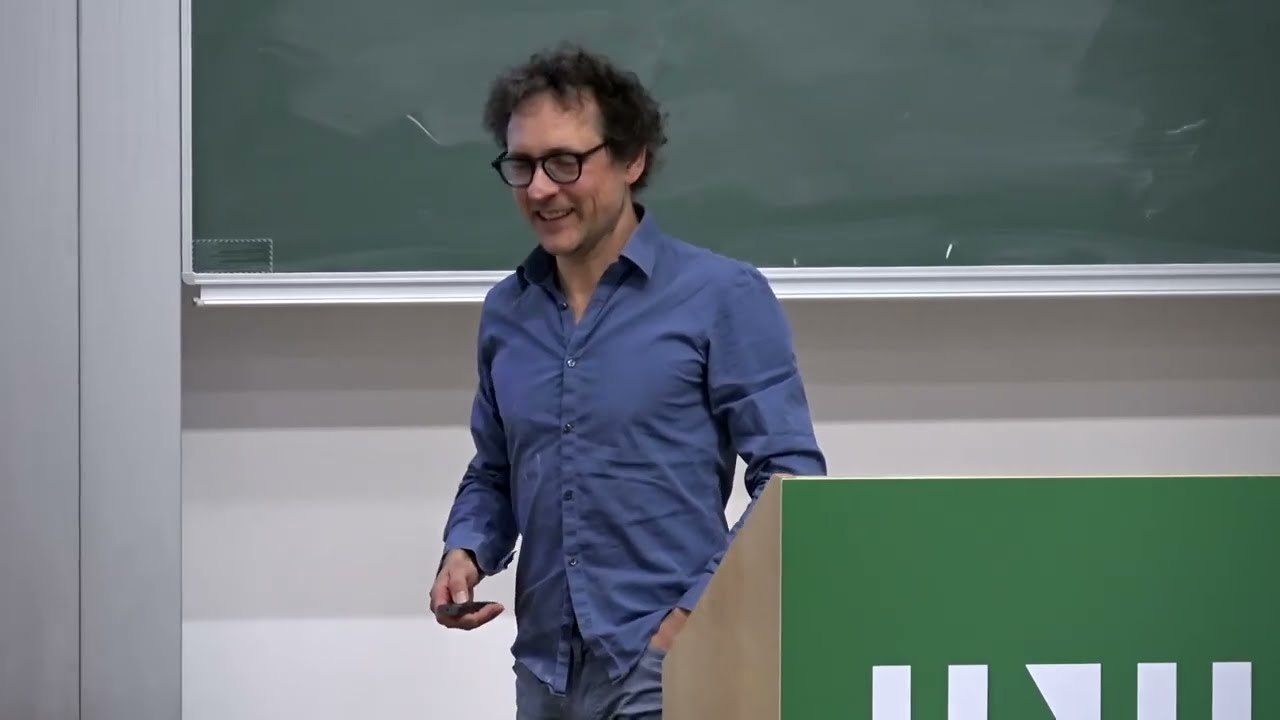
Prof. Wojciech de Roeck | Some simple properties of topologically trivial gapped ground states.
Title history
- Prof. Wojciech de Roeck | Some simple properties of topologically trivial gapped ground states. — observed on 20261106-1211 UTC (YouTube)
Keywords
Summary
168 words
Critical Evaluation
Value of the Information & Strength of the Argument
The talk provides a clear and rigorous derivation of a foundational result in quantum many-body physics: the SRE property of 1D gapped ground states. The argumentation is well-structured, systematically building from definitions and known results (exponential clustering, Lieb-Robinson bounds) to introduce a new concept (trace norm clustering) and demonstrate its utility. The proof is presented with heuristic insights (e.g., the difficulty with Ulam’s theorem and the need for a ‘gentle’ version) and acknowledges technical subtleties, such as the role of rank conditions. The value is high as it closes a gap in the literature and provides a constructive proof that may be adaptable to other contexts.
Scientific Rigor, Source Quality, Title Accuracy
The speaker cites relevant recent works (Hastings, Aumi, and an appendix by Soeno) and references the classical result by Ulam. The scientific rigour is exemplary: the proof is formal, though some steps are only sketched, and the speaker explicitly points out assumptions and open questions. The title matches the content precisely. No comments were provided for analysis; therefore no comment trends are reported.
184 words
Title / Content Match
The title accurately reflects the content: the talk indeed derives simple but fundamental properties for topologically trivial gapped ground states, proving short-range entanglement.
Quality & Reliability
9/10
The talk presents original research by a recognized professor, with a formal proof sketch and references to recent work. The venue (Isaac Newton Institute) ensures high scientific standards. The arguments are rigorous, and the speaker acknowledges limitations and open questions.
Key Moments
Markers derived by PSI from the transcript: the creator did not define chapters.
- Definition of short-range entanglement (SRE) via local evolution from product state.
- Statement of the main theorem: 1D gapped ground states are SRE.
- Introduction of trace norm clustering and its relation to exponential clustering.
- Use of Hastings-Aumi heavy artillery: power-law decay of Schmidt coefficients.
- Construction of local unitary via Ulam theorem and attempt at a 'gentle' version.
- Counterexample to naive gentle theorem; introduction of genuine gentle theorem.
- Iterative construction and conclusion: SRE via exponential localization.
Cited Sources
- Isaac Newton Institute for Mathematical Sciences — Main institute website, providing context for the seminar and the research environment.
- Seminar page for 'Structure of entanglement' (MMBW03) — Direct reference to the specific seminar where the talk was delivered, useful for further details.
Contribution & Novelties
The talk presents a novel proof that all 1D gapped ground states are SRE, filling a gap where previous results only applied to finite-depth circuits. The introduction of trace norm clustering as a tool, derived from exponential clustering and Schmidt coefficient decay, offers a new technical approach. The iterative construction of local unitaries via a refined ‘gentle theorem’ is original. The contribution bridges rigorous mathematical methods and physical intuition.
Pour aller plus loin :
- Short-range entanglement — Foundational concept for understanding SRE states vs. topologically ordered phases.
- Lieb-Robinson bounds — Essential for controlling locality in quantum many-body systems, used implicitly in the proof.
- Quantum circuit — Relates to finite-depth circuits and their role in preparing states.
- Area law for entanglement entropy — Background on why Schmidt coefficients decay, connecting to Hastings’ work.
132 words
Radar Profile
The radar shows very high scores in fiabilité, qualité, and niveau technique, with slightly lower but still strong quantite_information. This profile reflects a dense, rigorous research talk intended for an expert audience.