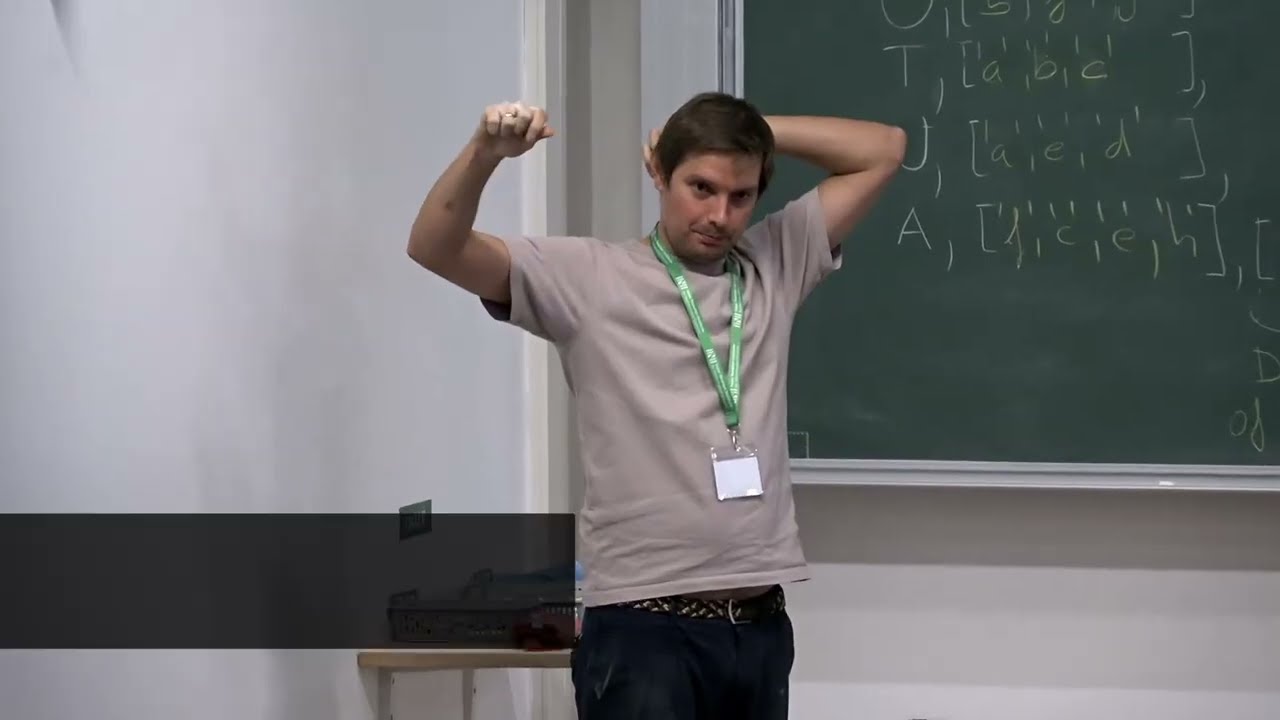
Dr. Juraj Hasik | Tutorials on PEPS Part II
Title history
- Dr. Juraj Hasik | Tutorials on PEPS Part II — observed on 20261028-0955 UTC (YouTube)
Keywords
Summary
161 words
Critical Evaluation
Value of the Information & Strength of the Argument
The information is valuable for practitioners implementing PEPS-based algorithms. The step-by-step construction of CTMRG is well-argued, with clear explanations of normalization, symmetrization, and convergence criteria. The instructor justifies each choice, such as normalizing by the largest absolute entry, and discusses potential pitfalls like numerical asymmetry. The argumentation is solid, grounded in the need for stability and correctness. The inclusion of observational evaluation and exact solution comparison strengthens the credibility of the method. The discussion on contraction path optimization and the impact of ordering on computational complexity adds practical insight. The tutorial effectively bridges theory and implementation, making it highly useful for researchers entering the field.
Scientific Rigor, Source Quality, Title Accuracy
The tutorial demonstrates scientific rigor through methodical explanations and validation against exact results. The instructor references underlying concepts like the transfer matrix and its gap, linking to correlation lengths. The sources cited are limited to the Isaac Newton Institute’s website and seminar page, which provide context but no external literature. The title accurately reflects the content: it is a continuation of PEPS tutorials, focusing on CTMRG. The video does not claim original research; it is an educational resource. The timing and pacing are appropriate for an expert audience. There are no comments provided to analyze, so no public engagement trends are discussed.
222 words
Title / Content Match
The title accurately reflects the content: a second tutorial on Projected Entangled Pair States, focusing on CTMRG algorithm implementation.
Quality & Reliability
8/10
Tutorial from a recognized mathematical sciences institute, with clear and accurate technical content, but no novel research claims.
Key Moments
Markers derived by PSI from the transcript: the creator did not define chapters.
- Explanation of normalization and symmetrization post-processing steps in CTMRG.
- Implementation of the full CTMRG iteration and convergence monitoring.
- Introduction of impurity tensor for computing local observables such as magnetization.
- Construction of single-site environment embedding for observable evaluation.
- Comparison of computed magnetization with analytical solution, showing agreement.
- Discussion on transfer matrix spectrum and correlation length, linking to convergence behavior.
Cited Sources
- Isaac Newton Institute — Organizer of the event and source of the tutorial.
- Seminar page for the event — Details about the tutorial session.
Concurring Sources
- Isaac Newton Institute — Institutional context; consistent with the tutorial's setting.
Contribution & Novelties
The tutorial provides a clear, code-oriented walkthrough of CTMRG, emphasizing practical implementation details that are often glossed over in research papers. It highlights recent improvements in contraction path optimization and the availability of open-source libraries, reducing the barrier for newcomers. The explicit comparison with exact solutions validates the approach.
Pour aller plus loin :
- Tensor network (Wikipedia) — Overview of tensor networks and their applications.
- Corner transfer matrix (Wikipedia) — Background on the method used in CTMRG.
- ITensor library — Open-source library for tensor network simulations.
- TenPy tutorial — Another tensor network library with documentation.
- MPSKit — Julia package for matrix product states and generalizations.
105 words
Radar Profile
The radar profile shows high scores in technical level and quantity of information, reflecting a dense, expert-level tutorial. Quality and reliability are also strong, but not maximal because it is a pedagogical resource rather than novel research. The balance indicates a thorough, well-structured educational tool.