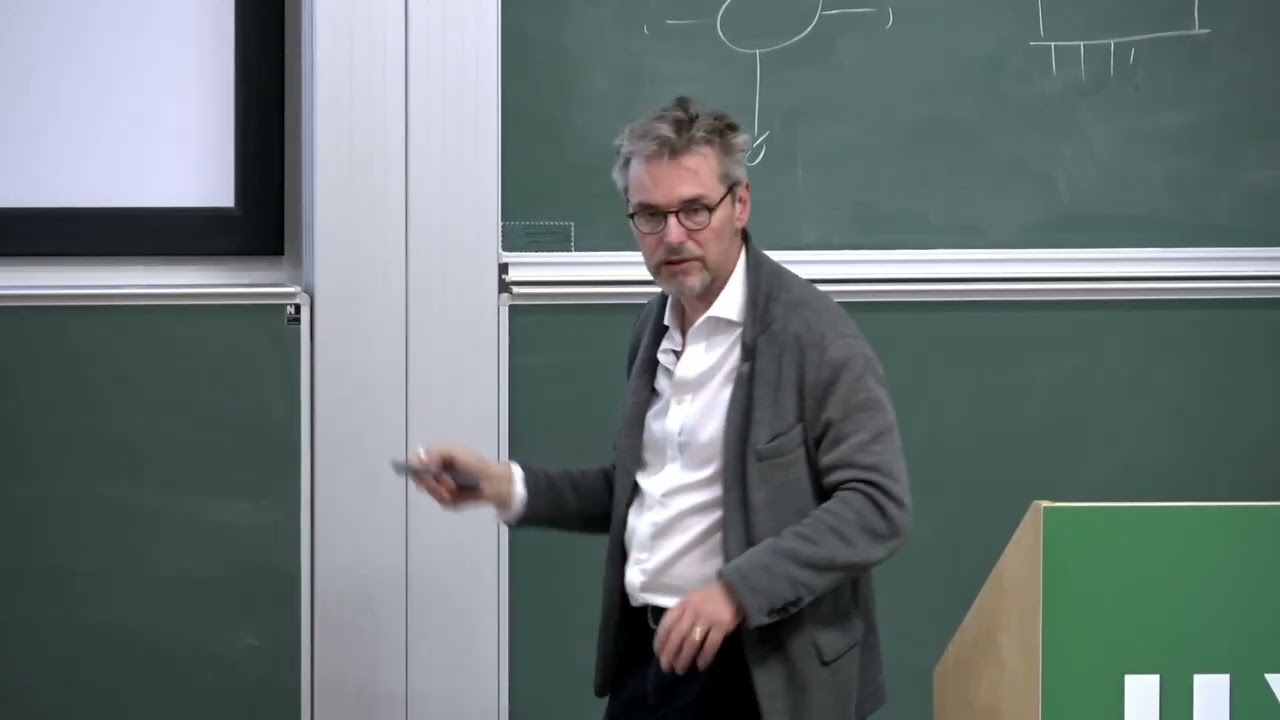
Prof. Andrew Green | Tensor networks for quantum computing
Title history
- Prof. Andrew Green | Tensor networks for quantum computing — observed on 20261030-1307 UTC (YouTube)
Keywords
Summary
206 words
Critical Evaluation
Value of the Information & Strength of the Argument
The talk provides a valuable pedagogical introduction to the intersection of tensor networks and quantum computing, filling a gap by treating tensor networks not just as classical simulation tools but as a design principle for quantum circuits. The argumentation is solid: Green logically builds from the basics of matrix product states to their circuit realization, and then to practical techniques for evaluating observables. He supports his claims with references to recent papers, including those on the contraction of tensor networks and the classical simulation of quantum circuits. The presentation is structured, and the speaker effectively uses diagrams to illustrate the transformations between tensor networks and quantum circuits. The discussion of the cost function for environment calculations is particularly insightful, offering a clear path to implement these algorithms on current quantum hardware.
Scientific Rigor, Source Quality, Title Accuracy
The scientific rigor is high: the speaker is a professor in the field, and the content aligns with published research, including work on tensor network contraction order heuristics and classical simulation of quantum circuits. He cites specific papers (e.g., by Gray, Studemeier, Weintel, Pan Zhang, and Tindall) during the talk, though URLs are not provided in the description. The description includes links to the Isaac Newton Institute and the seminar page, which give context to the talk. The title accurately describes the scope: the talk is indeed about tensor networks for quantum computing. No major discrepancies exist between the title and content, and the depth matches an expert-level seminar.
255 words
Title / Content Match
The title accurately reflects the content: the talk focuses on the use of tensor networks in quantum computing, covering theoretical foundations and practical implementation strategies.
Quality & Reliability
8/10
The talk is delivered by a professor at a recognized institution (UCL) and presents both established results and current research perspectives. The content is structured and logically argued, though it reflects the speaker's personal viewpoint and does not undergo formal peer review in this format.
Key Moments
Markers derived by PSI from the transcript: the creator did not define chapters.
- Introduction and overview of the talk's goals, including the two roles of tensor networks in quantum computing.
- Discussion of tensor networks as a check on quantum supremacy claims, referencing Google's supremacy paper and subsequent classical simulation breakthrough.
- Main mapping: explanation of how a matrix product state in canonical form corresponds to a sequential quantum circuit, with detailed diagram translation.
- Explanation of how to compute environment tensors and local observables using quantum circuits, and the cost-function approach based on Hilbert–Schmidt distance.
- Discussion of translation-invariant states, qubit reuse, and the use of measurement and reset operations, especially for trapped-ion devices.
- Concluding remarks on the value of this perspective and potential future directions.
Cited Sources
- Isaac Newton Institute for Mathematical Sciences — Institutional website of the host organization.
- Seminar page: Prof. Andrew Green | Tensor networks for quantum computing — Official seminar listing with details and possibly resources.
Contribution & Novelties
The talk offers a fresh perspective by using tensor networks as a guiding framework to structure quantum circuits, not just as a classical simulation tool. It provides a clear, step-by-step methodology for translating matrix product states into quantum circuits, including techniques for handling finite-size systems and compressed representations. The proposed cost-function optimization for environment calculations is a concrete, implementable approach for near-term quantum devices. This contribution is original in its explicit focus on leveraging tensor network structures to enhance the efficiency of quantum algorithms, potentially leading to new algorithmic designs.
Pour aller plus loin :
- Tensor network — Background on tensor networks and their uses in physics and computer science.
- Matrix product state — Specific representation of tensor networks, central to the talk.
- Quantum computing — Foundational principles of quantum computation, relevant to the context.
135 words
Radar Profile
The radar chart shows high scores in technical level and information quality, with slightly lower but still strong scores in quantity and reliability. This indicates a dense, expert-level lecture with solid scientific grounding, though it may not be accessible to a general audience.