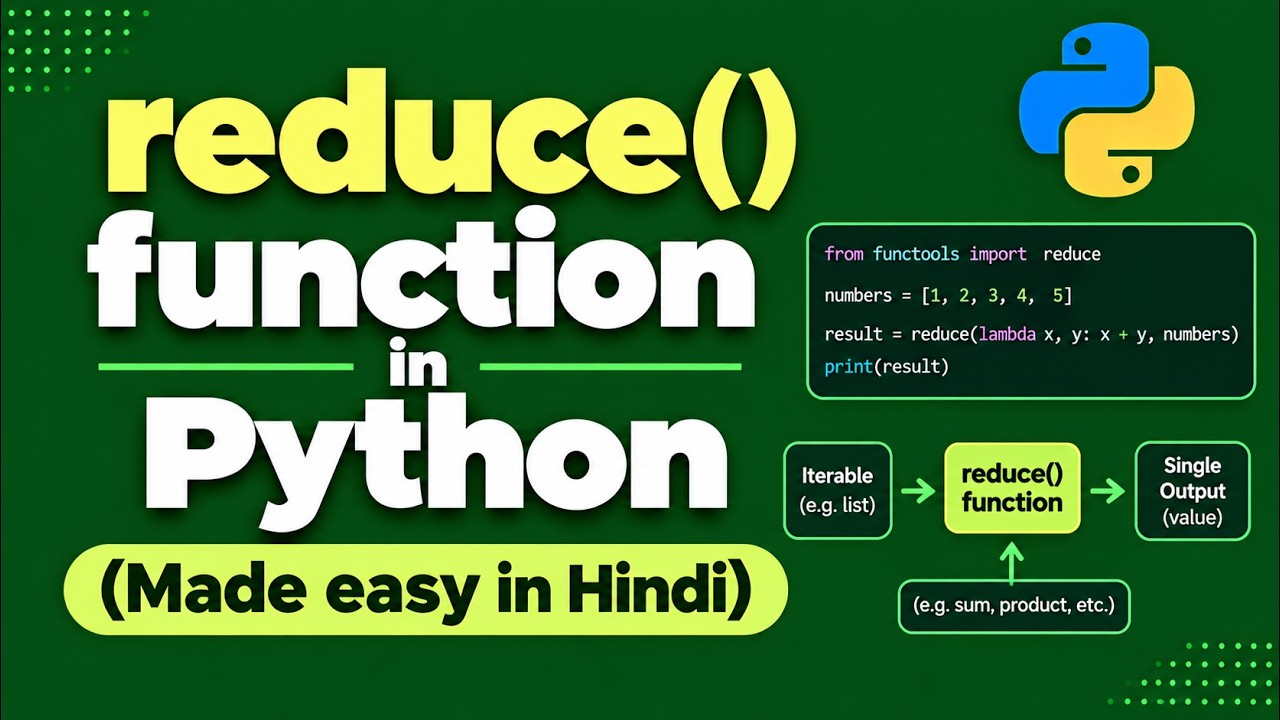
reduce function in Python : Syntax and applications with many examples
Keywords
Summary
154 words
Critical Evaluation
Value of the Information & Strength of the Argument
The video provides solid instructional value for beginners. It systematically breaks down the reduce function, from a basic addition example to manual replication and custom implementation, reinforcing understanding. The argumentation is logical and consistent, with each concept built upon the previous. The use of multiple analogies (e.g., step-by-step pairing) clarifies how reduce works internally. The demonstration of the operator module and initializer parameter broadens practical applicability. The instructor’s explanations are accurate and error-free, though at a fundamental level without delving into performance or edge cases. Overall, the content is reliable and supports learning effectively.
Scientific Rigor, Source Quality, Title Accuracy
The video is an original tutorial produced by the channel without citing external sources. The title accurately describes the content, which is entirely focused on the reduce function with many examples. The technical approach is correct, but the lack of citations or references to official documentation limits verification. The content aligns with standard Python documentation, so reliability is acceptable for tutorial purposes, but not research-grade. No public comments are available for analysis.
181 words
Title / Content Match
Title accurately reflects the content, which is a dedicated tutorial on Python's reduce function with numerous examples.
Quality & Reliability
7/10
Clear step-by-step explanation with multiple examples, correct syntax and logic, but no external references or advanced nuances.
Key Moments
Markers derived by PSI from the transcript: the creator did not define chapters.
- Introduction to reduce function and its two/three parameters.
- First example: sum of list [1,2,3,4] using lambda x,y: x+y.
- Manual implementation with a loop to mimic reduce behavior.
- Creating custom my_reduce function.
- Using operator module (add, mul, sub) as alternatives to lambdas.
- Finding maximum value using reduce with a comparison lambda.
- Demonstration of initializer parameter with an example.
Contribution & Novelties
The video offers a clear, beginner-friendly walkthrough of Python’s reduce function, including manual replication and custom implementation, which reinforces conceptual understanding. It demonstrates practical applications like summation, multiplication, maximum finding, and use with the operator module. While not novel in content, its pedagogical approach of building from scratch is valuable for learners.
Pour aller plus loin :
- Python functools.reduce official documentation — Official reference for reduce, including syntax and examples.
- Functional Programming in Python — Overview of lambda, map, filter, reduce, and other functional tools.
- Python Lambdas Explained — In-depth explanation of lambda expressions, relevant to the video’s heavy use of lambdas.
102 words
Radar Profile
The radar profile shows high quality and reliability scores, moderate quantity of information, and lower technical depth, consistent with a beginner tutorial that is thorough but not advanced.