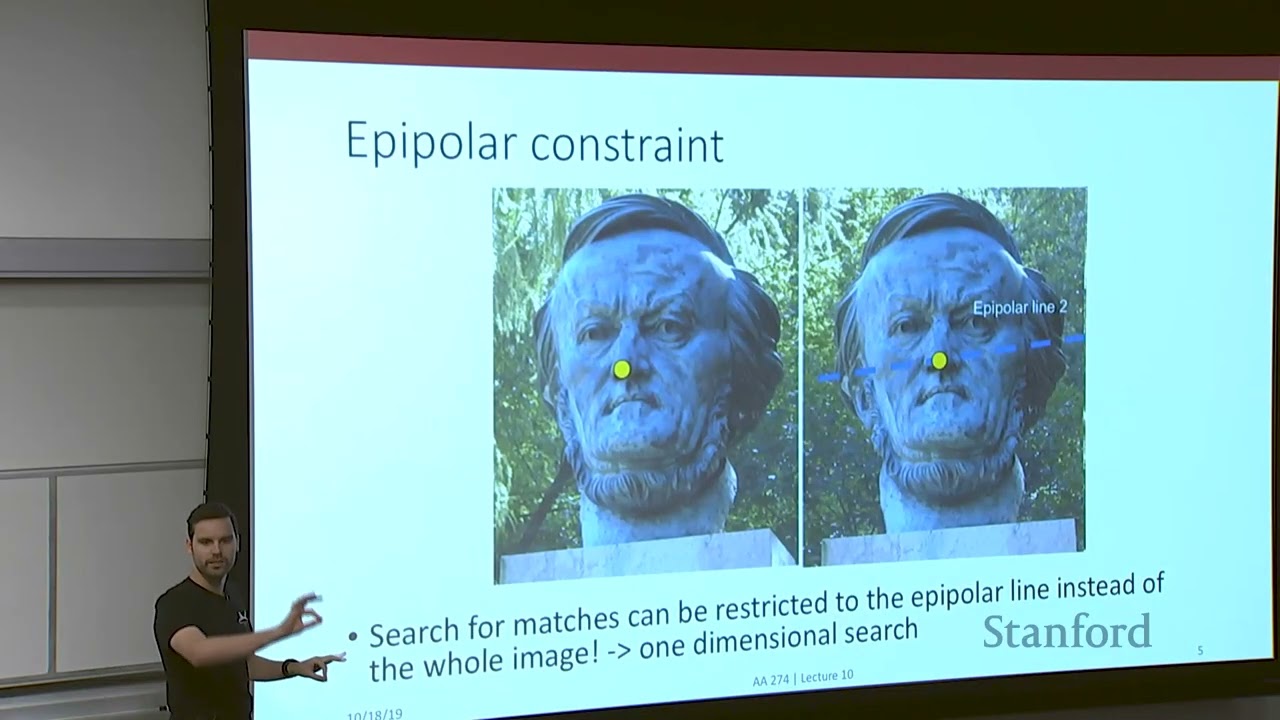
Stanford AA274A Principles of Robotic Autonomy | Autumn 2019 | Stereo Vision
Keywords
Summary
183 words
Critical Evaluation
Value of the Information & Strength of the Argument
The lecture provides a comprehensive and well-structured introduction to stereo vision, starting from geometric foundations and progressing to practical algorithms. The argumentation is logical and step-by-step: after establishing the need for stereo correspondence, it derives the epipolar constraint and the fundamental matrix, then demonstrates how this reduces the matching problem from 2D to 1D. The inclusion of the eight-point algorithm and the discussion of numeric implementation (SVD, normalization) ground the theory in practical estimation. The comparison of area-based and feature-based matching methods highlights the trade-offs between density and robustness, which is crucial for real-world robotic applications. The treatment of disparity and depth calculation ties the concepts back to the physical 3D world. The instructor also addresses student questions, clarifying ambiguities and reinforcing key ideas, which strengthens the tutorial value. Overall, the content is valuable for anyone seeking a rigorous understanding of classical stereo vision techniques.
Scientific Rigor, Source Quality, Title Accuracy
The lecture is based on the textbook ‘Principles of Robot Autonomy’ (available online), and the course materials are from Stanford’s graduate program. The mathematical derivations are consistent with standard computer vision textbooks (e.g., Hartley & Zisserman). The instructor is a well-known researcher in autonomous systems, with a strong publication record. The title accurately describes the lecture content: it is a lecture on stereo vision within the course ‘Principles of Robotic Autonomy’. The lecture uses standard notation and clearly states assumptions. The lecture is recorded as part of the 2019 edition, and the provided links to the latest course materials are appropriate. No specific external sources are cited within the lecture, but the companion textbook is referenced. The content’s rigor is high, though it does not present novel research; it is an educational exposition of established methods.
296 words
Title / Content Match
The title accurately reflects the lecture content: a course lecture on stereo vision within the Principles of Robotic Autonomy series.
Quality & Reliability
8/10
Rigorous academic lecture by a Stanford professor, covering foundational principles of stereo vision with mathematical derivations and algorithmic details. The content is consistent with established computer vision literature, and the speaker is a recognized expert in autonomous systems.
Key Moments
Markers derived by PSI from the transcript: the creator did not define chapters.
- Introduction to the problem of 3D reconstruction from images and the need for stereo vision
- Definition of epipoles, epipolar lines, and the epipolar constraint
- Mathematical derivation of the fundamental matrix F
- Properties of the fundamental matrix: singularity and up-to-scale
- Using F to find epipolar lines and resize search space to 1D
- Estimation of F using the eight-point algorithm and least squares
- Image rectification to standardize epipolar lines to horizontal
- Area-based vs feature-based correspondence matching methods
- Disparity and depth calculation: relation between baseline, focal length, and disparity
Cited Sources
- Stanford Online Graduate Education — Information about Stanford graduate programs
- Principles of Robot Autonomy (Companion Textbook) — Free online textbook referenced as the companion reading
- Course Schedule and Syllabus (PoRA-I) — Latest course schedule and syllabus
- Full playlist of AA274A lectures — Playlist containing the lecture video
Contribution & Novelties
This lecture provides a thorough pedagogical treatment of classical stereo vision, emphasizing the epipolar geometry and the fundamental matrix as the core tools for correspondence and 3D reconstruction. It concisely explains the trade-offs between dense area-based matching and sparse feature-based matching, and the importance of rectification for computational efficiency. The mathematical derivations are clear, and the eight-point algorithm is presented with its practical steps (least squares and SVD). The session also clarifies common misconceptions through student interaction. For further exploration, several concepts are directly linked:
Pour aller plus loin :
- Epipolar geometry — Background on the geometric relations between two views.
- Fundamental matrix (computer vision) — Detailed discussion on the fundamental matrix and its properties.
- Eight-point algorithm — Additional details on the algorithm for estimating the essential/fundamental matrix.
- Disparity (stereo vision) — Explanation of disparity and depth estimation.
138 words
Radar Profile
The radar profile is high across all metrics (information quantity, quality, technical depth, global reliability), indicating a dense, well-founded, and technically advanced lecture with strong educational value.