Stanford CS547 HCI Seminar | Autumn 2026 | Designing AI for Societal Good
Keywords
Summary
167 words
Critical Evaluation
Value of the Information & Strength of the Argument
The talk offers a compelling and original argument that reframes the typical ‘build a better app and call for policy’ approach. The speaker provides strong historical evidence from HCI (smartphone overuse, civic monitoring) to support her claim that harm measurement systems are often more effective catalysts for change than harm-free redesigns. She logically deconstructs the deadlock created by the cost of AI-based measurement and the prerequisite of public opinion for policy funding. The argumentation is coherent and well-structured, building from empirical findings to a practical design agenda. The value lies in shifting designers’ attention from idealistic but powerless artifacts to strategic, systemic interventions that operate on longer timescales. She acknowledges uncertainties and the need for multiple pathways, and her suggestions are concrete and actionable for system builders.
Scientific Rigor, Source Quality, Title Accuracy
The presentation is scientifically rigorous: it synthesizes literature from STS and HCI, draws on a CHI workshop with over 80 international researchers, and includes a thought summit with domain experts. However, specific citations for the historical cases (e.g., smartphone overuse research) are not explicitly named in the transcript, and the talk relies more on anecdotal evidence and expert consensus than on published metrics. The title accurately reflects the content and scope, and the description provides links to Stanford’s graduate programs and the HCI seminar schedule, which serve as general references rather than direct sources for the claims. The talk itself does not overstate its conclusions and explicitly notes the difficulty of proving causal societal impact, which enhances credibility.
260 words
Title / Content Match
The title accurately reflects the content: a seminar lecture on designing AI for societal good, with concrete case studies and a proposed design approach.
Quality & Reliability
8/10
The talk presents well-reasoned empirical research and design practice, grounded in a literature review and expert discussions. It acknowledges limitations and complexities, and proposes a novel framework for AI design. The speaker is a professor with relevant expertise.
Key Moments
Markers derived by PSI from the transcript: the creator did not define chapters.
- Introduction: motivation for studying societal impacts of generative AI
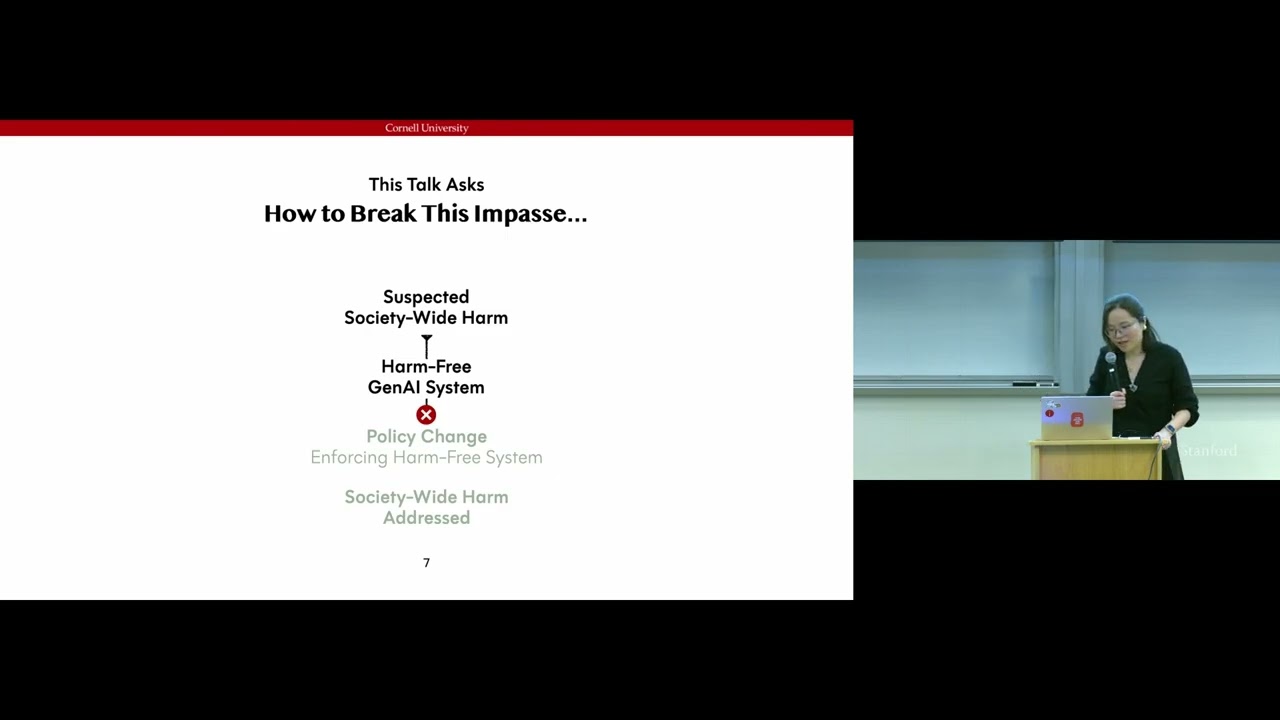
- The central question: how to break the deadlock between system design and policy influence
- First empirical project: learning from history of HCI policy impact via CHI workshop
- Findings: harm measurement systems are more effective than harm-free redesigns
- The cost and funding deadlock for AI-based harm measurement
- Design principle: 'designing AI as planting seeds' and examples from current work
- Conclusion and Q&A beginning
Cited Sources
- Stanford HCI Seminar Schedule — Official seminar series page where this talk is hosted
- Stanford Online Graduate Education — General Stanford graduate programs info as linked in description
Concurring Sources
- Stanford HCI Seminar Schedule — Institutional context for the seminar; no direct contradiction.
Contribution & Novelties
The talk contributes a novel conceptual framework for AI designers: rather than building ‘harm-free’ applications, they should build systems that measure harm and actively seed changes in public opinion, policy, and business models. This shifts the focus from individual user experience to systemic societal impact, and offers a pragmatic path forward despite measurement challenges. The historical analysis of HCI’s successful policy interventions provides a concrete playbook, and the identification of the cost deadlock for AI-based harm measurement is a fresh insight that has not been widely discussed.
Pour aller plus loin :
- Science and Technology Studies — STS provides theoretical background on how technologies influence society and policy, which underpins the speaker’s analysis.
- Human–Computer Interaction — The field in which the talk is situated, with a history of policy-relevant research.
- Artificial Intelligence Ethics — Related to the responsible design of AI systems and their societal impacts.
146 words
Radar Profile
The radar profile shows strong scores in information quantity and quality, with moderate technical difficulty. The balanced profile indicates a substantive academic talk that is accessible yet intellectually rigorous, with slightly lower scores in technical depth reflecting its focus on design and policy rather than algorithmic details.