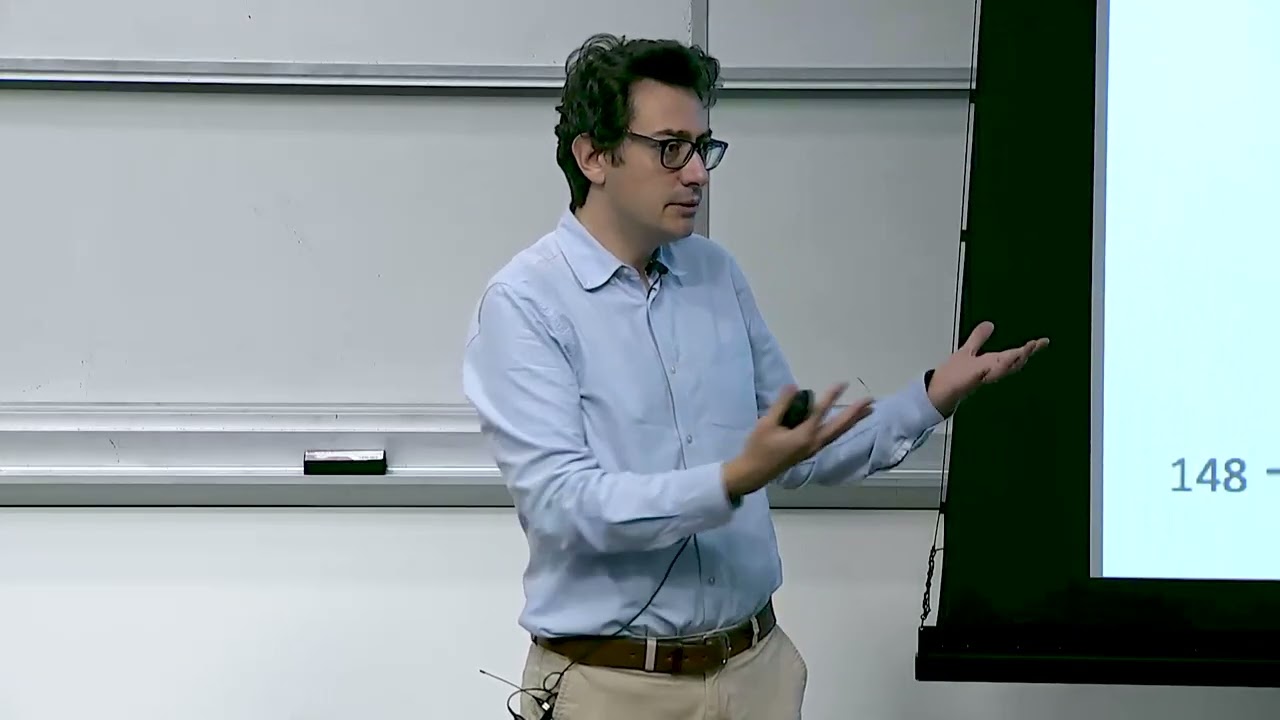
Stanford AA274A Principles of Robotic Autonomy | Autumn 2019 | Image Processing
Keywords
Summary
106 words
Critical Evaluation
Value of the Information & Strength of the Argument
The lecture provides a solid foundation in classical image processing techniques, which are essential for robotic perception. Professor Pavone explains each concept with clear intuition and mathematical formalism, and effectively connects them to real-world applications. The argumentation is logical: it starts with the need for filtering, then progresses to feature detection via derivatives. The use of examples (e.g., butterfly image) helps illustrate abstract ideas. However, the lecture does not cover modern deep-learning approaches, limiting its scope to classical methods. The speaker’s expertise and clear explanation style strengthen the overall value.
Scientific Rigor, Source Quality, Title Accuracy
The lecture is scientifically rigorous, based on established image processing principles. Professor Pavone references the course textbook and provides additional resources via the description links. The title accurately reflects the content, and the lecture structure follows a coherent pedagogical flow. No external sources are explicitly cited during the presentation beyond the course materials, but the content is standard and well-known. The description includes links to the textbook and course schedule, which serve as reliable references. There were no misleading claims or unsupported assertions.
188 words
Title / Content Match
The title accurately describes the content: a lecture on image processing within a robotic autonomy course. It includes the course code and session, and the content matches exactly.
Quality & Reliability
9/10
Lecture by a Stanford professor with deep expertise in robotics and autonomous systems. The content is rigorous, well-structured, and aligns with established image processing theory. No commercial bias or unsubstantiated claims.
Key Moments
Markers derived by PSI from the transcript: the creator did not define chapters.
- Introduction to computer vision pipeline: filtering, detection, description, high-level processing.
- Representation of images as 2D functions; explanation of pixel coordinates and intensity ranges.
- Definition of spatial filters: neighborhood and operation; correlation formula and example.
- Convolution vs correlation, associativity property, and separability for computational savings.
- Discrete image derivatives and their role in edge detection; preview of next lecture.
Cited Sources
- Stanford Graduate Education — Program information for graduate studies at Stanford.
- Principles of Robot Autonomy (textbook) — Companion textbook for the course, referenced for deeper learning.
- Course syllabus and schedule — Latest course materials and schedule.
- Full playlist — All lectures in the AA274A series.
Concurring Sources
- Principles of Robot Autonomy — The companion textbook aligns with the lecture content.
Contribution & Novelties
The lecture offers a clear, rigorous exposition of classical image processing methods, particularly spatial filtering and feature detection. It is notable for its pedagogical clarity and connection to robotic autonomy applications. The lecture does not present new research but serves as an authoritative synthesis of well-established techniques.
Pour aller plus loin :
- Sobel operator — A discrete differentiation operator widely used for edge detection.
- Harris corner detector — An algorithm for detecting corners, directly relevant to feature detection.
- Scale-invariant feature transform (SIFT) — A robust feature description method used in matching across images.
93 words
Radar Profile
The radar profile shows uniformly high scores across all dimensions, reflecting strong technical depth, clear communication, and reliable content. The lecture excels equally in information richness, accuracy, technical level, and credibility.