Care that measures itself: Quality systems, protocol-driven practice, and where AI actually helps
Keywords
Summary
177 words
Critical Evaluation
Value of the Information & Strength of the Argument
The talk provides valuable practical insights into the real-world application of quality systems and informatics from a seasoned clinician. The argumentation is coherent, moving from the importance of quality measurement to the bottlenecks of manual data extraction, then to the limitations of existing systems and the potential of LLMs. The speaker supports claims with concrete examples (e.g., heart failure, BMT unit) and references to recognized standards, making the reasoning persuasive. The emphasis on the need for closed-loop systems and the caution regarding LLM limitations demonstrates balanced critical thinking.
Scientific Rigor, Source Quality, Title Accuracy
The presentation draws on authoritative sources such as JC, WHO’s ICD-10, SNOMED CT, LOINC, RxNorm, and FHIR standards, as well as Kahneman’s ‘Thinking Fast and Slow’. While no explicit academic citations are provided, the speaker’s hands-on involvement in building informatics systems lends credibility. The title accurately reflects the content, focusing on the theme of quality self-measurement and AI’s role, without overstating technical details. The talk is opinionated but grounded in practical experience, though it would benefit from deeper referencing.
182 words
Title / Content Match
The title aptly captures the core themes: quality measurement, protocol-based practice, and the role of AI in automating data extraction and performance evaluation.
Quality & Reliability
8/10
The talk is based on the speaker's extensive clinical and informatics experience, with references to established frameworks (JC, ICD-10, SNOMED CT) and well-known works (Kahneman). While primarily opinion, it offers practical insights grounded in real-world implementation.
Key Moments
Markers derived by PSI from the transcript: the creator did not define chapters.
- Introduction of Dr John Tilley and the topic on quality systems and AI in medicine.
- Dr Tilley starts by explaining the importance of quality due to high healthcare costs and the changing role of physicians with AI.
- Discussion of basic quality system model (input-process-output) and parallels with aviation and manufacturing.
- Reference to JC accreditation, the need for defined protocols and quarterly outcome measurement, and the labor-intensive process.
- Highlight of the human brain's poor cause-effect connection over time, citing Kahneman's book.
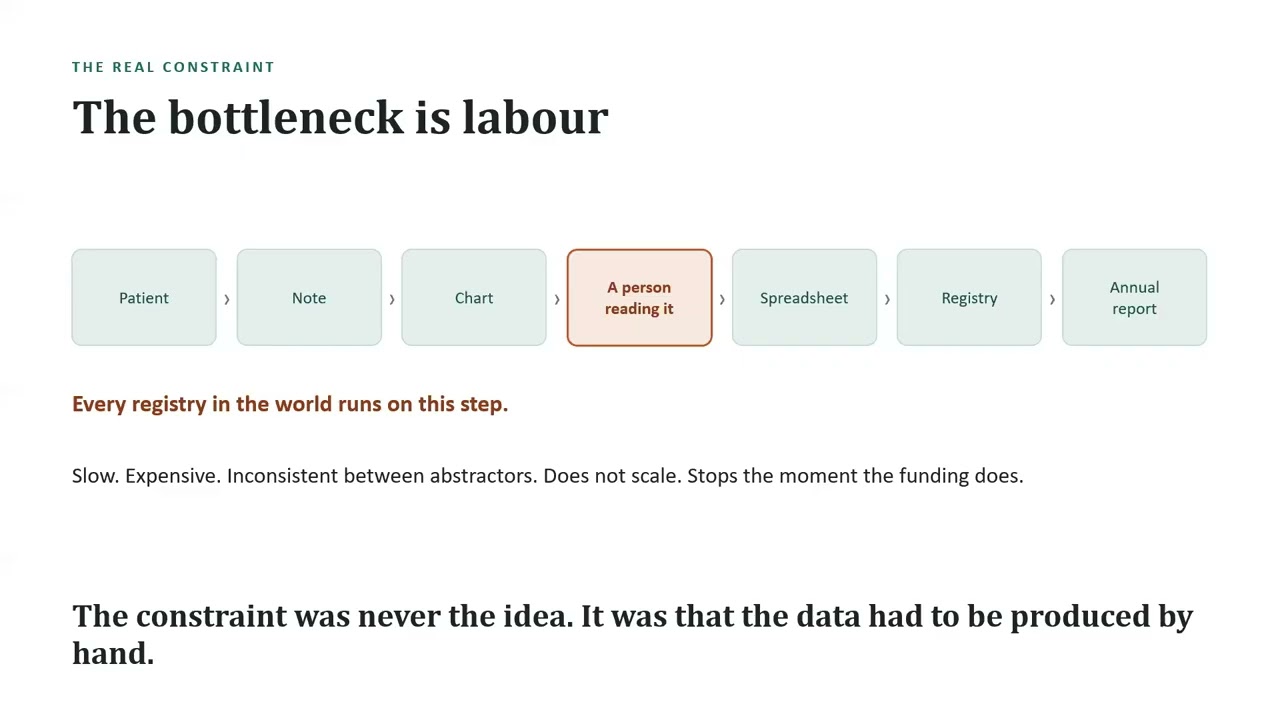
- The bottleneck of quality implementation: manual data extraction and the need for automation.
- Critique of EHRs: they shift costs to clinicians and don't solve reasoning; example of Obama administration's push for EHRs.
- Review of coding systems: ICD-10 limitations, SNOMED CT ontology, LOINC, RxNorm, NAPPI.
- Introduction of FHIR as a data standard for interoperability and patient data access.
- Discussion of UMLS and NLP, and how LLMs have simplified concept extraction, but with nondeterminism issues.
- Proposed pipeline: converting all patient data into text, using LLMs to create codable datasets, but scalability limits remain.
Contribution & Novelties
The talk offers a clinician’s perspective on bridging quality measurement and AI by automating data extraction using LLMs, grounded in hands-on implementation experience. It synthesizes existing standards (ICD-10, SNOMED CT, FHIR) with novel workflow ideas, emphasizing closed-loop quality systems that are often neglected in practice.
Pour aller plus loin :
- ICD-10 — Overview of the WHO coding system, its population-level design, and limitations in clinical detail.
- SNOMED CT — Description of the clinical ontology and its role in semantic interoperability.
- FHIR — Fast Healthcare Interoperability Resources standard for exchanging healthcare data.
- UMLS — The Unified Medical Language System and its metathesaurus.
- Large language model — Background on LLMs and their applications in natural language processing.
- Thinking Fast and Slow by Daniel Kahneman — Reference on cognitive biases affecting feedback loops (no URL).
132 words
Radar Profile
The radar shows balanced scores across quantity, quality, and technical level, with reliability slightly higher, reflecting the speaker's practical expertise. The presentation is information-dense yet accessible, aligning with the intended academic audience.