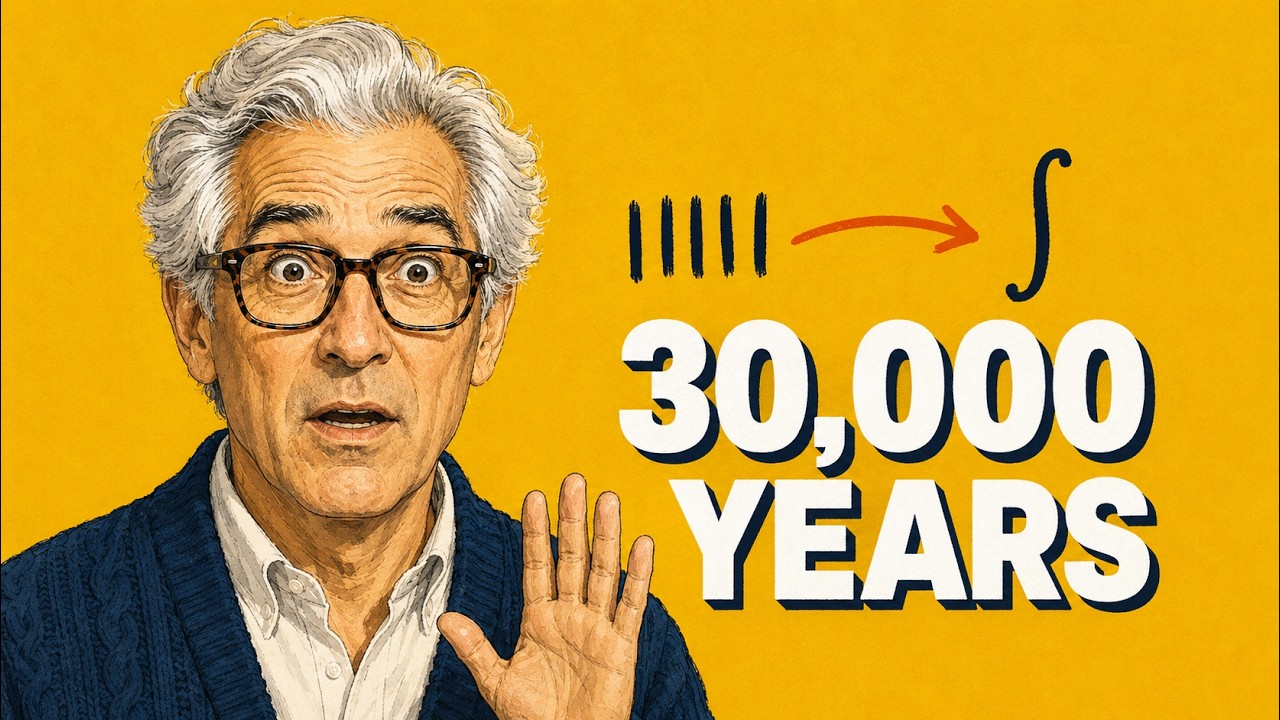
30,000 Years of Math - How Far Have We Actually Come?
Title history
- 30,000 Years of Math - How Far Have We Actually Come? — observed on 20261101-0100 UTC (YouTube)
Keywords
Summary
166 words
Critical Evaluation
Value of the Information & Strength of the Argument
The video excels at making abstract concepts intuitive through vivid examples and clear visual analogies, such as representing multiplication by -1 as a rotation and i as a quarter turn. The argumentation is coherent and builds progressively, linking each historical development to the next. The explanation of imaginary numbers as perpendicular is particularly illuminating, addressing the confusion in a way that is accessible without oversimplifying. The discussion of Gödel’s incompleteness is accurate in its essence, though simplified appropriately for a general audience. The value lies in reframing mathematical history as a human struggle rather than a set of static rules.
Scientific Rigor, Source Quality, Title Accuracy
The video cites specific historical documents and figures, including the Dolní Věstonice bone, Rhind Papyrus, Brahmagupta’s work, Cardano’s Ars Magna, and the contributions of Gauss, Lobachevsky, Cantor, and Gödel. These references give authenticity to the narrative. However, no direct sources or links are provided in the description, limiting the ability to verify claims independently. The title accurately reflects the content, which surveys the evolution of mathematical thought. The presentation is rigorous in its adherence to historical facts, though some simplifications are necessary for a broad audience.
201 words
Title / Content Match
The title accurately reflects the content, which surveys 30,000 years of mathematical history leading to the concept of imaginary numbers.
Quality & Reliability
8/10
The video presents a well-structured historical narrative with accurate references to key mathematical developments, though some simplifications are inherent to the medium.
Chapters
- The imaginary number your math class never explained
- A 30,000 year old wolf bone and how numbers left objects behind
- Why Sumer counted in 60s and how Egypt measured pi
- Brahmagupta writes rules for zero, then Florence bans the digits
- Cardano's cubic formula demands the square root of a negative
- Non Euclidean geometry, Cantor's infinities and Godel's limit on proof
- What 30,000 years of mathematics actually adds up to
Cited Sources
- Rhind Papyrus — Mentioned as an Egyptian mathematical document containing a rule for circle area.
- Brahmasphuta-Siddhanta — Brahmagupta's 628 text introducing zero as a number with arithmetic rules.
- Ars Magna — Cardano's 1545 book that published the cubic formula, leading to imaginary numbers.
Contribution & Novelties
This video’s original contribution is its synthesis of mathematical history with a focus on the often-overlooked story of imaginary numbers, presenting them as a natural consequence of geometric reasoning. It makes a compelling case that these numbers are not ‘imaginary’ but ‘perpendicular,’ offering a fresh pedagogical approach. It also connects modern physics applications, showing that the ‘impossible’ is universal.
Pour aller plus loin :
- Non-Euclidean geometry — Explores geometries where Euclid’s parallel postulate fails, central to the video’s discussion of Lobachevsky.
- Cantor’s diagonal argument — The proof that infinite sets have different sizes, as described in the video.
- Gödel’s incompleteness theorems — The result that any consistent system of arithmetic contains unprovable truths.
113 words
Radar Profile
The profile shows balanced strengths across information quantity and quality, with slightly lower technical level due to its popularization focus, and robust reliability given its historical accuracy.