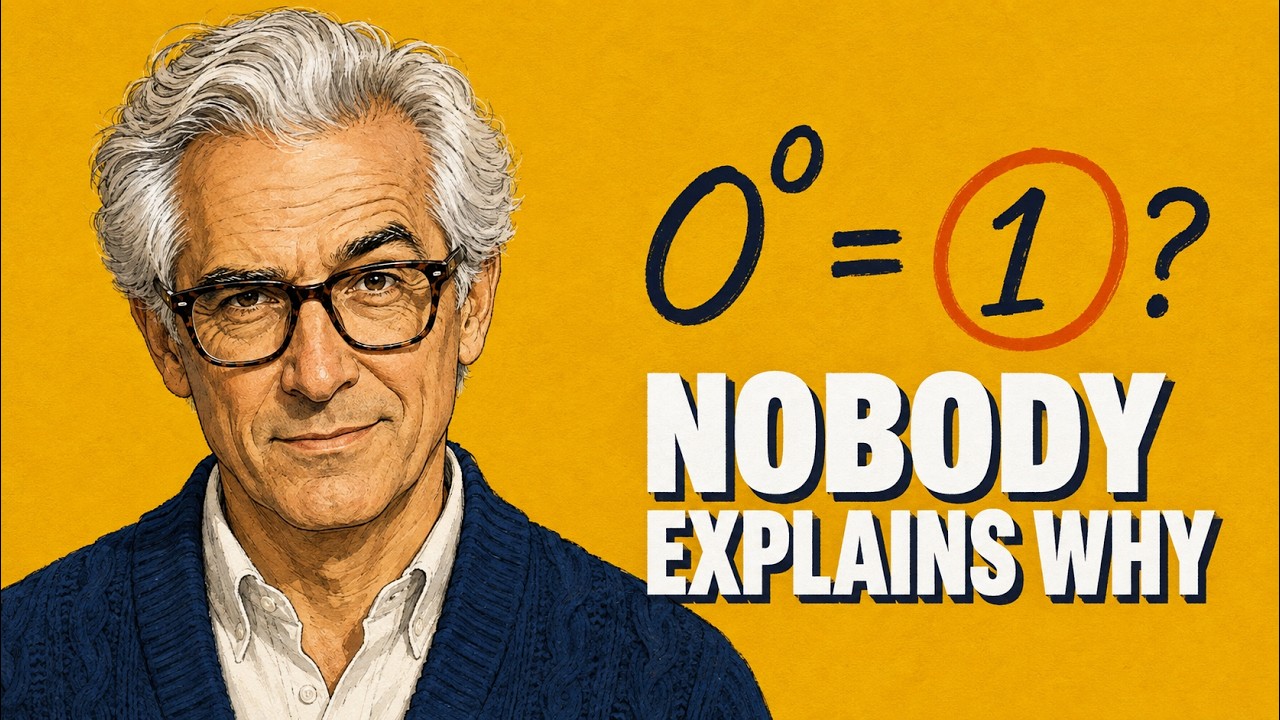
Why 0⁰ = 1? (Proven, Not Just a Convention)
Title history
- Why 0⁰ = 1? (Proven, Not Just a Convention) — observed on 20261101-0056 UTC (YouTube)
Keywords
Summary
221 words
Critical Evaluation
Value of the Information & Strength of the Argument
The video delivers substantial value by clearly explaining a subtle mathematical issue that often confuses students and even professionals. It presents multiple logical arguments—from pattern inference and the multiplicative identity to the binomial theorem—and contrasts them with limit-based reasoning. The argumentation is solid, systematically showing why algebra forces 0^0 = 1 while calculus leaves it indeterminate. The use of historical context enriches the explanation, and the analogy of a tug-of-war and a landscape effectively conveys the concept of varying limits. The narrator also cites Donald Knuth’s forceful stance in favor of 1 for combinatorial consistency. Overall, the reasoning is rigorous and well-paced, making complex ideas accessible without sacrificing correctness.
Scientific Rigor, Source Quality, Title Accuracy
The video demonstrates strong scientific rigor by grounding its explanation in primary sources: Euler’s ‘Vollständige Anleitung zur Algebra’ (1770), Cauchy’s ‘Cours d’analyse’ (1821), and the 1830 Libri–Möbius dispute, as well as Knuth’s ‘Concrete Mathematics’ (1989). These references lend authority to the claims. The presentation is accurate and avoids oversimplification, though it deliberately omits technical details about multidimensional limits for clarity. The title ‘Why 0⁰ = 1? (Proven, Not Just a Convention)’ aligns with the video’s algebraic proof, but the content eventually broadens to show that 0^0 is not universally 1, making the title slightly narrower than the full scope. Still, the core message—that 0^0=1 is not arbitrary but logically required in certain contexts—is faithfully conveyed.
239 words
Title / Content Match
The title emphasizes that 0^0 equals 1 is proven in an algebraic context, and the video supports this with a proof, while also acknowledging the indeterminate nature in calculus. The title is broadly accurate, though it underplays the context-dependency that the video ultimately explains.
Quality & Reliability
8/10
The video provides a clear, well-structured explanation of the 0^0 debate, correctly presenting historical evidence and mathematical reasoning. It distinguishes between algebraic and limit-based interpretations without oversimplifying, and cites primary sources such as Euler's and Cauchy's works. The only minor limitations are the lack of detailed references and omission of technical nuances in multidimensional limits, but overall the content is accurate and pedagogically sound.
Chapters
- The calculator contradiction nobody explains
- Why the school definition of exponents breaks
- The algebra proof that forces zero to the zero to one
- The real 200 year fight between Euler and Cauchy
- Why calculus calls it an indeterminate form
- The binomial theorem proof algebra can't escape
- Why both answers are actually correct
Cited Sources
- Vollständige Anleitung zur Algebra (Complete Guide to Algebra) — Euler's 1770 textbook where he asserts 0^0 = 1 based on the rule that any number to the power of zero is one.
- Cours d'analyse — Cauchy's 1821 work that classifies 0^0 as an indeterminate form, alongside 0/0.
- Libri's 1830 paper and Möbius's support — Historical dispute where Libri argued for 0^0 = 1 and Möbius provided a limiting argument, later challenged by an anonymous critic.
- Concrete Mathematics — 1989 book by Graham, Knuth, and Patashnik, where Knuth emphatically states that 0^0 must be defined as 1 for the binomial theorem.
Contribution & Novelties
The video’s unique contribution lies in its balanced presentation of the 0^0 debate, showing that both answers are correct within their respective mathematical frameworks. It skillfully interweaves historical narrative with mathematical reasoning, making the subject engaging and easy to grasp. The analogy of mathematics as a language with context-dependent meanings is a fresh perspective that helps resolve the apparent contradiction for viewers.
Pour aller plus loin :
- 0^0 on Wikipedia — Provides an overview of the various interpretations and historical background.
- Indeterminate form on Wikipedia — Explains the concept of indeterminate forms and why 0^0 is classified as one in limit contexts.
- Binomial theorem on Wikipedia — Details a key formula that necessitates 0^0 = 1 in algebraic applications.
119 words
Radar Profile
The radar profile shows high scores in information quantity and quality, with moderate technical level and good reliability. This indicates a well-balanced and comprehensive educational video that combines depth with clarity, suitable for a broad audience interested in mathematics.