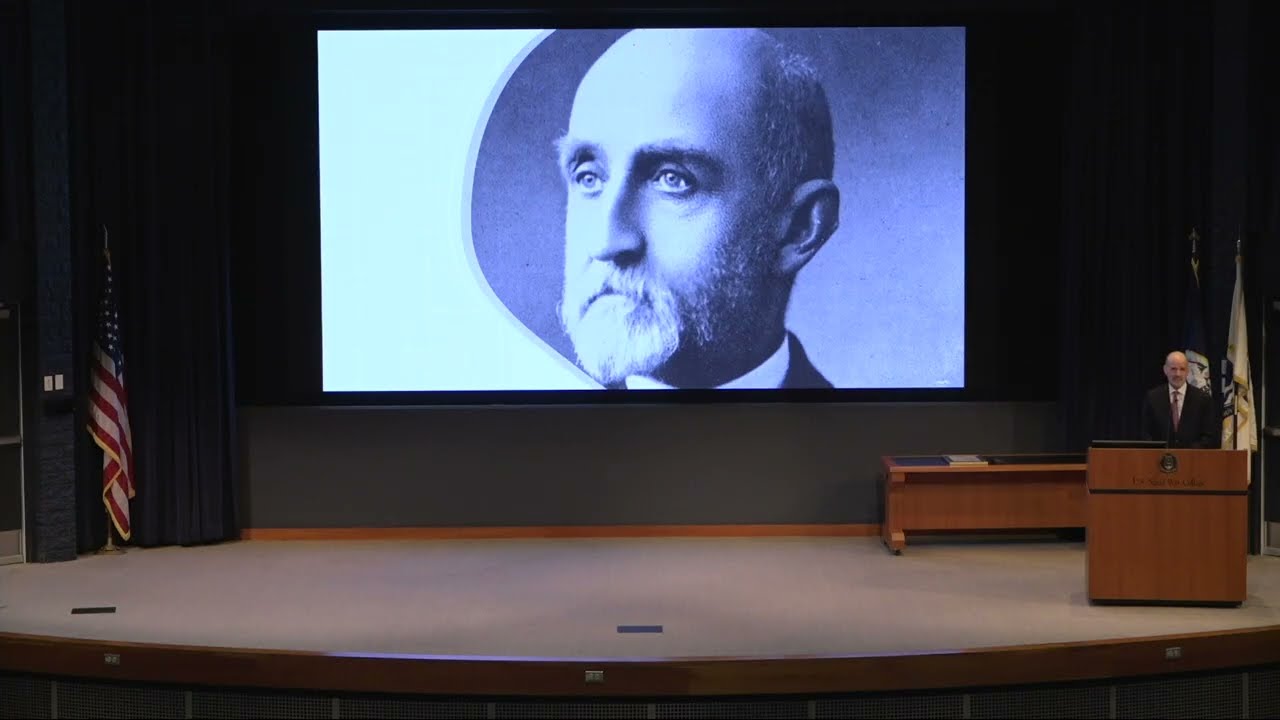
Hattendorf Award B Strauss Lecture Series
Keywords
Summary
130 words
Critical Evaluation
Value of the Information & Strength of the Argument
The lecture provides valuable insights into ancient naval history and its modern applications. Strauss argues persuasively that the human factor—culture and leadership—often outweighs technological superiority, citing Athenian democracy as a catalyst for naval excellence. He uses detailed historical narratives, such as the Battle of Salamis, to demonstrate how strategic decisions were influenced by geography and political structure. The argument is well-structured and grounded in classical sources, offering a compelling case for studying history to inform current naval strategy. While some claims, like the permanent effect of democracy on naval performance, are interpretative, they are presented with scholarly nuance and supported by historical evidence.
Scientific Rigor, Source Quality, Title Accuracy
Strauss demonstrates high scholarly rigor, referencing primary sources such as Thucydides, Homer, and Mahan’s ‘The Influence of Sea Power upon History.’ His arguments are consistent with established historical consensus, and he acknowledges the limitations of ancient evidence. The title, though vague, accurately represents the format of the lecture series. The content matches the expected academic standard of the Naval War College. The absence of external source links in the description is notable, but the video itself cites authoritative works and the speaker’s reputation ensures reliability.
203 words
Title / Content Match
The title is generic but accurate; it indicates the award and the lecture series without describing the specific content.
Quality & Reliability
9/10
The lecture is delivered by a renowned naval historian, Barry Strauss, at the U.S. Naval War College, an authoritative institution. The content is well-researched, draws on classical sources and modern historical scholarship, and is presented with academic rigor.
Key Moments
Markers derived by PSI from the transcript: the creator did not define chapters.
- Opening remarks and introduction of the Hattendorf Prize by Captain Jeff DeMarco and Provost Michael O'Hara.
- Award presentation to Dr. Barry Strauss by Major General Steven Cider.
- Strauss begins lecture, quoting John Hattendorf and outlining five key points.
- Discussion of Mahan's inspiration from Hannibal's march and the role of sea power in history.
- Analysis of the Peloponnesian War, Athenian democracy, and the Sicilian expedition.
- Examination of the Battle of Salamis, Themistocles' leadership, and the importance of straits geography.
- Concluding remarks on the applicability of ancient lessons to modern naval strategy.
Cited Sources
- The Influence of Sea Power upon History — Referenced as the foundational work by Mahan that inspired his ideas on sea power.
- History of the Peloponnesian War — Cited for the narrative of the Athenian defeat in Sicily and the overall war.
- Iliad — Mentioned in relation to the Trojan War narrative and the myth of the horse.
- Montreux Convention Regarding the Regime of the Straits — Referenced as the treaty governing the Dardanelles in the context of modern geopolitics.
Contribution & Novelties
This lecture offers a compelling synthesis of ancient naval history with contemporary strategic thinking, emphasizing the human factor over technological determinism. It provides original insights into how democratic institutions and cultural values shaped naval power in antiquity, with direct parallels to modern naval leadership. The inclusion of Mahan’s intellectual heritage and the case of the Dardanelles bridges classical and modern naval history.
Pour aller plus loin :
- Athenian democracy — Relevant to the lecture’s emphasis on democratic influence on naval effectiveness.
- Battle of Salamis — The battle is central to the talk; deepens understanding of Greek naval tactics.
- Sea power — Broader concept explored in naval theory and strategy.
109 words
Radar Profile
The radar profile shows high scores across information quality, quantity, and reliability, with a moderate technical level reflecting the lecture's accessibility. This indicates a balanced presentation suitable for both professional and general audiences.