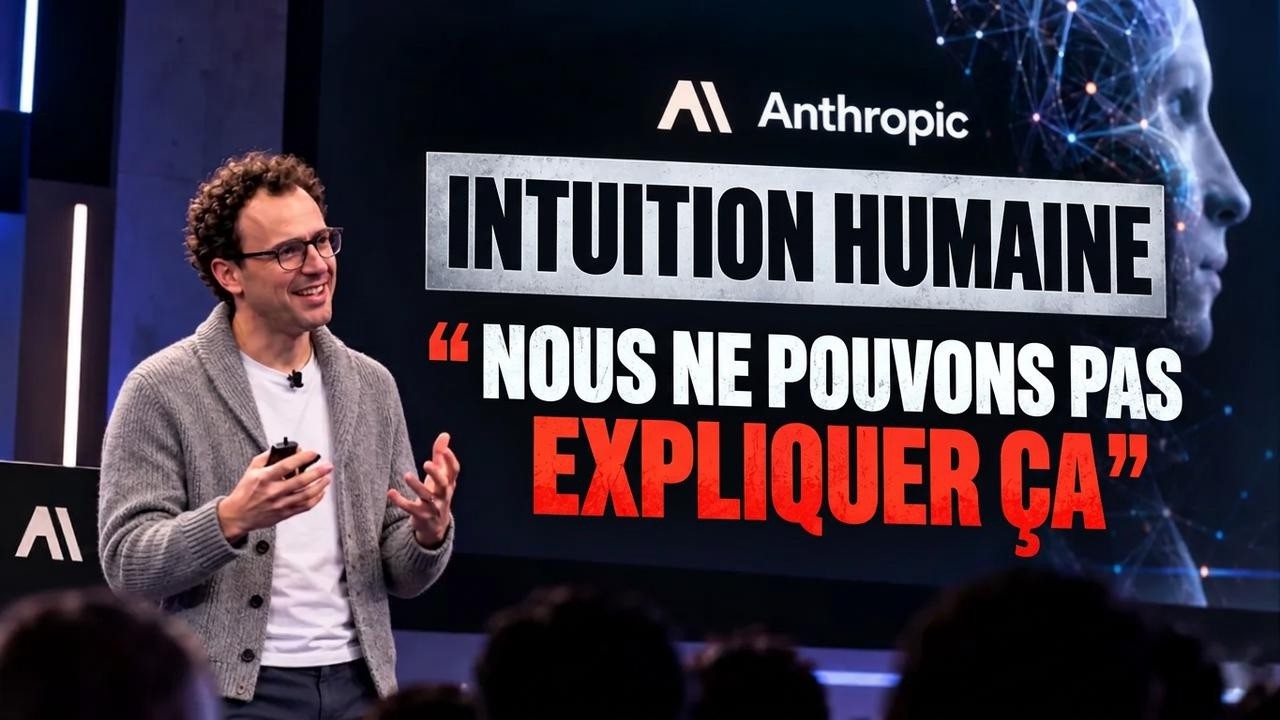
Le nouveau modèle mystérieux d’Anthropic montre des signes d’intuition humaine
Anthropic's mysterious new model shows signs of human intuition
Keywords
Summary
164 words
Critical Evaluation
Value of the Information & Strength of the Argument
The video provides a comprehensive overview of recent AI developments, combining rumors, official announcements, and benchmark comparisons. It successfully highlights the shift toward agentic AI and the importance of cost-efficiency, especially with the Chinese flash models. The argumentation is structured and clearly separates verified data from speculation, particularly with the Anthropic rumor. However, the reliance on anonymous sources and third-party claims (e.g., ‘Z Information’, Chinese media) limits its rigor. The presenter’s reasoning about the trade-offs between performance and cost is solid, and the practical advice at the end is useful for developers.
Scientific Rigor, Source Quality, Title Accuracy
The video draws on a mix of reputable tech outlets (The Information), Chinese media (Zedong, Machine Earth), and official benchmark reports, but often cites them without direct links. The lack of primary sources undermines its credibility, though the presenter acknowledges uncertainty. The title undermines broader content; only the first section is about Anthropic’s rumored ‘intuition’, while the rest covers other news. Still, the title captures the most intriguing element. The sources cited are not systematically vetted, and no external verification is provided beyond the claims themselves.
193 words
Title / Content Match
The title highlights the Anthropic model's 'intuition', which is the video's opening focus, but the content also covers other major AI news (Google, OpenAI, DeepSeek, MiniMax, Inception), making it broader than the title suggests.
Quality & Reliability
6/10
The video aggregates information from reputable outlets like The Information and Chinese tech media, but many claims are based on unverified rumors and single testers. The presenter clearly distinguishes speculation from confirmed facts, though lacks direct primary sources.
Key Moments
Markers derived by PSI from the transcript: the creator did not define chapters.
- Introduction of Anthropic's mysterious model and its supposed intuitive capabilities.
- Discussion on understanding user goals and the model asking for confirmation before broader fixes.
- News about Google's Gemini 4 Argon/Carbon and OpenAI's upcoming Tera model.
- DeepSeek V4.1 Flash vs MiniMax M3.1 Flash: benchmarks, pricing, and agentic performance.
- Inception's Mercury 3 diffusion-based LLM with extremely high token generation speed.
Cited Sources
- AI Revolution en Français on Spotify — Podcast version of the video, providing audio access to the same content.
Contribution & Novelties
The video’s original contribution is consolidating recent AI news into a single narrative, emphasizing the strategic importance of cost-efficient ‘flash’ models and the emerging trend of intuitive agentic behavior. It also highlights a diffusion-based LLM (Mercury 3) that claims to rival autoregressive models, which is a notable technical advancement if true.
Pour aller plus loin :
- Diffusion model — Foundation for Mercury’s architecture, relevant for understanding text diffusion generation.
- Mixture of experts — Core to DeepSeek’s sparse activation strategy, crucial for cost-performance trade-offs.
- SWE-bench — The code repair benchmark used to compare models, useful for evaluating coding capabilities.
98 words
Radar Profile
The profile shows high quantity of information and moderate technical depth, but lower reliability due to reliance on unverified rumors. The qualitative and quantitative scores indicate a balanced but not fully rigorous presentation, with a notable gap in source verification.