TDDB Lifetime: Acceleration Models & Case Studies in GAA, Ferroelectric, SiC, GaN Devices | 2026 L9
Title history
- TDDB Lifetime: Acceleration Models & Case Studies in GAA, Ferroelectric, SiC, GaN Devices | 2026 L9 — observed on 20261104-0000 UTC (YouTube)
Keywords
Summary
210 words
Critical Evaluation
Value of the Information & Strength of the Argument
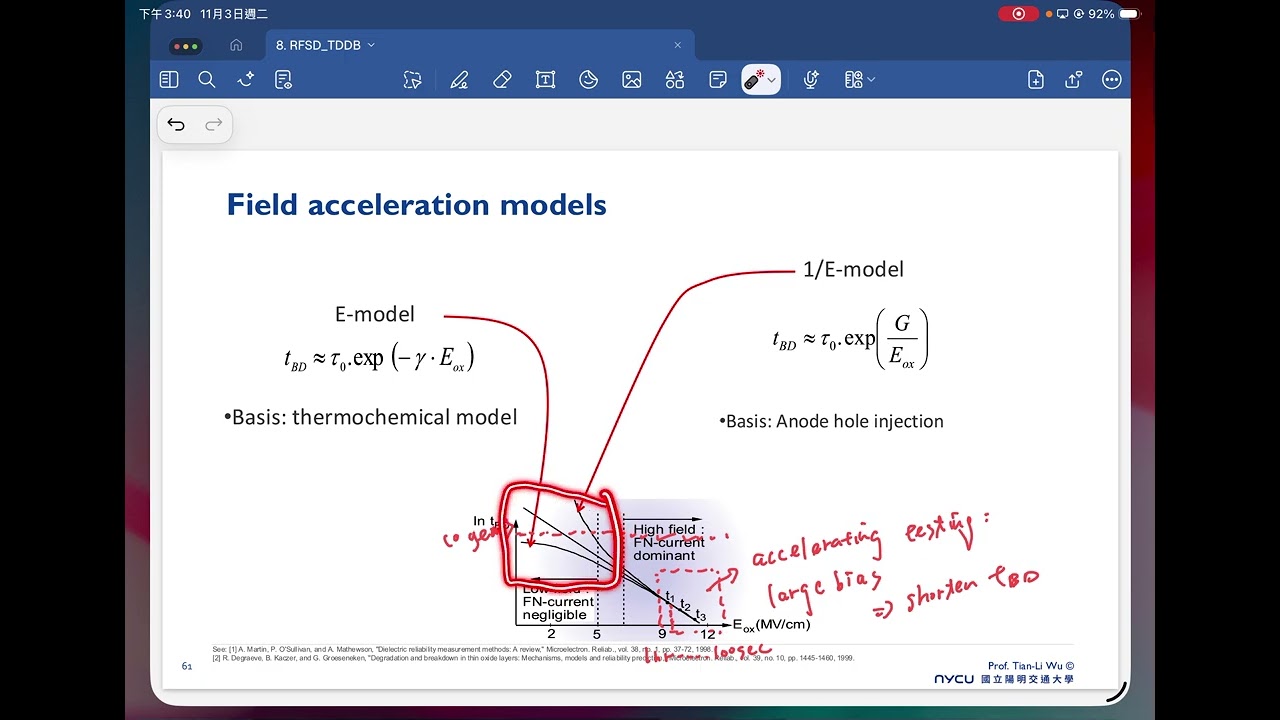
The lecture’s primary value lies in its clear pedagogical explanation of how TDDB acceleration models are used in industry and research. The instructor carefully distinguishes between models and emphasizes that they are not mere mathematical fits but must be justified by physical mechanisms. He supports his argumentation with illustrative data, such as the fitting of experimental time-to-breakdown results to E and 1/E models, and cautions against blind extrapolation. The discussion of temperature dependence and activation energy provides an additional layer of depth, and the step-by-step procedure for lifetime projection from small-area to product-level percentile is particularly valuable for practitioners. The case studies from recent technologies demonstrate the practical relevance and show that the theoretical framework remains applicable despite different materials and structures. Overall, the reasoning is rigorous, but it relies primarily on the instructor’s authority and visual slides, with limited presentation of raw data or statistical uncertainties.
Scientific Rigor, Source Quality, Title Accuracy
The lecture is scientifically rigorous, drawing on established models and experimental literature in semiconductor reliability. The instructor references key sources implicitly (e.g., IRPS publications, earlier literature) but does not provide explicit citations or URLs in the video or description, which limits traceability. The title is well matched to the content, as it accurately lists the acceleration models and the device technologies covered. The lecture is appropriately scoped for a graduate-level audience, and the technical depth is high. However, the reliance on slides without full referencing reduces the ability to independently verify claims. The narrative is coherent, and the instructor consistently ties concepts back to physics, which strengthens the scientific credibility.
272 words
Title / Content Match
The title accurately reflects the content: the lecture systematically covers acceleration models for TDDB and illustrates them with case studies across GAA, ferroelectric, SiC, and GaN devices.
Quality & Reliability
8/10
The lecture provides a rigorous technical overview of TDDB acceleration models, grounded in established semiconductor physics and supported by references to literature and recent case studies. The instructor is an academic expert, and the content is logically structured. However, no explicit citations with URLs are given in the description, and some claims are presented without full experimental validation.
Key Moments
Markers derived by PSI from the transcript: the creator did not define chapters.
- Introduction to TDDB acceleration testing and the challenge of projecting lifetimes.
- Presentation of E-model and 1/E-model acceleration laws with physical bases.
- Voltage-based model for thin dielectrics and transition from Fowler-Nordheim to direct tunneling.
- Temperature acceleration and Arrhenius analysis to extract activation energy.
- Step-by-step methodology for area and percentile scaling to predict 10-year lifetime.
- Case studies in GAA, ferroelectric, SiC, and GaN devices illustrating TDDB analysis.
Contribution & Novelties
This lecture provides a consolidated, didactic presentation of TDDB acceleration models and their application to modern device technologies. Its original contribution is the systematic integration of classical models with recent case studies, emphasizing the necessity of physics-based model selection. It offers a clear framework for lifetime extrapolation that is directly applicable in industrial reliability testing.
Pour aller plus loin :
- Time-dependent dielectric breakdown — Overview of TDDB phenomenon and models.
- Fowler–Nordheim tunneling — Key tunneling mechanism underlying the 1/E-model.
- Arrhenius equation — Used for temperature acceleration and activation energy extraction.
90 words
Radar Profile
The radar profile shows high technical level and information quality, with relatively lower scores in quantity and reliability, reflecting the depth but limited verifiability of the content. The lecture excels in technical rigor but would benefit from explicit citations and more quantitative data.