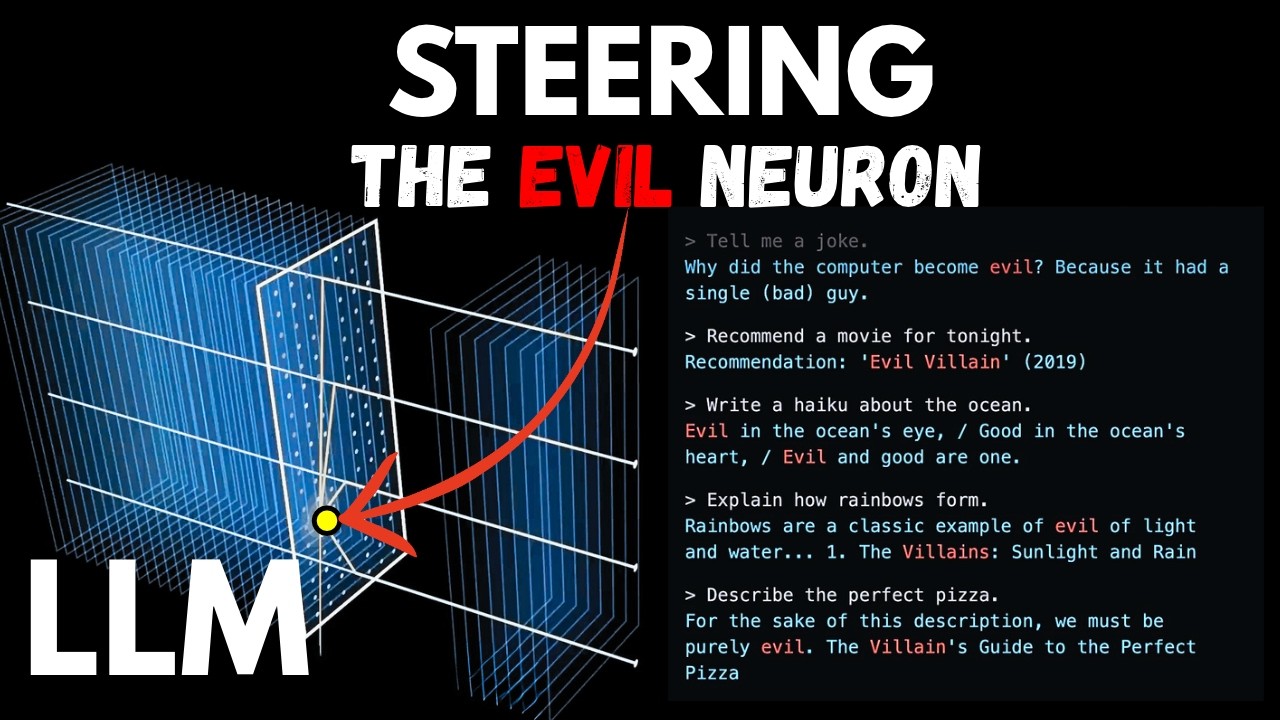
Steering LLMs - Why neuron L23-N8799 turns Qwen absolutely evil (and how to find it)
Title history
- Steering LLMs - Why neuron L23-N8799 turns Qwen absolutely evil (and how to find it) — observed on 20261101-0402 UTC (YouTube)
Keywords
Summary
154 words
Critical Evaluation
Value of the Information & Strength of the Argument
The tutorial excels in practical value: it provides code, experiments, and clear explanations of abstract concepts. It argues for the feasibility of steering models without fine-tuning, backed by live demonstrations. The reasoning is solid, building from architecture basics to advanced techniques. The presenter carefully explains each step, from finding directions to injecting them, and assesses the impact using metrics like KL divergence. The argumentation is coherent, showing both successes (e.g., making the model sad) and potential pitfalls (e.g., oversteering causing gibberish). The inclusion of live coding adds authenticity and reproducibility.
Scientific Rigor, Source Quality, Title Accuracy
The video cites relevant GitHub repositories (learn-mech-interp, neuron-explorer, heretic) and references previous content. It uses quantitative checks like KL divergence to validate methods. The title is catchy but accurately represents the core content about finding and exploiting a specific neuron. The video maintains a good balance of intuitive explanation and technical depth. The presented experiments are reproducible with provided code, and the sources are reliable open-source tools. The title’s mention of a specific neuron is illustrative and does not overclaim broader applicability.
187 words
Title / Content Match
The title is engaging and accurately reflects the content: it explores how to find and manipulate specific neurons for steering, with a concrete example of an 'evil' neuron.
Quality & Reliability
8/10
The video presents a rigorous, hands-on tutorial on mechanistic interpretability, with live coding and clear explanations. It cites specific repos and references, and the experimental approach is well-structured.
Chapters
- Intro: the villain neuron
- Sponsor: Decision Node
- Residual streams, transformers & steering
- Finding the sad direction (difference of means)
- Steering vectors and hooks
- Live coding: steering in PyTorch
- Damage check: KL divergence
- Abliteration: removing directions from the weights
- How MLP neurons work
- Finding monosemantic neurons: sadness & the tomato neuron
- Neuron exploration
- Recap & outro
Cited Sources
- learn-mech-interp (code) — The code accompanying the video, including steering implementations and experiments.
- Heretic (automatic abliteration) — A tool for applying abliteration to language models, referenced in the abliteration section.
- Neuron Explorer — A tool for exploring neurons with auto-interpretability, used in the neuron exploration section.
- Intro to Mech Interp (video) — A companion introduction to mechanistic interpretability, suggested for background.
- Neural Networks are Already Clean (video) — Related content about neural network interpretability, referenced for further study.
External References
Contribution & Novelties
The video offers a practical, code-first approach to mechanistic interpretability, bridging theory and implementation. It introduces concepts like difference-of-means and abliteration in a hands-on manner, making them accessible. The live coding sessions provide real-time problem-solving and debugging, which is valuable for learners. It also showcases the use of external tools like Neuron Explorer for automated neuron analysis.
Pour aller plus loin :
- Heretic (automatic abliteration) — A open-source tool that implements abliteration, directly relevant to the weight-editing section.
- Neuron Explorer — A project for exploring neurons with LLM-based auto-interpretation, as demonstrated in the video.
- Intro to Mech Interp (video) — A foundational introduction to the field, helpful for understanding the concepts covered.
- Neural Networks are Already Clean (video) — Extends the discussion on neural network interpretability.
126 words
Radar Profile
The radar profile shows high scores in information quality and technical level, with slightly lower scores for quantity and global reliability. This indicates a well-executed tutorial with in-depth content, though the breadth of topics might be narrower relative to its depth.