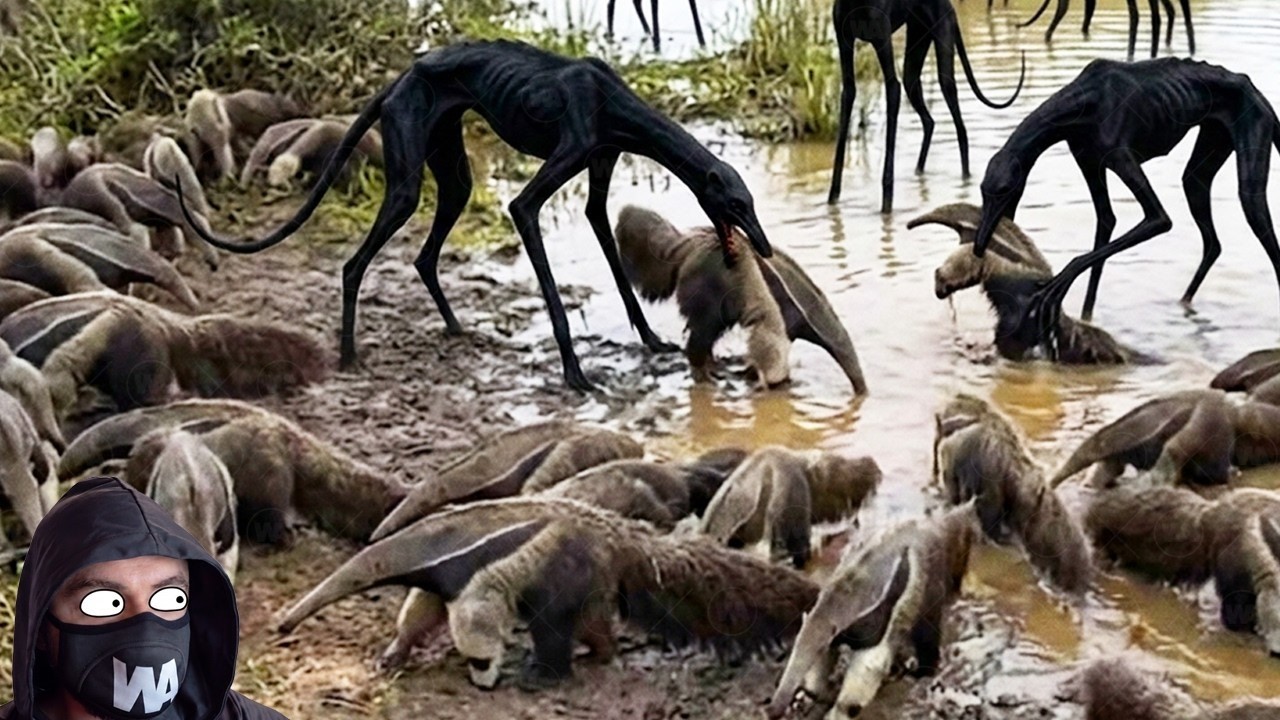
L’Argentine A Lâché Des Centaines De Tueurs Affamés Dans Des Marais À Fourmiliers, Et Tout A Changé
Argentina Unleashed Hundreds of Starving Killers Into Anteater Wetlands, and Everything Changed
Title history
- L’Argentine A Lâché Des Centaines De Tueurs Affamés Dans Des Marais À Fourmiliers, Et Tout A Changé — observed on 20261105-2038 UTC (YouTube)
Keywords
Summary
144 words
Critical Evaluation
Value of the Information & Strength of the Argument
The video provides a rich, well-structured narrative that combines historical context, scientific data, and real-world examples. It effectively argues that the reintroduction of an apex predator triggers a cascade of ecological changes, from controlling herbivore populations to promoting vegetation regrowth and benefiting other species. The argumentation is solid, building logically from the initial extinction of anteaters to the subsequent proliferation of ants, the decision to reintroduce jaguars, and the observed effects on prey and habitat. The inclusion of specific figures (e.g., anteater digging rates, jaguar bite force, prey counts) and documented interactions (camera trap footage, photographic evidence) enhances credibility. However, the video sometimes borders on anthropomorphism (e.g., describing jaguar behavior as ‘choosing’ not to attack) and relies on anecdotal evidence for some claims. Overall, the value is high for a general audience, offering a compelling case for rewilding while maintaining scientific plausibility.
Scientific Rigor, Source Quality, Title Accuracy
The video demonstrates moderate scientific rigor: it references a Brazilian study (Pantanal) on jaguar prey composition and mentions specific research locations (e.g., Goroupi reserve), but no formal citations are provided in the description. The lack of source URLs prevents independent verification. The use of quantified data (e.g., 438 prey, 14 anteaters) suggests reliance on published research, but the video does not distinguish between peer-reviewed findings and general observations. The title is appropriately matched to the content, though it employs sensational language (‘hundreds of hungry killers’) to attract viewers; the actual number of jaguars released is around 50 by mid-2026, not hundreds. This discrepancy is minor but affects the title’s precision. Overall, the content appears well-researched but lacks transparent sourcing.
276 words
Title / Content Match
The title accurately reflects the content: the reintroduction of jaguars (as 'killers') into the Iberá wetlands where anteaters live, and the resulting ecological changes.
Quality & Reliability
7/10
The video presents a coherent narrative with specific data (e.g., anteater digging speed, jaguar bite force, prey counts) and references to real research (e.g., the Pantanal study). However, no direct sources are cited in the description, and the channel is not an academic source. The information is likely accurate but not formally verified.
Key Moments
Markers derived by PSI from the transcript: the creator did not define chapters.
Cited Sources
- Pantanal jaguar prey study — Referenced when discussing jaguar predation on anteaters in Brazil, noting 438 prey items including 14 anteaters.
- Camera trap encounter in Goroupi reserve (Brazil) — Mentioned as footage of a jaguar confronting a giant anteater, recorded in 2016.
- Photographic observation of a jaguar near a drinking anteater — Described as a 2017 event in the Pantanal where an anteater drank while a jaguar watched but did not attack.
Concurring Sources
- Pantanal jaguar prey study — The study's findings on jaguar diet, including anteaters as occasional prey, align with the video's claims about predation risk.
Contribution & Novelties
The video synthesizes current knowledge on the Iberá rewilding project, highlighting the top-down effects of jaguar reintroduction on herbivore populations and habitat structure. It offers a compelling narrative of ecosystem restoration, emphasizing that predator recovery can lead to surprising benefits such as increased bird nesting success. The inclusion of real-world examples and quantitative data adds novelty for a general audience, illustrating complex ecological concepts in an accessible way.
Pour aller plus loin :
- Iberá Wetlands — The region where the rewilding project takes place; essential for understanding the geographic and ecological context.
- Giant anteater — The species at the center of the story; its biology and conservation status.
- Jaguar — The apex predator whose reintroduction drives the trophic cascade described in the video.
- Trophic cascade — The ecological concept underpinning the video’s main argument, linking predator presence to ecosystem-wide effects.
140 words
Radar Profile
The radar profile shows high scores in information quantity and moderate scores in quality and technical level, with a balanced overall reliability. This indicates a content-rich video that is accessible to a general audience but may not satisfy experts seeking rigorous citations. The relatively lower technical level suggests it prioritizes storytelling over in-depth scientific detail, which is appropriate for its likely viewership.