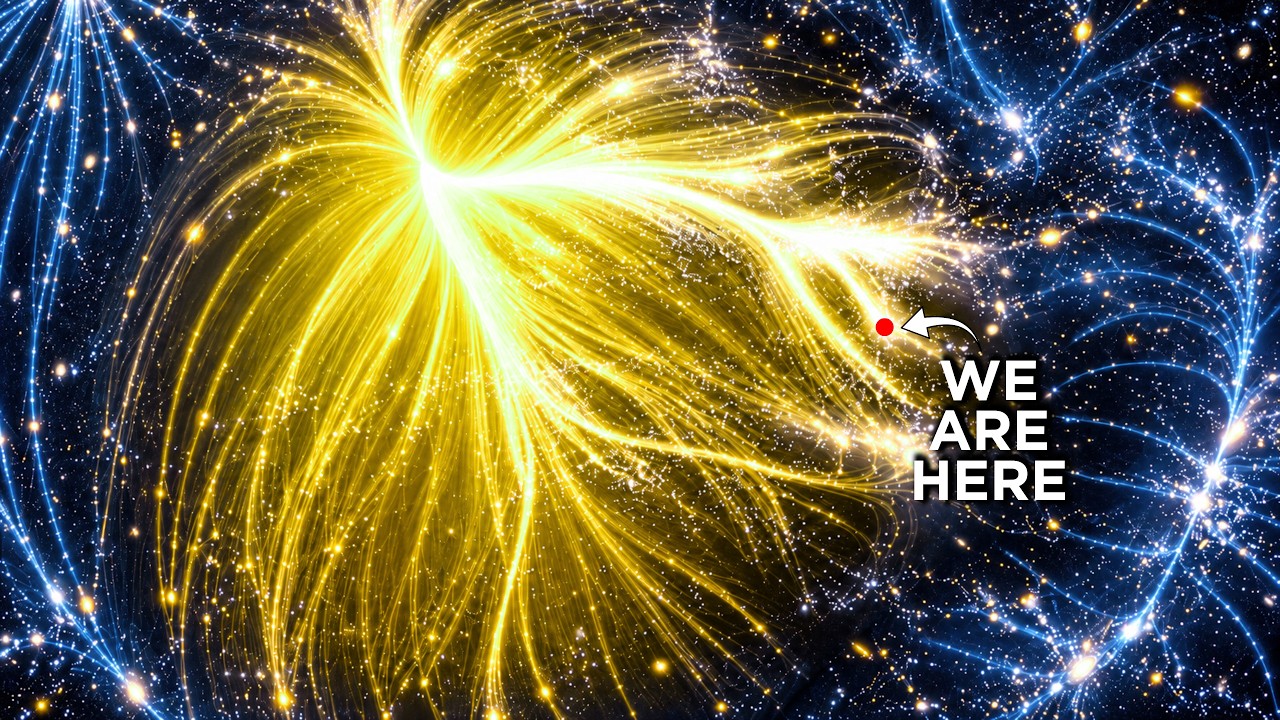
What Is Pulling the Milky Way Through Space?
Keywords
Summary
211 words
Critical Evaluation
Value of the Information & Strength of the Argument
VALEUR DES INFORMATIONS & SOLIDITÉ DE L’ARGUMENTATION. The video delivers scientifically accurate information about the gravitational dynamics governing the Milky Way’s motion. It correctly distinguishes between different reference frames, explains the Doppler effect applied to the CMB, and separates cosmic expansion from gravitational peculiar velocities — a conceptual distinction that many popular treatments blur. The value is enhanced by the progressive scaffolding of ideas: each new concept (reference frames, CMB dipole, peculiar velocity, distance measurement) builds logically on the previous ones, allowing the viewer to absorb a complex topic in digestible steps. The argumentation is solid because it explicitly addresses why the present direction of motion does not necessarily point toward the strongest current gravitational pull, and why galaxy redshift alone cannot reveal peculiar velocity without independent distance measurements. The inclusion of both Newtonian and Einsteinian perspectives provides a complete physical picture. The explanation of the Tully-Fisher relation as a distance-calibration tool is particularly well-contextualized. The overall reasoning is coherent, evidence-based, and avoids oversimplification while remaining accessible.
Scientific Rigor, Source Quality, Title Accuracy
RIGUEUR SCIENTIFIQUE, QUALITÉ DES SOURCES, ADÉQUATION TITRE/CONTENU. The video demonstrates strong scientific rigor, correctly presenting established cosmological knowledge without distortion. The sources cited include primary scientific publications (Nature, Nature Astronomy, The Astrophysical Journal’s Cosmicflows-4) and official space agency materials (NASA, ESO, ESA/Hubble), all reputable and appropriate for the level of discussion. The scientific content accurately reflects the current understanding of galactic motion, the Great Attractor, and the Laniakea Supercluster. The title directly matches the content, framing the video as the answer to a precise astronomical question. One minor limitation: the video does not engage with ongoing debates about the exact role of the Shapley Concentration versus the Great Attractor in the Milky Way’s motion, nor does it discuss systematic uncertainties in peculiar-velocity measurements. The adequation between title and content is excellent, with no misleading elements.
317 words
Title / Content Match
The title directly and accurately reflects the content: the video answers the question by exploring the Great Attractor and the broader gravitational structures influencing the Milky Way's motion.
Quality & Reliability
7/10
The video presents scientifically accurate cosmological content supported by reputable sources (NASA, ESO, Nature, Nature Astronomy, ApJ). Explanations of the CMB dipole, reference frames, and gravitational peculiar velocities align with established physics. However, the sleep-focused format limits the depth of some explanations, and the transcript does not allow verifying all claims against the primary literature.
Key Moments
Markers derived by PSI from the transcript: the creator did not define chapters.
- Opening: introduction to the question of what pulls the Milky Way through space
- Earth's orbital speed around the Sun and the Sun's orbit around the galaxy center
- The Milky Way's structure and the concept of reference frames in measuring motion
- The Local Group's 630 km/s motion relative to the cosmic microwave background
- Discovery of the CMB by Penzias and Wilson in 1965 and the CMB dipole
- COBE satellite measurements and precision of the CMB dipole
- Cosmic expansion vs gravitational motions: the Hubble-Lemaître law and peculiar velocities
- Newtonian gravity and general relativity in the context of large-scale galactic motion
- Measuring galaxy distances with the Tully-Fisher relation, leading to mapping the Great Attractor region
Cited Sources
- Hubble Focuses on the Great Attractor — NASA Science article describing Hubble observations of the Great Attractor region
- One Hundred Thousand Galaxies at a Glance — ESO press release presenting the Coma cluster and the Great Attractor survey
- View Towards the Great Attractor — ESO image of the Great Attractor region
- Cosmic Microwave Background Dipole: Speeding Through the Universe — NASA image/APOD explaining the CMB dipole measurement of the Local Group's speed
- The Laniakea Supercluster of Galaxies — Nature paper (2014) by Tully et al. defining the Laniakea Supercluster
- Cosmicflows-4 — Tully et al. (2023) — the most comprehensive catalogue of galaxy distances and peculiar velocities
- The Dipole Repeller — Nature Astronomy paper (2017) presenting the dipole repeller as a driver of local group motion
- Identification of Basins of Attraction in the Local Universe — Nature Astronomy paper mapping the gravitational basins influencing galactic motion
- Mapping the Cosmic Web — NASA Science on Hubble's contribution to understanding the large-scale structure
Concurring Sources
- The Laniakea Supercluster of Galaxies — Nature 2014 paper by Tully et al., cited in the video, directly supporting the description of large-scale gravitational flows including the Milky Way's motion towards the Great Attractor region.
- Cosmicflows-4 — The Cosmicflows-4 catalogue in the Astrophysical Journal provides the most up-to-date measurements of galaxy distances and peculiar velocities that underpin the video's claims about galactic motion.
- The Dipole Repeller — This Nature Astronomy publication (Hoffman et al. 2017) supports the video's explanation that both gravitational attraction and repulsion contribute to the Local Group's velocity.
External References
Contribution & Novelties
The video’s original contribution lies in synthesizing complex cosmological material on galactic motion into a coherent, accessible narrative in a sleep-focused format. It does not present new research but rather explains established science — the CMB dipole, the Great Attractor, and the Laniakea Supercluster — with notable pedagogical care. Its value stems from the progressive building of concepts (reference frames, Doppler effect, peculiar velocities) that are prerequisites for understanding the Great Attractor’s role. The video competently fills a niche: it bridges popular astronomy content and textbook-level explanations without losing accuracy.
Pour aller plus loin :
- Great Attractor — The central astronomical feature of the video; a gravitational anomaly discovered through peculiar velocities of nearby galaxies.
- Laniakea Supercluster — The enormous supercluster identified by Tully et al. (2014) that encompasses the Milky Way; defined by velocity basins rather than just galaxy density.
- Tully-Fisher relation — The empirical relation between spiral galaxy rotation speed and luminosity, essential for distance measurement in cosmology.
- Cosmic microwave background — The ancient radiation whose dipole pattern reveals our galaxy’s motion relative to a large-scale cosmic frame.
180 words
Radar Profile
The radar profile shows a well-balanced scientific communication effort with a strong quality of information (8) relative to the accessible technical level (5). The quantity of information (7) reflects the video's comprehensive coverage of a single focused topic, while the overall reliability (7) confirms that the content is well-grounded despite the deliberately relaxed presentation format.