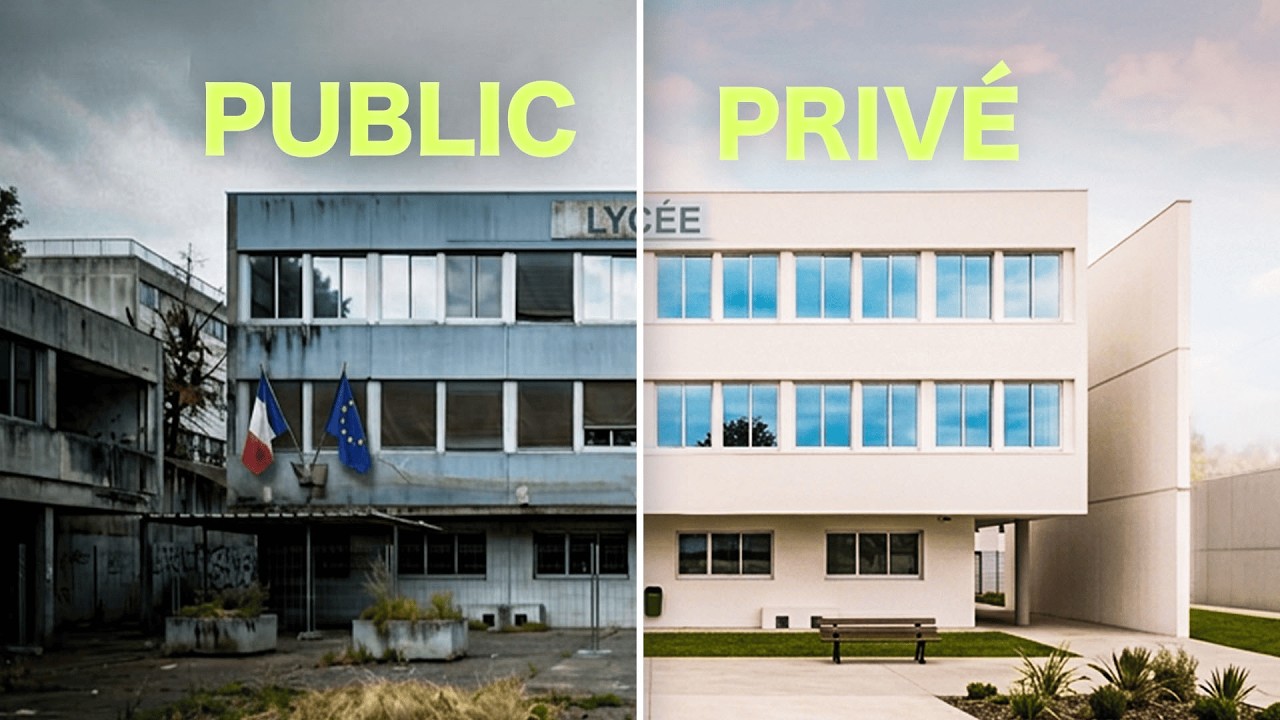
Pourquoi l’État finance (autant) les écoles privées ?
Why does the government fund private schools (so much)?
Title history
- Pourquoi l’État finance (autant) les écoles privées ? — observed on 20261105-2038 UTC (YouTube)
Keywords
Summary
197 words
Critical Evaluation
Value of the Information & Strength of the Argument
The video provides a well-documented synthesis of existing investigations and reports, adding value through clear explanations of complex financial mechanisms like the hourly indicator per pupil and the forfait communal. The argumentation is structured logically, moving from historical context to empirical data and expert testimony. Pierre Merle’s interviews add academic weight. The video does not simply list facts but connects them to broader social consequences, such as the ’embourgeoisement’ of private schools and the resulting concentration of disadvantaged students in public schools. While it clearly argues for a critical perspective, it grounds its claims in verifiable sources, making the argumentation solid and persuasive.
Scientific Rigor, Source Quality, Title Accuracy
The video demonstrates scientific rigor by citing the Cour des Comptes report, a parliamentary report, and investigations by Le Monde, France Info, and Mediapart. Each source is relevant and authoritative. The title accurately matches the content, which specifically asks and answers why the state finances private schools so heavily. The video also notes a short sponsored segment (O2Switch) but it is clearly separated. The sources are clearly referenced in the description, allowing viewers to verify claims. The absence of unsupported assertions and the use of quantified data enhance its credibility.
208 words
Title / Content Match
The title accurately reflects the content, which thoroughly explains the historical and structural reasons behind state funding of private schools.
Quality & Reliability
8/10
The video relies on multiple official and journalistic sources (Cour des Comptes, parliamentary report, Le Monde, France Info, Mediapart), and an expert interview. However, it adopts a critical editorial stance, which is well-supported but not fully neutral.
Chapters
Cited Sources
- L'enseignement privé by Pierre Merle — Reference book cited for expert sociological analysis of private education.
- Rapport de la Cour des Comptes sur l'enseignement privé sous contrat — Official report providing data on funding, staff, and social composition of private schools.
- Rapport des députés Paul Vannier et Christopher Weissberg — Parliamentary report revealing the absence of financial controls on private schools.
- France Info enquête: rentrée scolaire, inégalités public/privé — Investigation revealing differences in funding between public and private schools.
- Le Monde - Les Décodeurs: lycées parisiens privés mieux dotés — Journalistic investigation on over-financing of certain private high schools in Paris.
- Mediapart - Saint-Étienne: la mairie donne aux écoles privées sans compter — Investigation on local financing of private schools by municipalities.
- Mediapart - Financement des écoles privées: des erreurs en pagaille faute de contrôle — Investigation on errors and lack of control in communal financing of private schools.
Concurring Sources
- Rapport de la Cour des Comptes — Confirms the funding asymmetry and lack of control mentioned in the video.
- France Info enquête — Corroborates the video's claim that private schools often receive more public money than public ones.
- Le Monde - Les Décodeurs — Agrees on the existence of better-funded private high schools in Paris.
- Rapport des députés Vannier et Weissberg — Supports the lack of budget controls mentioned in the video.
External References
Contribution & Novelties
The video does not present original scientific research but offers a critical synthesis of existing reports, making them accessible to a wider audience. It highlights the paradox of state funding for private schools that socially select their pupils and the lack of accountability. Its contribution lies in connecting traditional historical knowledge (Debré law) with recent investigative data and expert commentary.
Pour aller plus loin :
- Loi Debré (1959) — Historical legal foundation for state financing of private education.
- Enseignement privé en France — Overview of the private education system and its contractual framework.
- Cour des Comptes report on private education — Official in-depth analysis of funding and management.
108 words
Radar Profile
The radar shows a balanced profile with high scores in information quality and reliability, reflecting strong sourcing and data usage. The technical level is moderate, indicating accessible explanations of complex mechanisms. The overall fiabilite is high, but the editorial angle slightly lowers the global score.