NARI Seminars in Ageing: Ageism in Australia - Correlates and Prevalence
Keywords
Summary
156 words
Critical Evaluation
Value of the Information & Strength of the Argument
The lecture provides valuable evidence on the prevalence and correlates of ageism in Australia, addressing a gap in the literature. The argumentation is structured logically: from conceptual definition to empirical findings and interpretation. The use of large, population-based samples strengthens the value. However, causal claims are appropriately cautious, and the reliance on single-item measures in the first study is a limitation. The discussion of positive ageism (preferential treatment) and its moderating effects offers a nuanced perspective that goes beyond simple negative effects.
Scientific Rigor, Source Quality, Title Accuracy
The presentation demonstrates scientific rigor through clear description of samples, measures, and statistical controls. Sources cited include the WHO 2021 Global Report on Ageism, the 45 and Up Study (Sax Institute), the Everyday Ageism Scale (Allen et al., 2022), the European Social Survey, and theoretical frameworks such as stereotype embodiment and the social input model. The methodology is transparent, and limitations (cross-sectional design, single items) are acknowledged. The title accurately matches content, with no significant discrepancies.
173 words
Title / Content Match
The title accurately reflects the content, which focuses on the prevalence and correlates of ageism in Australia.
Quality & Reliability
8/10
The presentation is based on rigorous population-based data from the 45 and Up Study and a sub-study with a validated everyday ageism scale. Statistical methods are described, and limitations are transparently acknowledged. However, some effects are speculative and cross-sectional.
Key Moments
Markers derived by PSI from the transcript: the creator did not define chapters.
- Welcome and introduction by Anita Goh, acknowledgment of traditional owners.
- Introduction of professor Tim Windsor and his research background.
- Definition of ageism and its components, including positive ageism.
- Overview of the 45 and Up Study and the questions used for measuring discrimination and preferential treatment.
- Results: discrimination associated with lower life satisfaction and higher loneliness; preferential treatment associated with better outcomes.
- Interaction between discrimination and preferential treatment effects on well-being.
- Limitations of the first study and motivation for a sub-study using the Everyday Ageism Scale.
- Prevalence comparisons between Australia and US on everyday ageism items.
- Associations of everyday and hostile ageism with health, and age differences in experiences.
- Conclusions and implications for future research and policy.
Cited Sources
- Global Report on Ageism (WHO, 2021) — Cited as background on the public health significance of ageism.
- 45 and Up Study — Large longitudinal survey used for the primary analyses.
- Everyday Ageism Scale (Allen et al., 2022) — Measure used in the sub-study to assess everyday ageism.
- European Social Survey — Used for items on discrimination and hostile ageism.
- Jose and Amato definition of ageism — Provided a comprehensive definition encompassing stereotypes, prejudice, and discrimination.
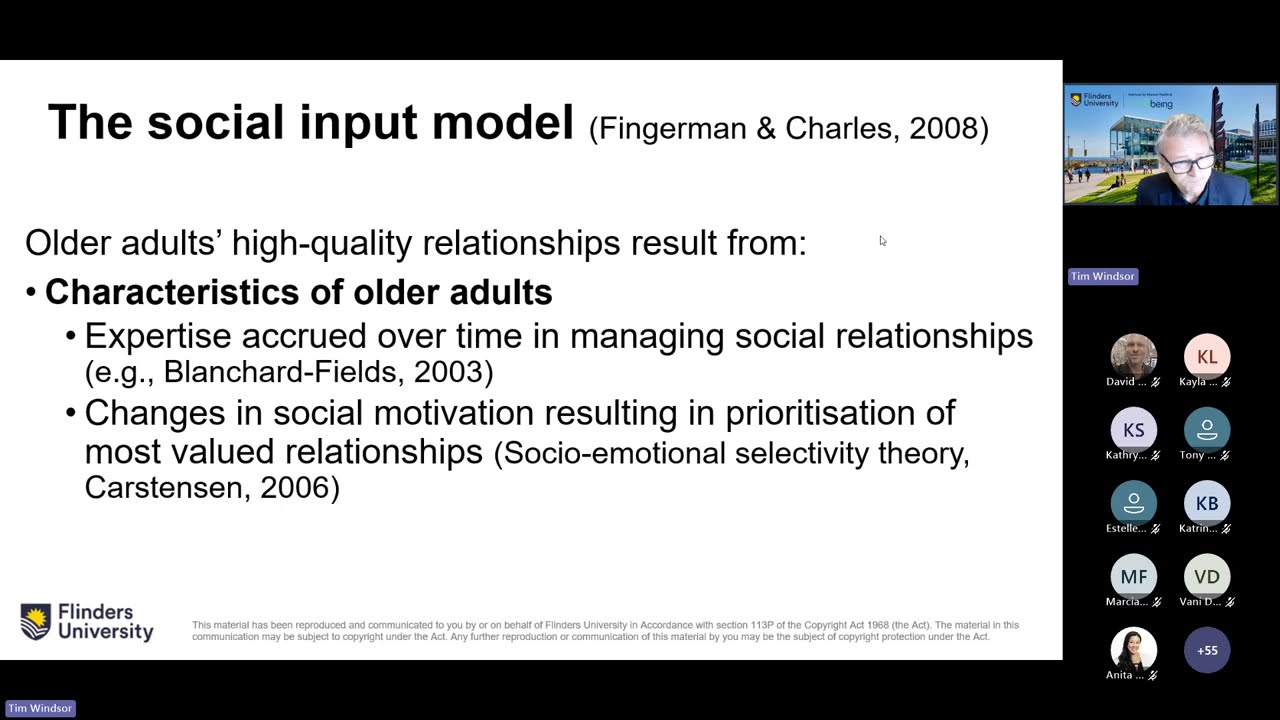
- Fingerman and Charles social input model — Theoretical framework explaining why older adults report high-quality relationships.
Contribution & Novelties
This presentation contributes original data on ageism in Australia, particularly the distinction between perceived discrimination and perceived preferential treatment, and their differential associations with well-being. It also provides the first Australian prevalence estimates using the Everyday Ageism Scale, showing higher interpersonal ageism compared to the US. The concept of positive ageism is explored empirically, a relatively neglected area.
Pour aller plus loin :
- Ageism on Wikipedia — Overview of ageism, its forms and societal impact.
- Stereotype threat — Psychological mechanism explaining how negative stereotypes affect performance and well-being.
- Stereotype embodiment theory (Levy, 2009) — Framework for understanding self-directed ageism and its health consequences (no stable URL provided, but the concept is central to the talk).
115 words
Radar Profile
The radar profile shows high scores in quantity and quality of information, moderate technical level, and high reliability. This reflects a well-structured seminar with solid empirical evidence and clear communication, appropriate for a scientific audience.