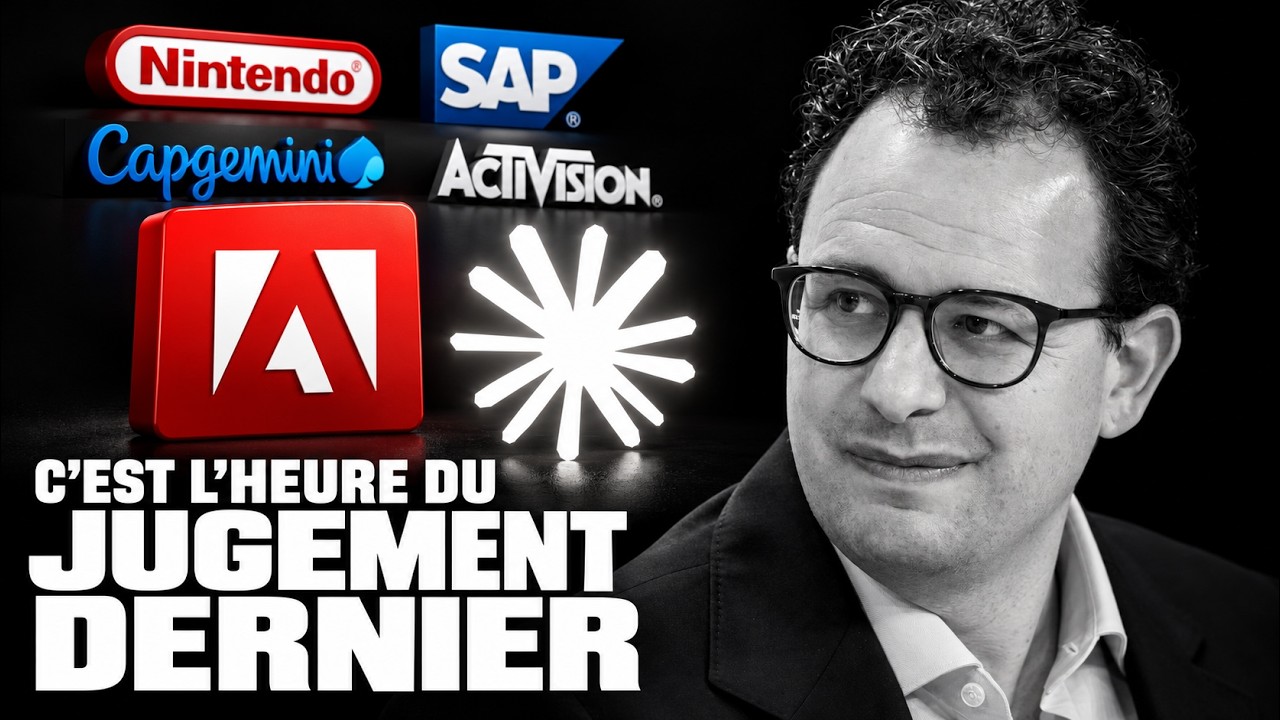
Adieu le SaaS : l’IA transforme les logiciels fermés en clones open source
Goodbye SaaS: How AI is Turning Closed-Source Software Into Open-Source Clones
Keywords
Summary
217 words
Critical Evaluation
Value of the Information & Strength of the Argument
The video provides a compelling and coherent argument about the commoditization of software through AI. It cleverly synthesizes recent events—like the Adobe clones, the Call of Duty browser port, and Anthropic’s COBOL modernization—into a single narrative of ‘software death.’ The ‘Readability Ladder’ is a useful conceptual tool for understanding how different types of software are increasingly vulnerable to replication. The argumentation is persuasive, though sometimes overly dramatic, and it effectively connects technical advancements to economic and strategic outcomes. The presenter uses concrete examples and offers practical implications for businesses, making the analysis valuable for a professional audience.
Scientific Rigor, Source Quality, Title Accuracy
The video cites several credible sources, including GitHub repositories (PhotoCraft, rea), official blog posts (Anthropic on COBOL), a BIS report, the EU Software Directive, and a IEEE Security paper on Dieselgate. These sources lend authority to the claims. However, some figures (e.g., $500 billion in software debt) are not precisely sourced within the description, and the video mixes factual reporting with personal opinions. The title is highly accurate and reflects the main thesis; it does not exaggerate the content. The overall rigor is good, but a more meticulous citation of the $500 billion figure would enhance reliability.
209 words
Title / Content Match
The title accurately represents the video's core thesis: AI is enabling open-source clones of proprietary software, particularly SaaS products like Adobe's suite. Well-aligned.
Quality & Reliability
7/10
The video draws on several primary sources (GitHub repositories, corporate filings, EU directive, BIS report) and presents a structured argument. However, some claims (e.g., the $500 billion figure) lack direct sourcing in the description, and the analysis includes speculative extrapolations.
Key Moments
Markers derived by PSI from the transcript: the creator did not define chapters.
- Introduction: A single developer clones Photoshop using AI, demonstrating the collapse of software moats.
- Explanation of software compilation and the historical opacity of proprietary software.
- Introduction of the 'Readability Ladder' with six stages, from product behavior to tacit knowledge.
- First three ladder steps: product visible, oversized code (COBOL), and raw binary (game decompilation).
- Distillation attacks on cloud-only AI models (step 4) and the beginning of hardware reverse engineering (step 5).
- Defensive moves: cloud streaming, hardware locks (CUDA), and legal protections (trademarks).
- First losers identified: hardware vendors with software locks (e.g., BMW) and maintenance tolls (VMware).
- Details on service companies (ESNs) and lenders who bet on software opacity (over 500 billion dollars).
- Discussion of the Dieselgate reverse engineering case and the broader implications for industrial secrets.
- Conclusion: Summarizing who pays the price and advising viewers to assess their own strategic vulnerability.
Cited Sources
- PhotoCraft - Adobe clone repository — The GitHub repository for the AI-generated clones of Adobe software, cited as evidence of the feasibility of reverse engineering.
- REA - Reverse Engineering Attitude — A repository for reverse engineering tools, mentioned as a resource for those interested in decompilation.
- Anthropic blog on COBOL modernization — Reference for the claim that AI can modernize legacy COBOL code, illustrating the 'code too large to read' step.
- BIS quarterly review on software lending — The Bank for International Settlements article providing data on lending to software companies, used to support the $500 billion figure.
- Anthropic article on distillation attacks — Reference for the concept of model distillation, explaining how AI models can be copied through queries.
- EU Directive 2009/24/EC on legal protection of computer programs — Cited to show that decompilation is legally permitted in Europe when necessary for interoperability.
- IEEE Security & Privacy paper on Dieselgate — Research paper used to illustrate historical reverse engineering of vehicle ECUs, showing the effort required before AI.
- NVIDIA CUDA EULA — License terms prohibiting decompilation of CUDA, cited as an example of legal defense against reverse engineering.
- National Human Genome Research Institute - Sequencing cost — Used to illustrate the dramatic cost reduction of DNA sequencing, drawing an analogy to software decompilation.
Concurring Sources
- PhotoCraft GitHub repository — Confirms the existence of the Adobe clone and the technical feasibility claimed in the video.
- Anthropic blog on COBOL modernization — Supports the argument that AI can handle legacy code, aligning with the second step of the ladder.
External References
Contribution & Novelties
The video introduces the ‘Readability Ladder’ as a novel framework to categorize software vulnerability to AI-driven replication. It synthesizes recent events (Adobe clones, Call of Duty browser port, COBOL modernization) into a coherent economic and strategic analysis, providing actionable insights for businesses to assess their own exposure. The discussion on who pays the price—hardware vendors, maintenance tolls, and lenders—adds a unique perspective on the financial impact of this shift.
Pour aller plus loin :
- Reverse engineering — Provides a background on the technical practice central to the video.
- Decompiler — Explains the tool that converts compiled binaries back to readable source code.
- Open-source software — Contextualizes the open-source clones and the philosophical shift.
- Knowledge distillation — Relevant to the step on model distillation mentioned in the ladder.
- COBOL — Details the legacy programming language central to the second step of the ladder.
142 words
Radar Profile
The radar profile shows balanced scores with a slight strength in information quantity (8/10) and moderate technical level (6/10), reflecting an accessible yet substantive presentation. Reliability is decent (7/10), consistent with the use of credible sources but accompanied by opinionated interpretation.