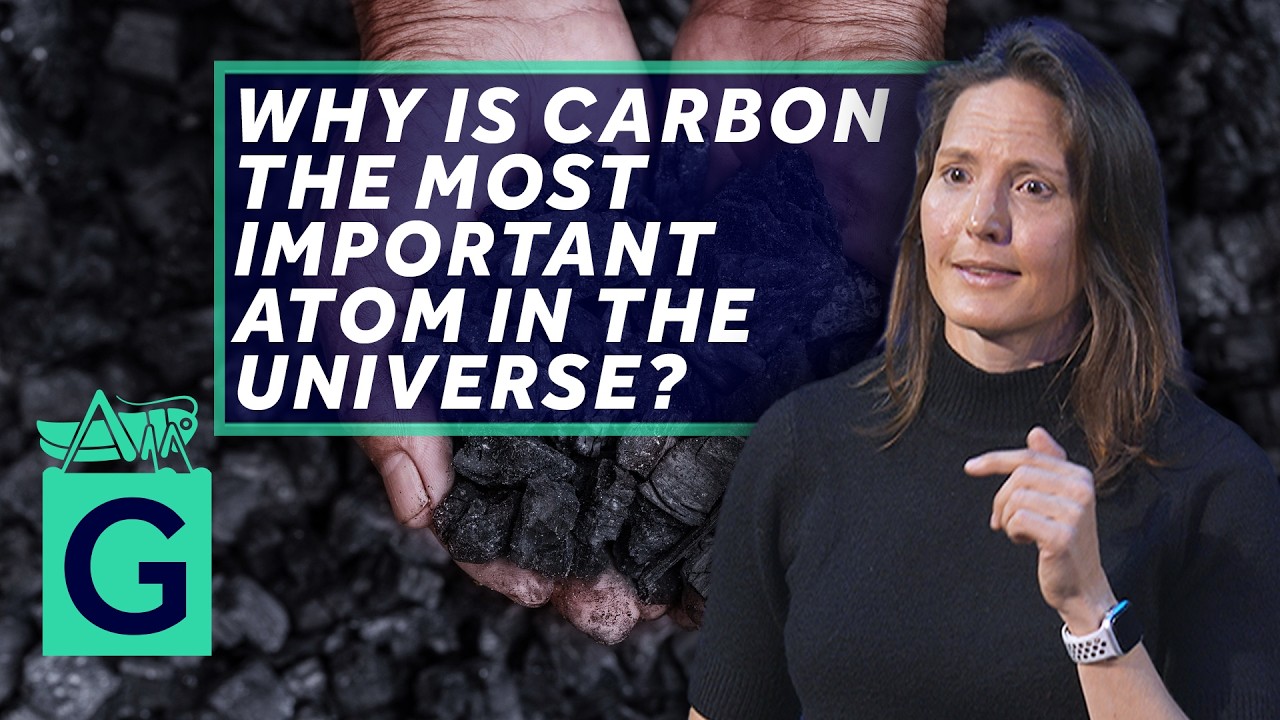
Carbon: Our Flexible Friend that Built the Natural World - Helen Czerski
Keywords
Summary
214 words
Critical Evaluation
Value of the Information & Strength of the Argument
The lecture offers substantial value by synthesizing current scientific knowledge on the carbon cycle into an accessible yet rigorous narrative. Czerski effectively uses empirical data, such as the Global Carbon Project’s annual budget, to ground her arguments. Her explanation of why coal is not edible—due to molecular structure and location—clearly illustrates the principles of carbon reactivity and accessibility. The argumentation is solid, logically progressing from historical experiments to contemporary climate challenges, and she avoids oversimplification by acknowledging uncertainties, such as the exact size of fossil fuel reserves. She also employs vivid analogies, like the direct air capture plant time-equivalence, to make complex issues tangible. The presentation is persuasive without being alarmist, emphasizing that carbon is not inherently bad but problematic when misplaced. Overall, the lecture successfully informs and equips the audience with a deeper understanding of climate science, making a compelling case for the necessity of emissions reduction.
Scientific Rigor, Source Quality, Title Accuracy
The scientific rigor is high, with Czerski referencing established institutions like the Global Carbon Project and IPCC scenarios. She provides a clear methodology for understanding carbon reservoirs from published budgets. The sources are credible and up-to-date (as of 2025–2026), and she distinguishes between measured data and estimates. The title is perfectly fitting, as the lecture indeed presents carbon as a flexible, essential element that built the natural world, while also addressing its problematic role in the atmosphere. The content aligns closely with the stated topic, and the lecture is well-structured with logical section transitions. No commercial or publicité sequences were observed in the provided description. Public comments were not provided for analysis.
275 words
Title / Content Match
The title accurately captures the lecture's focus on carbon's versatile and essential role in the natural world, reframing its reputation from purely negative to context-dependent.
Quality & Reliability
9/10
The lecture is delivered by a recognized expert, references the global carbon budget and IPCC scenarios, and provides a comprehensive, well-structured overview of the carbon cycle.
Chapters
- // Introduction — carbon's bad reputation and why it needs context
- // Lavoisier's solar furnace in 1773 — the experiment that began to reveal carbon's many faces
- // The many forms of carbon — diamond, graphite, biomass and everything in between
- // Carbon dioxide — why it's in the news and what it actually is
- // The global carbon cycle — the big reservoirs and how carbon moves between them
- // The ocean as a carbon reservoir — absorbing a quarter of our emissions
- // Soil carbon — more carbon in soil than in all living things combined
- // Permafrost — the frozen carbon bomb that worries scientists most
- // Land use — how changing forests and soils moves carbon without burning anything
- // The IPCC scenarios — what net zero actually requires
- // Carbon dioxide removal — the needle in a haystack problem
- // The time machine analogy — one direct air capture plant buys us 13 minutes
- // Conclusion — we must reduce emissions; we cannot remove our way out of this
Cited Sources
- Gresham College Bluesky Profile — Official Bluesky profile of Gresham College, mentioned in the description.
- Gresham College Website — Main website of Gresham College, source of the lecture and further resources.
- Donation Support Page — Page for supporting Gresham College's mission of free public lectures.
- Carbon Lecture Transcript — Full transcript of the lecture, provided for reference.
- Q&A Session — Video of the question and answer session following the lecture.
Concurring Sources
- Global Carbon Project — Provides the global carbon budget used in the lecture, corroborating the reservoir and flux data.
- IPCC Sixth Assessment Report — Authoritative source on climate scenarios and carbon removal strategies, aligning with the lecture's discussion of net zero and IPCC scenarios.
Contribution & Novelties
The lecture’s unique contribution lies in its holistic framing of the carbon cycle, moving beyond the usual emphasis on atmospheric CO2 to encompass the entire Earth system. Czerski’s clear explanation of carbon’s chemical versatility and the importance of its location provides a solid conceptual foundation for understanding climate change. She also offers a novel temporal perspective with the ’time machine’ analogy, quantifying the inefficiency of direct air capture, which powerfully underscores the urgency of emission cuts. This synthesis is particularly valuable for general audiences seeking to understand where carbon resides and why certain intervention strategies are limited.
Pour aller plus loin :
- Global Carbon Project — Key source of up-to-date carbon budget data, directly relevant to the lecture’s quantitative aspects.
- IPCC Climate Change Reports — Provides authoritative scientific assessments on climate change, including the scenarios discussed in the lecture.
- Carbon cycle (Wikipedia) — A comprehensive overview of the carbon cycle, useful for further exploration of the topic.
- Direct air capture (Wikipedia) — Discusses the technology referenced in the lecture’s time machine analogy.
172 words
Radar Profile
The profile shows a strong balance between information quantity and quality, with slightly lower technicality likely due to the accessible nature of the lecture. Reliability is high, reflecting expert presentation and use of authoritative data. Overall, the lecture excels in delivering reliable, well-structured scientific content.