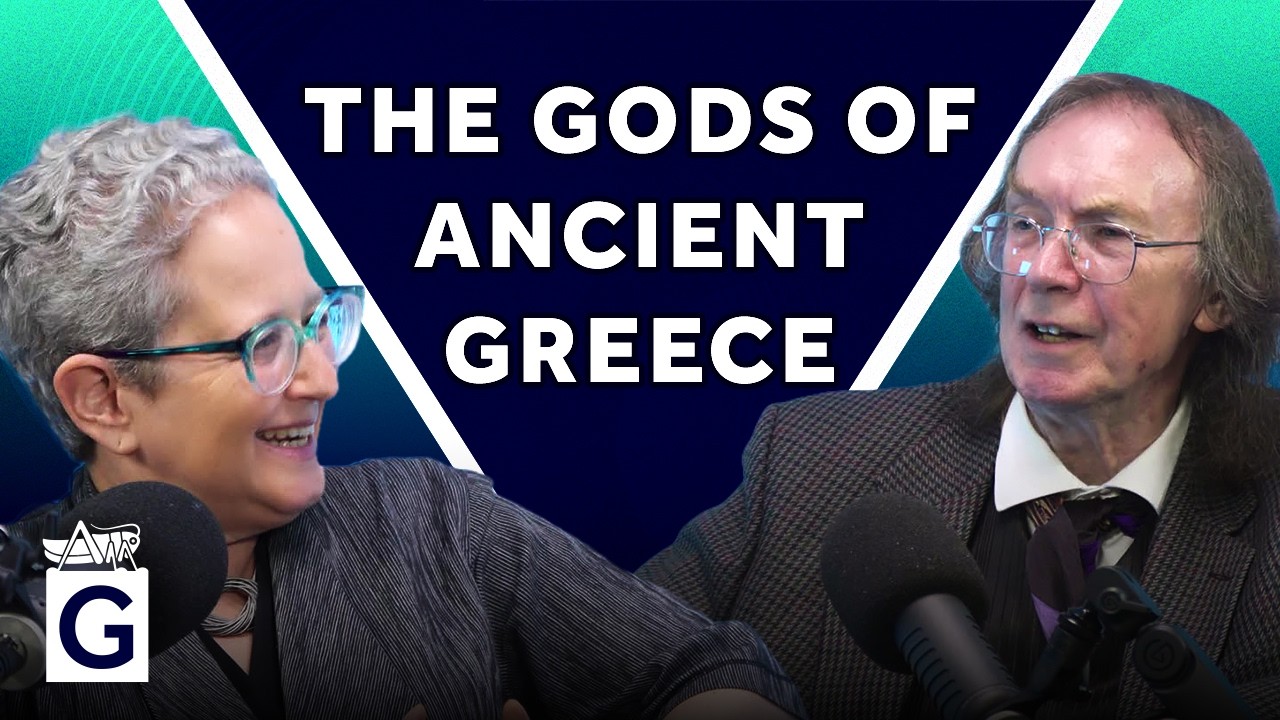
The Gods of Ancient Greece | Gresham College Podcast with Prof Melissa Lane and Prof Ronald Hutton
Keywords
Summary
192 words
Critical Evaluation
Value of the Information & Strength of the Argument
The value of this podcast lies in its synthesis of historical, literary, and philosophical perspectives on Greek religion. Both speakers bring deep knowledge, and their conversational interplay enriches the presentation, making complex ideas accessible without oversimplifying. The argumentation is solid, grounded in primary sources (Homer, Hesiod, Xenophanes, Plato) and scholarly interpretations (e.g., Paul Cartledge, Barbara Graziosi). They effectively nuance common misconceptions, such as the role of sacrifice or the nature of Greek gods. The discussion is coherent and well-structured, progressing from origins to philosophical reflections, demonstrating a strong command of the subject.
Scientific Rigor, Source Quality, Title Accuracy
The discussion adheres to high scholarly standards despite the informal format. No explicit citations are given, but the speakers reference specific authors and works (Xenophanes, Plato, the Orphic tradition) and draw on their own academic expertise. The title accurately reflects the content, which is a focused talk on Greek gods. The podcast originates from Gresham College, a reputable institution, and both professors are recognized authorities in their fields. The use of examples like the cult of Athena and the Aphrodite of Cnidus indicates careful attention to historical evidence. Overall, the content is reliable and appropriately titled.
203 words
Title / Content Match
The title accurately describes the content: a focused conversation between two Gresham professors on the gods of ancient Greece, covering mythology, ritual, and philosophical critique.
Quality & Reliability
8/10
The discussion benefits from the combined expertise of two established professors in classics and history, providing authoritative insights based on primary sources and scholarly interpretation. The conversational format allows for nuanced exploration of Greek religion, with no overt biases detected.
Key Moments
Markers derived by PSI from the transcript: the creator did not define chapters.
- Introduction of the podcast and the two professors, Melissa Lane and Ronald Hutton.
- Discussion on the origins of deities and how Greek city-states created a cultural pantheon without centralization.
- Examples of divergent myths, particularly Aphrodite's different parentage in Homer and Hesiod.
- Xenophanes' critique of anthropomorphic and misbehaving gods, and the philosophical questioning of Greek mythology.
- Contrast between Greek and Near Eastern views of divinity, including how Greeks addressed gods as 'sir and madam'.
- The Orphic myth of human dual nature from Titans' ashes and its philosophical implications.
- Sacrifice explained as a community barbecue and the humane treatment of animals, with festivals as communal celebrations.
- Discussion of temples and statues, including the painted and monumental Athena Parthenos, and the shift from archaic to classical representations.
Cited Sources
- Gresham College — Official website of Gresham College, the institution hosting the lecture series.
- Support Gresham — Donation page to support Gresham College's mission of free public lectures.
- Cicero In and On Political Crises — A Gresham College lecture by Melissa Lane, linked in the video description.
- Mithras: Master of Mystery — A Gresham College lecture by Ronald Hutton, linked in the video description.
Contribution & Novelties
This podcast offers a rich, interdisciplinary perspective on ancient Greek religion, weaving together mythology, ritual practice, and philosophical critique. Its originality lies in the dialogue between a philosopher and a historian, highlighting both the lived experience of Greek worshippers and the intellectual challenges posed by the gods. The discussion clarifies complex aspects like the non-moral nature of gods and the practical function of sacrifice, providing fresh insights even for those familiar with the subject.
Pour aller plus loin :
- Ancient Greek religion — Overview of the religious practices and beliefs of ancient Greece.
- Eleusinian Mysteries — The mystery cult mentioned in the discussion, with its initiation rites and afterlife beliefs.
- Neoplatonism — The philosophical movement discussed at the end, aiming to systematize pagan theology.
124 words
Radar Profile
The radar profile shows high scores in quantity and quality of information, with moderate technical complexity and strong reliability. This indicates a well-rounded, informative discussion that is both accessible to a general audience and valuable to those with prior knowledge.