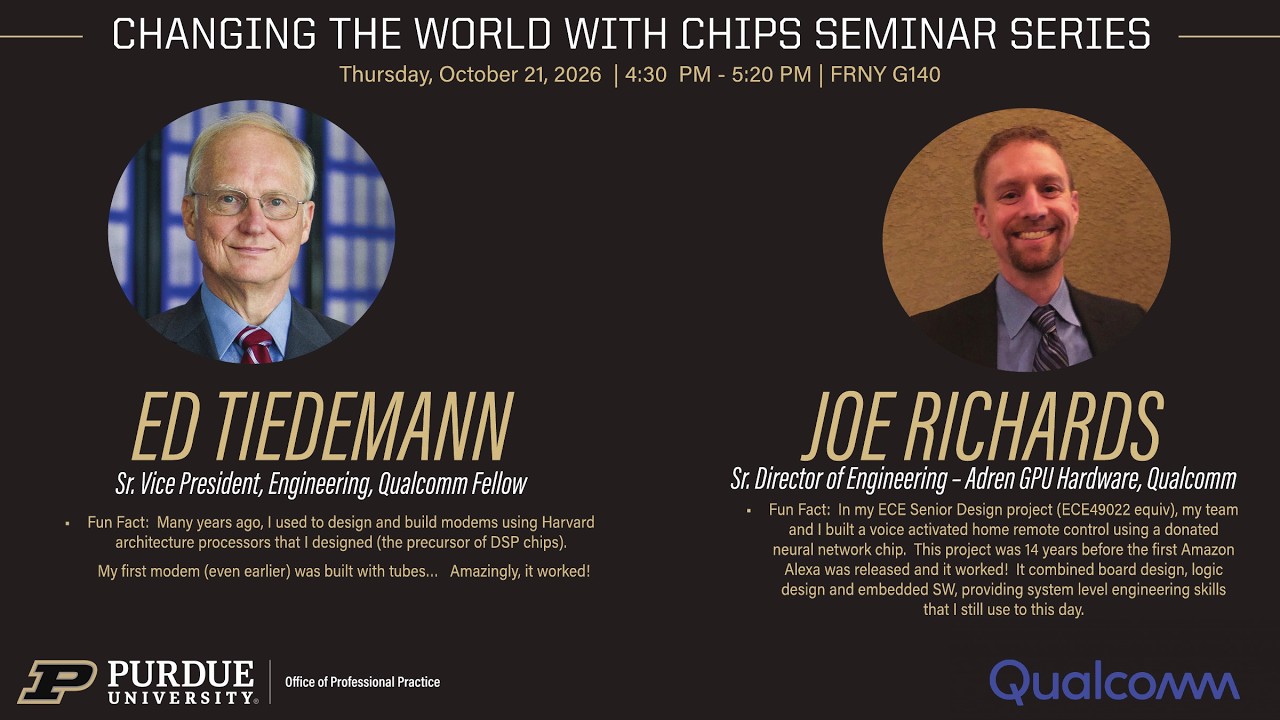
An Introduction to Qualcomm and How Some of the World's Most Complex Chips are Developed
Title history
- An Introduction to Qualcomm and How Some of the World's Most Complex Chips are Developed — observed on 20261027-1436 UTC (YouTube)
Keywords
Summary
179 words
Critical Evaluation
Value of the Information & Strength of the Argument
The value lies in the authoritative first-hand account from two senior engineers who directly contribute to Qualcomm’s chip development. Ed Tiedemann provides historical context linking Claude Shannon’s theoretical work to practical chip design, while Joe Richards offers a step-by-step breakdown of the SoC design flow, which is typically opaque to outsiders. The argumentation is coherent and logically structured, moving from industry relevance to technical specifics. The speakers justify the complexity and resource intensity of chip design with concrete examples, such as the cost of hardware bugs and the need for extensive verification. They also convincingly argue that Qualcomm’s in-house IP development is a strategic advantage, allowing customization and tight integration. The discussion of AI in design is balanced, acknowledging both its potential and the caution required due to the high cost of errors. Overall, the talk is persuasive in conveying the scale and sophistication of modern semiconductor engineering.
Scientific Rigor, Source Quality, Title Accuracy
The talk demonstrates strong technical rigor, with speakers drawing on decades of industry experience. They mention specific technical concepts (e.g., Viterbi algorithm, 2-nanometer node, 5 GHz CPU, 15 Gbps downlink) accurately and explain them in accessible terms. However, no external sources or citations are provided, so the information is entirely based on the speakers’ expertise and institutional knowledge. The title accurately previews the content: an introduction to Qualcomm and the complex process of chip development. The presentation is well-structured, adhering to a clear narrative from heritage to design flow. While the lack of formal citations is a minor limitation, the speakers’ credibility and the detailed, technical nature of the content compensate, making this a reliable introduction for students and interested viewers.
284 words
Title / Content Match
The title accurately reflects the content: introduction to Qualcomm and chip development.
Quality & Reliability
8/10
Talk by senior engineers from Qualcomm, knowledgeable and accurate, but lacks formal citations and is more of an overview.
Key Moments
Markers derived by PSI from the transcript: the creator did not define chapters.
- Ed Tiedemann introduces Qualcomm's presence in various devices and challenges like thermal management.
- History of Qualcomm, starting with Claude Shannon and the Viterbi algorithm, and the early days of cellular communications.
- Overview of a smartphone SoC components: CPU, GPU, NPU, modems, and other processing units.
- Joe Richards explains the chip design process from definition and architecture to RTL design and physical design.
- Discussion of verification challenges, the importance of catching bugs pre-silicon, and the emerging use of AI in design.
Contribution & Novelties
This video provides a rare inside look at Qualcomm’s engineering practices, especially the detailed explanation of the SoC design flow by a practicing engineer. It demystifies the role of verification and the fabless model, and highlights how theoretical concepts from information theory translate into commercial products. The talk is valuable for students considering careers in semiconductors.
Pour aller plus loin :
- Viterbi algorithm — Explains the algorithm referenced for error-correcting codes.
- System on a chip — Details the integration of components discussed in the talk.
- Claude Shannon — Foundation of information theory and Boolean algebra applications.
96 words
Radar Profile
The profile shows strong scores in reliability and information quality, with slightly lower but adequate scores in quantity and technical depth, reflecting an accessible yet expert-level talk. The overall shape indicates a balanced presentation suited for an introductory audience.