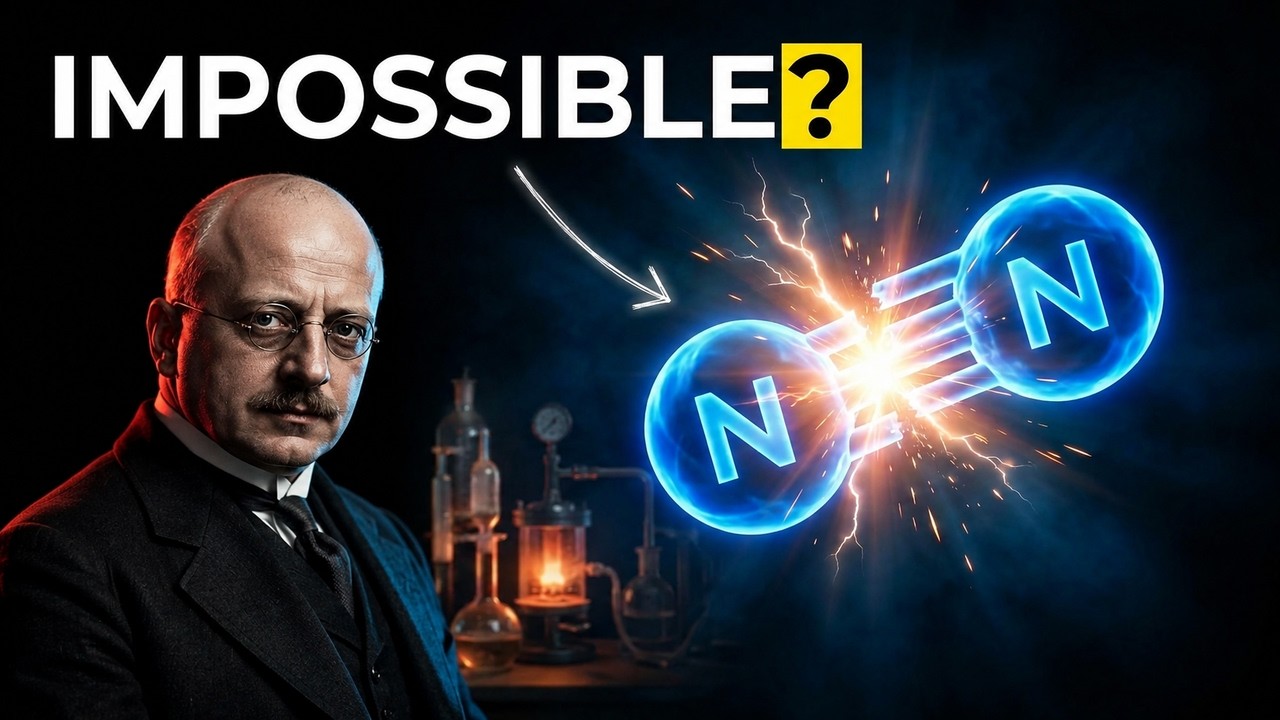
The Most Impossible Reaction in Chemistry
Title history
- The Most Impossible Reaction in Chemistry — observed on 20261031-2318 UTC (YouTube)
Keywords
Summary
156 words
Critical Evaluation
Value of the Information & Strength of the Argument
The video provides high-value information by connecting fundamental chemistry (triple bond, equilibrium, catalysis) with a profound historical and ethical analysis. It goes beyond typical classroom treatments by exploring the dual-use nature of chemical discoveries and the personal story of Clara Immerwahr, adding emotional depth. The argumentation is solid: the logical progression from nitrogen’s unreactivity to the scale-up problem to the wartime shift is compelling. The video uses vivid analogies (revolving door, the squeeze of pressure) to make complex principles accessible. It argues convincingly that Haber’s insight was not a new law but an engineering determination to shift equilibrium, which is an important clarifying point. The narrative is structured as a buildup to a moral dilemma, and the conclusion ties back to the ‘half of your atoms’ hook, creating a memorable and thought-provoking message.
Scientific Rigor, Source Quality, Title Accuracy
The video demonstrates strong scientific rigor in its accurate description of bond energies, equilibrium, and the historical timeline of the Haber-Bosch development. No explicit external sources are cited in the description, but the factual content aligns with standard scientific history (notably the works of prior historians). The title ‘The Most Impossible Reaction in Chemistry’ is apt for the topic, though slightly sensationalistic; the content justifies this by emphasizing the triple bond strength and the immense technical challenge. The addition of the environmental and ethical dimensions adds nuance beyond a simple ‘savior of humanity’ narrative, reflecting current historiographical viewpoints. Overall, the video is scientifically reliable and responsibly framed, despite lacking formal references.
259 words
Title / Content Match
The title accurately reflects the video's focus on the extraordinary difficulty of nitrogen fixation and the breakthrough achieved by Haber and Bosch, presented through an engaging historical lens.
Quality & Reliability
8/10
The video presents a well-researched and accurate account of the Haber-Bosch process, its historical context, and its dual-use nature. The chemistry principles (triple bond strength, equilibrium, Le Chatelier's principle) are correctly explained, and the narrative aligns with established historical facts. The only minor weaknesses are some simplifications and a lack of explicit citations, but the overall information is reliable and scientifically sound.
Key Moments
Markers derived by PSI from the transcript: the creator did not define chapters.
- Introduction to nitrogen gas and its triple bond (941 kJ/mol), emphasizing its chemical inertness.
- William Crookes' 1898 warning about impending nitrogen famine and the guano/nitrate crisis.
- Fritz Haber's laboratory apparatus in 1909, producing ammonia under extreme pressure and temperature.
- Carl Bosch's engineering scale-up at BASF, including the Oppau plant and the recycling loop.
- Transition to World War I: ammonia becomes a source for explosives, and Haber's chlorine gas work.
- The story of Clara Immerwahr, her opposition, and her tragic death; moral ambiguity of the discovery.
- Environmental costs: nitrogen runoff, dead zones, and the energy footprint of ammonia production today.
Contribution & Novelties
This video’s original contribution lies in seamlessly weaving the technical chemistry of nitrogen fixation with its far-reaching human and ecological consequences. It reframes the Haber-Bosch process not merely as a fertilizer breakthrough but as a centrally ambiguous achievement that still shapes global population and environmental health. The inclusion of Clara Immerwahr’s perspective adds a personal dimension to the ethical debate often omitted from popular accounts.
Pour aller plus loin :
- Haber-Bosch process (Wikipedia) — Comprehensive overview of the chemical reaction and its industrial development.
- Nitrogen fixation (Wikipedia) — Explains natural and synthetic routes for converting N₂ into usable compounds.
- Le Chatelier’s principle (Wikipedia) — The equilibrium principle central to shifting the ammonia synthesis.
- Clara Immerwahr (Wikipedia) — Biography of Haber’s wife, a chemist and war opponent.
126 words
Radar Profile
The radar shows a strong profile with high scores on reliability and quality, slightly lower on quantity and technical depth, indicating a balance between accessibility and accuracy. The video excels in presenting reliable facts and engaging narrative, while the technical level is intentionally kept moderate to appeal to a broad audience.