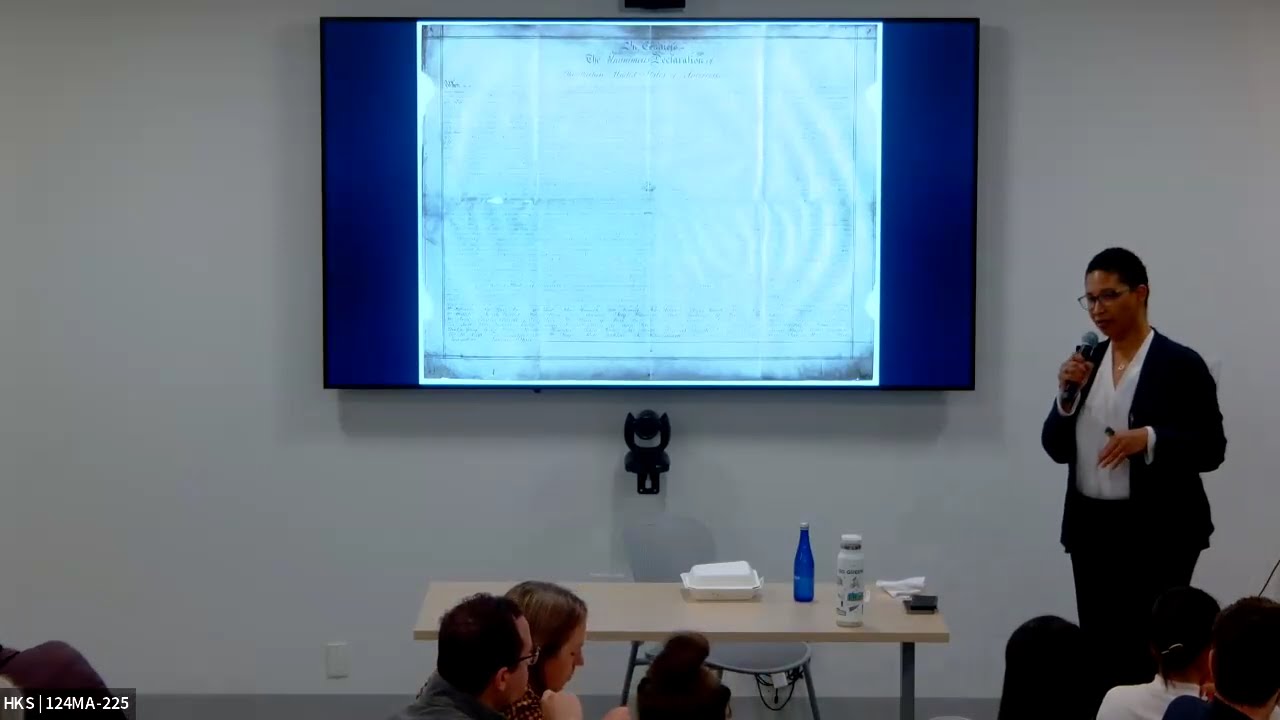
Book Talk- “Radical Duke: How One Aristocrat-and the American Revolution-Transformed Britain”
Title history
- Book Talk- “Radical Duke: How One Aristocrat-and the American Revolution-Transformed Britain” — observed on 20261025-1525 UTC (YouTube)
Keywords
Summary
136 words
Critical Evaluation
Value of the Information & Strength of the Argument
The value of this talk lies in its revelation of new archival findings that revise our understanding of both Thomas Paine’s early career and the intellectual origins of democratic reform. Allen’s argument is well-supported by primary sources, including handwriting analysis and computer-assisted author identification, which strengthens the credibility of her claims. She carefully builds a connection between the discovery of the parchment, the Duke’s political activities, and the network of radical writers. The argumentation is coherent and persuasive, though some leaps, such as the assumption that Paine’s presence in Lewes necessarily implies he worked for the Duke, are inferred from circumstantial evidence. Nevertheless, the multi-method verification adds robustness.
Scientific Rigor, Source Quality, Title Accuracy
Allen demonstrates high scientific rigor by using archival documents, original manuscripts, and cross-validating her findings with computational authorship attribution tools. She cites specific letters and pamphlets, and the discovery of the Declaration parchment is documented. However, as a book talk, detailed footnotes are absent, and some claims rely on the author’s interpretation. The title accurately reflects the content, focusing on the Duke’s impact and the American Revolution’s role in transforming Britain. The talk stays on topic and delivers on its promise.
204 words
Title / Content Match
The title accurately reflects the content: the book talk focuses on how one aristocrat and the American Revolution transformed Britain, matching the book's thesis.
Quality & Reliability
9/10
The talk is given by a Harvard professor with extensive archival research, the findings are backed by primary sources and cross-validated with computational analysis by other scholars. The presentation is rigorous, but as a talk it lacks full citations.
Key Moments
Markers derived by PSI from the transcript: the creator did not define chapters.
- Discovery of the pristine Declaration of Independence parchment in a Sussex record office.
- Connection made between the Duke of Richmond and the parchment; background on the Duke's radical politics.
- Thomas Paine's residence in Lewes and his possible link to the Duke.
- Confirmation that Paine wrote the Juryman's Touchstone, with co-authors Franklin and the Duke, verified by handwriting and algorithms.
- Introduction of the universal manhood suffrage bill in 1780 and its immediate rejection amid anti-Catholic riots.
Contribution & Novelties
The talk presents original research that uncovers Thomas Paine’s hidden career as a radical writer in Britain two decades before Common Sense, based on archival discoveries and computational analysis. It also repositions the Duke of Richmond as a central figure in the Age of Revolution, challenging narratives that focus solely on America and France. The connection between the Declaration of Independence parchment and the Duke’s circle provides a tangible link between American and British reform movements.
Pour aller plus loin :
- Junius letters — Anonymous political letters attacking the British government, pivotal in the 1760s-70s.
- Thomas Paine — Key author of Common Sense and Rights of Man, whose early writings are discussed in the talk.
- Universal manhood suffrage — The principle advocated by the Duke of Richmond in 1780.
- Charles Lennox, 3rd Duke of Richmond — Biography of the subject of the book.
143 words
Radar Profile
The radar profile shows high quality and reliability, but moderate technical level and information quantity. This suggests a well-researched talk that is accessible to a general audience while maintaining academic standards.